

1.1 The Taylor Formulae
3
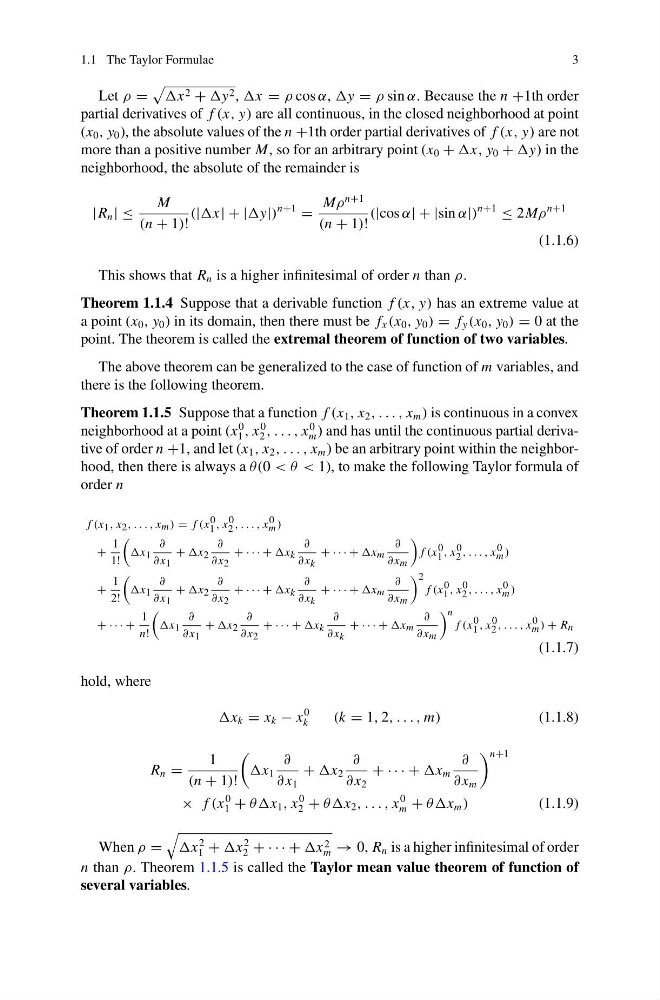
Let ρ =
x 2 + y 2 , x = ρ cos α, y = ρ sin α. Because the n +1th order
partial derivatives of f (x, y) are all continuous, in the closed neighborhood at point
(x 0 , y 0 ), the absolute values of the n +1th order partial derivatives of f (x, y) are not
more than a positive number M, so for an arbitrary point (x 0 + x, y 0 + y) in the
neighborhood, the absolute of the remainder is
|R n | ≤
M
(n + 1)!
(|x| + |y|)
n+1
=
Mρ
n+1
(n + 1)!
(|cos α| + |sin α|)
n+1
≤ 2Mρ
n+1
(1.1.6)
This shows that R n is a higher infinitesimal of order n than ρ.
Theorem 1.1.4 Suppose that a derivable function f (x, y) has an extreme value at
a point (x 0 , y 0 ) in its domain, then there must be f x (x 0 , y 0 ) = f y (x 0 , y 0 ) = 0 at the
point. The theorem is called the extremal theorem of function of two variables.
The above theorem can be generalized to the case of function of m variables, and
there is the following theorem.
Theorem 1.1.5 Suppose that a function f (x 1 , x 2 , . . . , x m ) is continuous in a convex
neighborhood at a point (x
0
1 , x
0
2 , . . . , x
0
m ) and has until the continuous partial derivative of order n +1, and let (x 1 , x 2 , . . . , x m ) be an arbitrary point within the neighborhood, then there is always a θ (0 < θ < 1), to make the following Taylor formula of
order n
f (x 1 , x 2 , . . . , x m ) = f (x 0
1 , x 0
2 , . . . , x 0
m )
+
1
1!
x 1
∂
∂ x 1
+ x 2
∂
∂ x 2
+ · · · + x k
∂
∂ x k
+ · · · + x m
∂
∂ x m
f (x 0
1 , x 0
2 , . . . , x 0
m )
+
1
2!
x 1
∂
∂ x 1
+ x 2
∂
∂ x 2
+ · · · + x k
∂
∂ x k
+ · · · + x m
∂
∂ x m
2
f (x 0
1 , x 0
2 , . . . , x 0
m )
+ · · · +
1
n!
x 1
∂
∂ x 1
+ x 2
∂
∂ x 2
+ · · · + x k
∂
∂ x k
+ · · · + x m
∂
∂ x m
n
f (x 0
1 , x 0
2 , . . . , x 0
m ) + R n
(1.1.7)
hold, where
x k = x k − x
0
k
(k = 1, 2, . . . , m)
(1.1.8)
R n =
1
(n + 1)!
x 1
∂
∂ x 1
+ x 2
∂
∂ x 2
+ · · · + x m
∂
∂ x m
n+1
× f (x
0
1 + θθx 1 , x
0
2 + θθx 2 , . . . , x
0
m + θθx m )
(1.1.9)
When ρ =
x
2
1 + x
2
2 + · · · + x 2
m → 0, R n is a higher infinitesimal of order
n than ρ. Theorem 1.1.5 is called the Taylor mean value theorem of function of
several variables.
3
Let ρ =
x 2 + y 2 , x = ρ cos α, y = ρ sin α. Because the n +1th order
partial derivatives of f (x, y) are all continuous, in the closed neighborhood at point
(x 0 , y 0 ), the absolute values of the n +1th order partial derivatives of f (x, y) are not
more than a positive number M, so for an arbitrary point (x 0 + x, y 0 + y) in the
neighborhood, the absolute of the remainder is
|R n | ≤
M
(n + 1)!
(|x| + |y|)
n+1
=
Mρ
n+1
(n + 1)!
(|cos α| + |sin α|)
n+1
≤ 2Mρ
n+1
(1.1.6)
This shows that R n is a higher infinitesimal of order n than ρ.
Theorem 1.1.4 Suppose that a derivable function f (x, y) has an extreme value at
a point (x 0 , y 0 ) in its domain, then there must be f x (x 0 , y 0 ) = f y (x 0 , y 0 ) = 0 at the
point. The theorem is called the extremal theorem of function of two variables.
The above theorem can be generalized to the case of function of m variables, and
there is the following theorem.
Theorem 1.1.5 Suppose that a function f (x 1 , x 2 , . . . , x m ) is continuous in a convex
neighborhood at a point (x
0
1 , x
0
2 , . . . , x
0
m ) and has until the continuous partial derivative of order n +1, and let (x 1 , x 2 , . . . , x m ) be an arbitrary point within the neighborhood, then there is always a θ (0 < θ < 1), to make the following Taylor formula of
order n
f (x 1 , x 2 , . . . , x m ) = f (x 0
1 , x 0
2 , . . . , x 0
m )
+
1
1!
x 1
∂
∂ x 1
+ x 2
∂
∂ x 2
+ · · · + x k
∂
∂ x k
+ · · · + x m
∂
∂ x m
f (x 0
1 , x 0
2 , . . . , x 0
m )
+
1
2!
x 1
∂
∂ x 1
+ x 2
∂
∂ x 2
+ · · · + x k
∂
∂ x k
+ · · · + x m
∂
∂ x m
2
f (x 0
1 , x 0
2 , . . . , x 0
m )
+ · · · +
1
n!
x 1
∂
∂ x 1
+ x 2
∂
∂ x 2
+ · · · + x k
∂
∂ x k
+ · · · + x m
∂
∂ x m
n
f (x 0
1 , x 0
2 , . . . , x 0
m ) + R n
(1.1.7)
hold, where
x k = x k − x
0
k
(k = 1, 2, . . . , m)
(1.1.8)
R n =
1
(n + 1)!
x 1
∂
∂ x 1
+ x 2
∂
∂ x 2
+ · · · + x m
∂
∂ x m
n+1
× f (x
0
1 + θθx 1 , x
0
2 + θθx 2 , . . . , x
0
m + θθx m )
(1.1.9)
When ρ =
x
2
1 + x
2
2 + · · · + x 2
m → 0, R n is a higher infinitesimal of order
n than ρ. Theorem 1.1.5 is called the Taylor mean value theorem of function of
several variables.