

2.8 Variational Problems Depending on Functions of Several Variables
165
This equation is called the biharmonic equation. The function u satisfying the
biharmonic equation is called the biharmonic function. Sometimes it is abbreviated
to u = 0 or
2 u = 0.
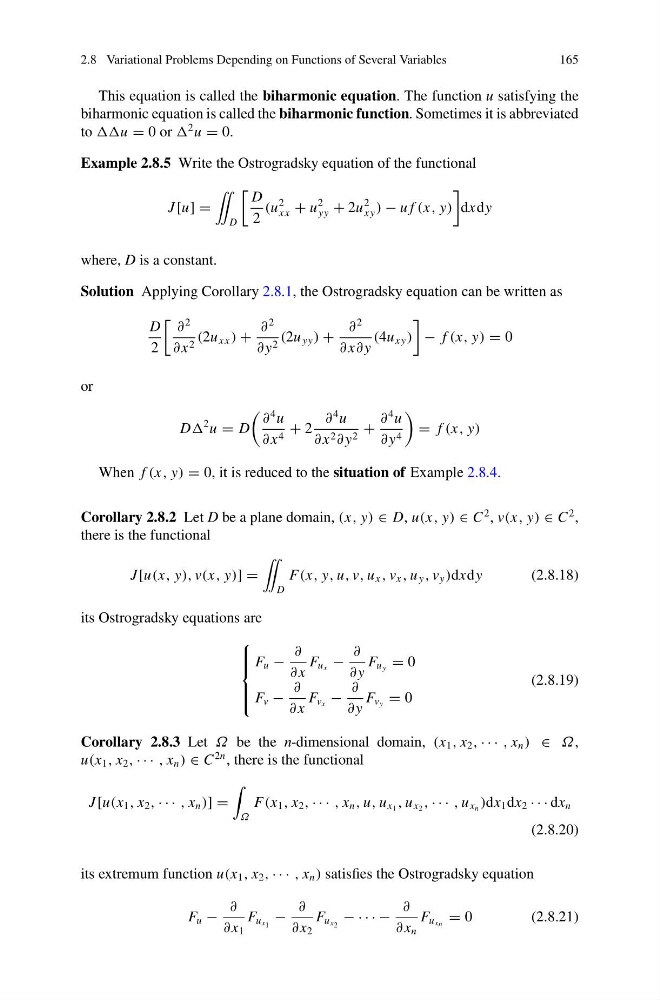
Example 2.8.5 Write the Ostrogradsky equation of the functional
J [u] =
¨
D
D
2
(u
2
xx + u
2
yy + 2u
2
xy ) − u f (x, y)
dxdy
where, D is a constant.
Solution Applying Corollary 2.8.1, the Ostrogradsky equation can be written as
D
2
∂
2
∂ x 2 (2u xx ) +
∂
2
∂ y 2 (2u yy ) +
∂
2
∂ x∂ y
(4u xy )
− f (x, y) = 0
or
D
2 u = D
∂
4 u
∂ x 4 + 2
∂
4 u
∂ x 2 ∂ y 2 +
∂
4 u
∂ y 4
= f (x, y)
When f (x, y) = 0, it is reduced to the situation of Example 2.8.4.
Corollary 2.8.2 Let D be a plane domain, (x, y) ∈ D, u(x, y) ∈ C
2 , v(x, y) ∈ C
2 ,
there is the functional
J [u(x, y), v(x, y)] =
¨
D
F(x, y, u, v, u x , v x , u y , v y )dxdy
(2.8.18)
its Ostrogradsky equations are
⎧
⎪ ⎪ ⎨
⎪ ⎪ ⎩
F u −
∂
∂ x
F u x −
∂
∂ y
F u y = 0
F v −
∂
∂ x
F v x −
∂
∂ y
F v y = 0
(2.8.19)
Corollary 2.8.3 Let Ω be the n-dimensional domain, (x 1 , x 2 , · · · , x n ) ∈ Ω,
u(x 1 , x 2 , · · · , x n ) ∈ C
2n , there is the functional
J [u(x 1 , x 2 , · · · , x n )] =
Ω
F(x 1 , x 2 , · · · , x n , u, u x 1 , u x 2 , · · · , u x n )dx 1 dx 2 · · · dx n
(2.8.20)
its extremum function u(x 1 , x 2 , · · · , x n ) satisfies the Ostrogradsky equation
F u −
∂
∂ x 1
F u x 1 −
∂
∂ x 2
F u x 2 − · · · −
∂
∂ x n
F u xn = 0
(2.8.21)
165
This equation is called the biharmonic equation. The function u satisfying the
biharmonic equation is called the biharmonic function. Sometimes it is abbreviated
to u = 0 or
2 u = 0.
Example 2.8.5 Write the Ostrogradsky equation of the functional
J [u] =
¨
D
D
2
(u
2
xx + u
2
yy + 2u
2
xy ) − u f (x, y)
dxdy
where, D is a constant.
Solution Applying Corollary 2.8.1, the Ostrogradsky equation can be written as
D
2
∂
2
∂ x 2 (2u xx ) +
∂
2
∂ y 2 (2u yy ) +
∂
2
∂ x∂ y
(4u xy )
− f (x, y) = 0
or
D
2 u = D
∂
4 u
∂ x 4 + 2
∂
4 u
∂ x 2 ∂ y 2 +
∂
4 u
∂ y 4
= f (x, y)
When f (x, y) = 0, it is reduced to the situation of Example 2.8.4.
Corollary 2.8.2 Let D be a plane domain, (x, y) ∈ D, u(x, y) ∈ C
2 , v(x, y) ∈ C
2 ,
there is the functional
J [u(x, y), v(x, y)] =
¨
D
F(x, y, u, v, u x , v x , u y , v y )dxdy
(2.8.18)
its Ostrogradsky equations are
⎧
⎪ ⎪ ⎨
⎪ ⎪ ⎩
F u −
∂
∂ x
F u x −
∂
∂ y
F u y = 0
F v −
∂
∂ x
F v x −
∂
∂ y
F v y = 0
(2.8.19)
Corollary 2.8.3 Let Ω be the n-dimensional domain, (x 1 , x 2 , · · · , x n ) ∈ Ω,
u(x 1 , x 2 , · · · , x n ) ∈ C
2n , there is the functional
J [u(x 1 , x 2 , · · · , x n )] =
Ω
F(x 1 , x 2 , · · · , x n , u, u x 1 , u x 2 , · · · , u x n )dx 1 dx 2 · · · dx n
(2.8.20)
its extremum function u(x 1 , x 2 , · · · , x n ) satisfies the Ostrogradsky equation
F u −
∂
∂ x 1
F u x 1 −
∂
∂ x 2
F u x 2 − · · · −
∂
∂ x n
F u xn = 0
(2.8.21)