

2.8 Variational Problems Depending on Functions of Several Variables
163
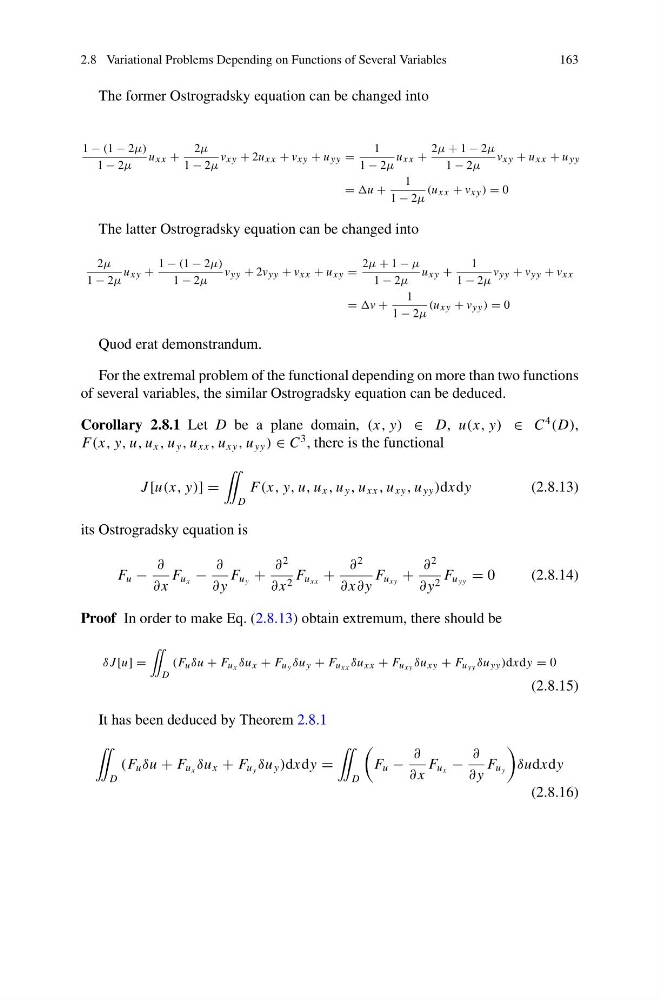
The former Ostrogradsky equation can be changed into
1 − (1 − 2μ)
1 − 2μ
u xx +
2μ
1 − 2μ
v xy + 2u xx + v xy + u yy =
1
1 − 2μ
u xx +
2μ + 1 − 2μ
1 − 2μ
v xy + u xx + u yy
= u +
1
1 − 2μ
(u xx + v xy ) = 0
The latter Ostrogradsky equation can be changed into
2μ
1 − 2μ
u xy +
1 − (1 − 2μ)
1 − 2μ
v yy + 2v yy + v xx + u xy =
2μ + 1 − μ
1 − 2μ
u xy +
1
1 − 2μ
v yy + v yy + v xx
= v +
1
1 − 2μ
(u xy + v yy ) = 0
Quod erat demonstrandum.
For the extremal problem of the functional depending on more than two functions
of several variables, the similar Ostrogradsky equation can be deduced.
Corollary 2.8.1 Let D be a plane domain, (x, y) ∈ D, u(x, y) ∈ C
4
(D),
F(x, y, u, u x , u y , u xx , u xy , u yy ) ∈ C
3 , there is the functional
J [u(x, y)] =
¨
D
F(x, y, u, u x , u y , u xx , u xy , u yy )dxdy
(2.8.13)
its Ostrogradsky equation is
F u −
∂
∂ x
F u x −
∂
∂ y
F u y +
∂
2
∂ x 2 F u xx +
∂
2
∂ x∂ y
F u xy +
∂
2
∂ y 2 F u yy = 0
(2.8.14)
Proof In order to make Eq. (2.8.13) obtain extremum, there should be
δ J [u] =
¨
D
(F u δu + F ux δu x + F u y δu y + F uxx δu xx + F uxy δu xy + F u yy δu yy )dxdy = 0
(2.8.15)
It has been deduced by Theorem 2.8.1
¨
D
(F u δu + F u x δu x + F u y δu y )dxdy =
¨
D
F u −
∂
∂ x
F u x −
∂
∂ y
F u y
δudxdy
(2.8.16)
163
The former Ostrogradsky equation can be changed into
1 − (1 − 2μ)
1 − 2μ
u xx +
2μ
1 − 2μ
v xy + 2u xx + v xy + u yy =
1
1 − 2μ
u xx +
2μ + 1 − 2μ
1 − 2μ
v xy + u xx + u yy
= u +
1
1 − 2μ
(u xx + v xy ) = 0
The latter Ostrogradsky equation can be changed into
2μ
1 − 2μ
u xy +
1 − (1 − 2μ)
1 − 2μ
v yy + 2v yy + v xx + u xy =
2μ + 1 − μ
1 − 2μ
u xy +
1
1 − 2μ
v yy + v yy + v xx
= v +
1
1 − 2μ
(u xy + v yy ) = 0
Quod erat demonstrandum.
For the extremal problem of the functional depending on more than two functions
of several variables, the similar Ostrogradsky equation can be deduced.
Corollary 2.8.1 Let D be a plane domain, (x, y) ∈ D, u(x, y) ∈ C
4
(D),
F(x, y, u, u x , u y , u xx , u xy , u yy ) ∈ C
3 , there is the functional
J [u(x, y)] =
¨
D
F(x, y, u, u x , u y , u xx , u xy , u yy )dxdy
(2.8.13)
its Ostrogradsky equation is
F u −
∂
∂ x
F u x −
∂
∂ y
F u y +
∂
2
∂ x 2 F u xx +
∂
2
∂ x∂ y
F u xy +
∂
2
∂ y 2 F u yy = 0
(2.8.14)
Proof In order to make Eq. (2.8.13) obtain extremum, there should be
δ J [u] =
¨
D
(F u δu + F ux δu x + F u y δu y + F uxx δu xx + F uxy δu xy + F u yy δu yy )dxdy = 0
(2.8.15)
It has been deduced by Theorem 2.8.1
¨
D
(F u δu + F u x δu x + F u y δu y )dxdy =
¨
D
F u −
∂
∂ x
F u x −
∂
∂ y
F u y
δudxdy
(2.8.16)