

2.7 Variational Problems Depending on Higher Order Derivatives
149
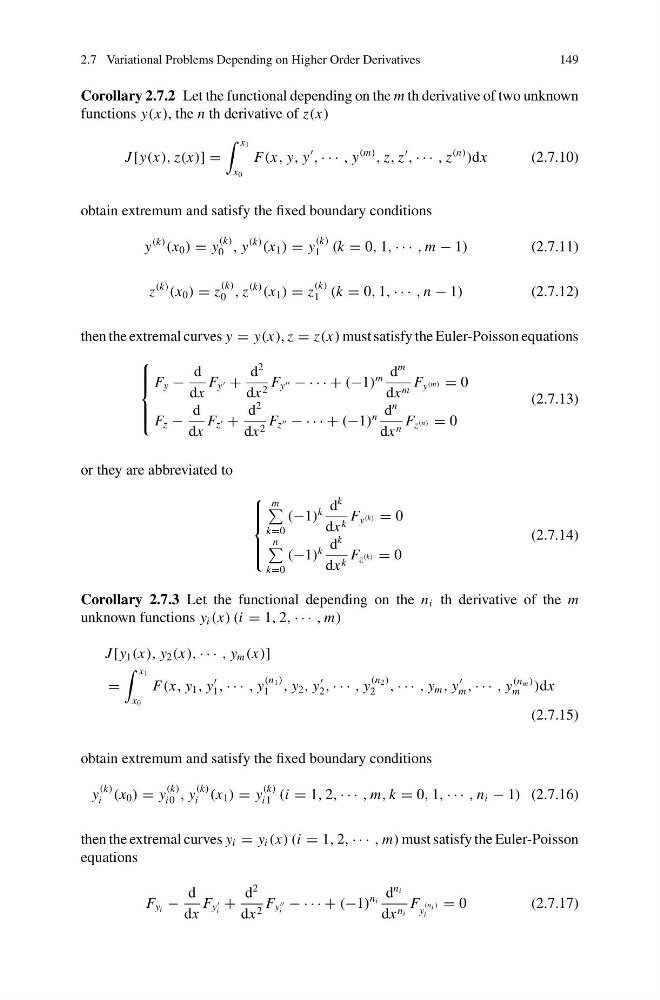
Corollary 2.7.2 Let the functional depending on the m th derivative of two unknown
functions y(x), the n th derivative of z(x)
J [y(x), z(x)] =
x 1
x 0
F(x, y, y
, · · · , y
(m)
, z, z
, · · · , z
(n)
)dx
(2.7.10)
obtain extremum and satisfy the fixed boundary conditions
y
(k)
(x 0 ) = y
(k)
0 , y
(k)
(x 1 ) = y
(k)
1 (k = 0, 1, · · · , m − 1)
(2.7.11)
z
(k)
(x 0 ) = z
(k)
0 , z
(k)
(x 1 ) = z
(k)
1 (k = 0, 1, · · · , n − 1)
(2.7.12)
then the extremal curves y = y(x), z = z(x) must satisfy the Euler-Poisson equations
⎧
⎪ ⎪ ⎨
⎪ ⎪ ⎩
F y −
d
dx
F y +
d
2
dx 2 F y − · · · + (−1)
m d
m
dx m F y (m) = 0
F z −
d
dx
F z +
d
2
dx 2 F z − · · · + (−1)
n d
n
dx n F z (n) = 0
(2.7.13)
or they are abbreviated to
⎧
⎪ ⎪ ⎨
⎪ ⎪ ⎩
m
k=0
(−1)
k d
k
dx k F y (k) = 0
n
k=0
(−1)
k d
k
dx k F z (k) = 0
(2.7.14)
Corollary 2.7.3 Let the functional depending on the n i th derivative of the m
unknown functions y i (x) (i = 1, 2, · · · , m)
J [y 1 (x), y 2 (x), · · · , y m (x)]
=
x 1
x 0
F(x, y 1 , y
1 , · · · , y
(n 1 )
1 , y 2 , y
2 , · · · , y
(n 2 )
2 , · · · , y m , y
m , · · · , y
(n m )
m )dx
(2.7.15)
obtain extremum and satisfy the fixed boundary conditions
y
(k)
i (x 0 ) = y
(k)
i0 , y
(k)
i (x 1 ) = y
(k)
i1 (i = 1, 2, · · · , m, k = 0, 1, · · · , n i − 1) (2.7.16)
then the extremal curves y i = y i (x) (i = 1, 2, · · · , m) must satisfy the Euler-Poisson
equations
F y i −
d
dx
F y
i
+
d
2
dx 2 F y
i
− · · · + (−1)
n i
d
n i
dx n i
F y
(n i )
i
= 0
(2.7.17)
149
Corollary 2.7.2 Let the functional depending on the m th derivative of two unknown
functions y(x), the n th derivative of z(x)
J [y(x), z(x)] =
x 1
x 0
F(x, y, y
, · · · , y
(m)
, z, z
, · · · , z
(n)
)dx
(2.7.10)
obtain extremum and satisfy the fixed boundary conditions
y
(k)
(x 0 ) = y
(k)
0 , y
(k)
(x 1 ) = y
(k)
1 (k = 0, 1, · · · , m − 1)
(2.7.11)
z
(k)
(x 0 ) = z
(k)
0 , z
(k)
(x 1 ) = z
(k)
1 (k = 0, 1, · · · , n − 1)
(2.7.12)
then the extremal curves y = y(x), z = z(x) must satisfy the Euler-Poisson equations
⎧
⎪ ⎪ ⎨
⎪ ⎪ ⎩
F y −
d
dx
F y +
d
2
dx 2 F y − · · · + (−1)
m d
m
dx m F y (m) = 0
F z −
d
dx
F z +
d
2
dx 2 F z − · · · + (−1)
n d
n
dx n F z (n) = 0
(2.7.13)
or they are abbreviated to
⎧
⎪ ⎪ ⎨
⎪ ⎪ ⎩
m
k=0
(−1)
k d
k
dx k F y (k) = 0
n
k=0
(−1)
k d
k
dx k F z (k) = 0
(2.7.14)
Corollary 2.7.3 Let the functional depending on the n i th derivative of the m
unknown functions y i (x) (i = 1, 2, · · · , m)
J [y 1 (x), y 2 (x), · · · , y m (x)]
=
x 1
x 0
F(x, y 1 , y
1 , · · · , y
(n 1 )
1 , y 2 , y
2 , · · · , y
(n 2 )
2 , · · · , y m , y
m , · · · , y
(n m )
m )dx
(2.7.15)
obtain extremum and satisfy the fixed boundary conditions
y
(k)
i (x 0 ) = y
(k)
i0 , y
(k)
i (x 1 ) = y
(k)
i1 (i = 1, 2, · · · , m, k = 0, 1, · · · , n i − 1) (2.7.16)
then the extremal curves y i = y i (x) (i = 1, 2, · · · , m) must satisfy the Euler-Poisson
equations
F y i −
d
dx
F y
i
+
d
2
dx 2 F y
i
− · · · + (−1)
n i
d
n i
dx n i
F y
(n i )
i
= 0
(2.7.17)