

132
2 Variational Problems with Fixed Boundaries
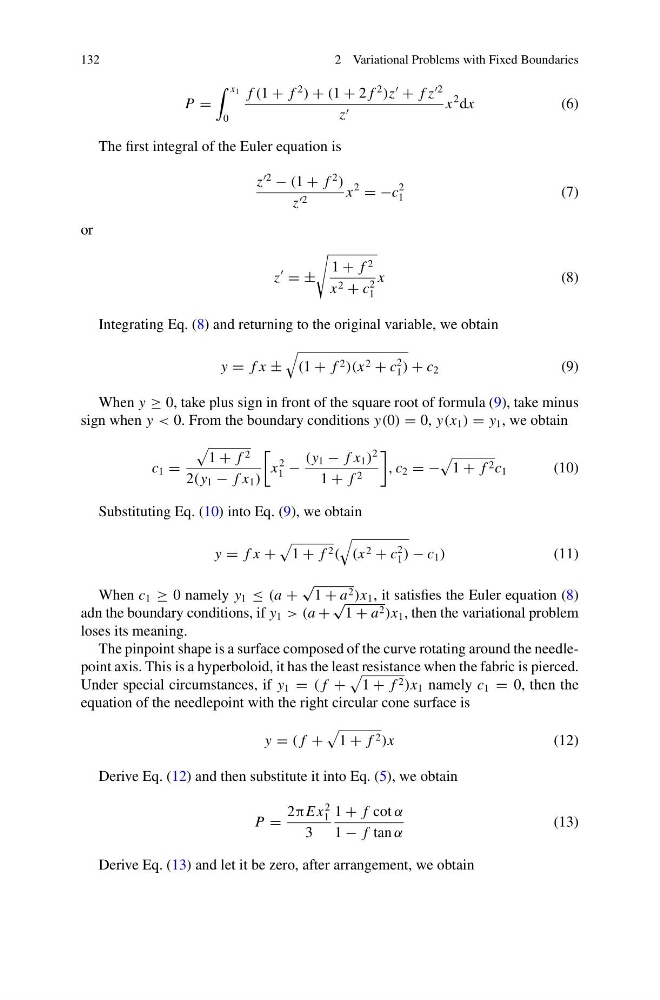
P =
x 1
0
f (1 + f
2
) + (1 + 2 f
2
)z
+ f z
2
z
x
2 dx
(6)
The first integral of the Euler equation is
z
2
− (1 + f
2
)
z 2
x
2
= −c
2
1
(7)
or
z
= ±
1 + f 2
x 2 + c
2
1
x
(8)
Integrating Eq. (8) and returning to the original variable, we obtain
y = f x ±
(1 + f 2 )(x 2 + c
2
1 ) + c 2
(9)
When y ≥ 0, take plus sign in front of the square root of formula (9), take minus
sign when y < 0. From the boundary conditions y(0) = 0, y(x 1 ) = y 1 , we obtain
c 1 =
1 + f 2
2(y 1 − f x 1 )
x
2
1 −
(y 1 − f x 1 )
2
1 + f 2
, c 2 = −
1 + f 2 c 1
(10)
Substituting Eq. (10) into Eq. (9), we obtain
y = f x +
1 + f 2 (
(x 2 + c
2
1 ) − c 1 )
(11)
When c 1 ≥ 0 namely y 1 ≤ (a +
√
1 + a 2 )x 1 , it satisfies the Euler equation (8)
adn the boundary conditions, if y 1 > (a +
√
1 + a 2 )x 1 , then the variational problem
loses its meaning.
The pinpoint shape is a surface composed of the curve rotating around the needlepoint axis. This is a hyperboloid, it has the least resistance when the fabric is pierced.
Under special circumstances, if y 1 = ( f +
1 + f 2 )x 1 namely c 1 = 0, then the
equation of the needlepoint with the right circular cone surface is
y = ( f +
1 + f 2 )x
(12)
Derive Eq. (12) and then substitute it into Eq. (5), we obtain
P =
2πE x
2
1
3
1 + f cot α
1 − f tan α
(13)
Derive Eq. (13) and let it be zero, after arrangement, we obtain
2 Variational Problems with Fixed Boundaries
P =
x 1
0
f (1 + f
2
) + (1 + 2 f
2
)z
+ f z
2
z
x
2 dx
(6)
The first integral of the Euler equation is
z
2
− (1 + f
2
)
z 2
x
2
= −c
2
1
(7)
or
z
= ±
1 + f 2
x 2 + c
2
1
x
(8)
Integrating Eq. (8) and returning to the original variable, we obtain
y = f x ±
(1 + f 2 )(x 2 + c
2
1 ) + c 2
(9)
When y ≥ 0, take plus sign in front of the square root of formula (9), take minus
sign when y < 0. From the boundary conditions y(0) = 0, y(x 1 ) = y 1 , we obtain
c 1 =
1 + f 2
2(y 1 − f x 1 )
x
2
1 −
(y 1 − f x 1 )
2
1 + f 2
, c 2 = −
1 + f 2 c 1
(10)
Substituting Eq. (10) into Eq. (9), we obtain
y = f x +
1 + f 2 (
(x 2 + c
2
1 ) − c 1 )
(11)
When c 1 ≥ 0 namely y 1 ≤ (a +
√
1 + a 2 )x 1 , it satisfies the Euler equation (8)
adn the boundary conditions, if y 1 > (a +
√
1 + a 2 )x 1 , then the variational problem
loses its meaning.
The pinpoint shape is a surface composed of the curve rotating around the needlepoint axis. This is a hyperboloid, it has the least resistance when the fabric is pierced.
Under special circumstances, if y 1 = ( f +
1 + f 2 )x 1 namely c 1 = 0, then the
equation of the needlepoint with the right circular cone surface is
y = ( f +
1 + f 2 )x
(12)
Derive Eq. (12) and then substitute it into Eq. (5), we obtain
P =
2πE x
2
1
3
1 + f cot α
1 − f tan α
(13)
Derive Eq. (13) and let it be zero, after arrangement, we obtain