

2.3 Variations of the Simplest Functionals and Necessary Conditions …
113
δ J =
x 1
x 0
dN
dx
δy + F y δy
dx
(2.3.38)
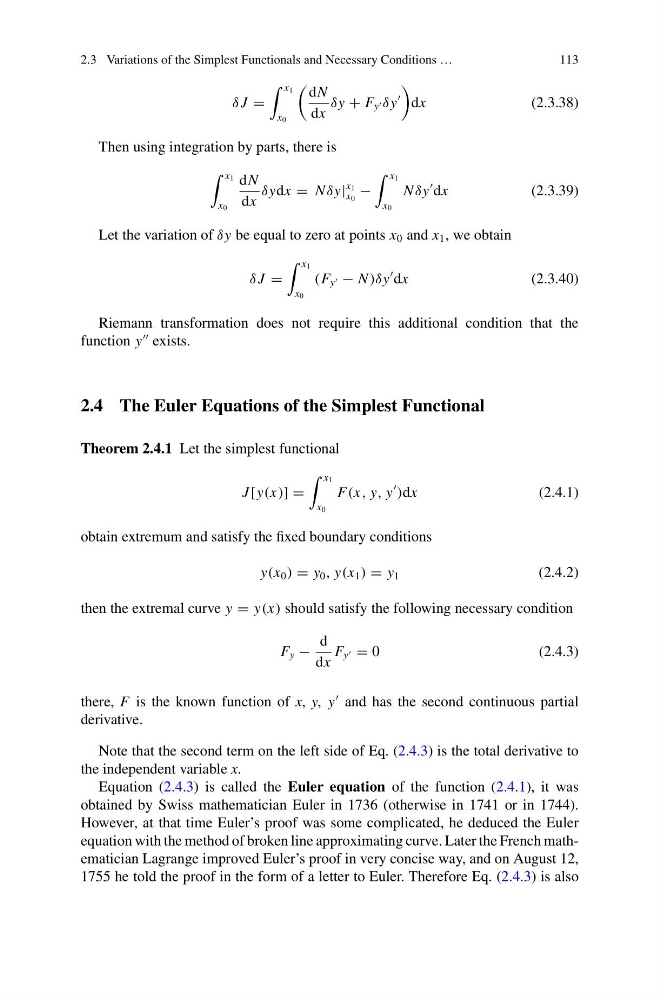
Then using integration by parts, there is
x 1
x 0
dN
dx
δydx = N δy|
x 1
x 0
−
x 1
x 0
N δy
dx
(2.3.39)
Let the variation of δy be equal to zero at points x 0 and x 1 , we obtain
δ J =
x 1
x 0
(F y − N )δy
dx
(2.3.40)
Riemann transformation does not require this additional condition that the
function y
exists.
2.4 The Euler Equations of the Simplest Functional
Theorem 2.4.1 Let the simplest functional
J [y(x)] =
x 1
x 0
F(x, y, y
)dx
(2.4.1)
obtain extremum and satisfy the fixed boundary conditions
y(x 0 ) = y 0 , y(x 1 ) = y 1
(2.4.2)
then the extremal curve y = y(x) should satisfy the following necessary condition
F y −
d
dx
F y = 0
(2.4.3)
there, F is the known function of x, y, y
and has the second continuous partial
derivative.
Note that the second term on the left side of Eq. (2.4.3) is the total derivative to
the independent variable x.
Equation (2.4.3) is called the Euler equation of the function (2.4.1), it was
obtained by Swiss mathematician Euler in 1736 (otherwise in 1741 or in 1744).
However, at that time Euler’s proof was some complicated, he deduced the Euler
equation with the method of broken line approximating curve. Later the French mathematician Lagrange improved Euler’s proof in very concise way, and on August 12,
1755 he told the proof in the form of a letter to Euler. Therefore Eq. (2.4.3) is also
113
δ J =
x 1
x 0
dN
dx
δy + F y δy
dx
(2.3.38)
Then using integration by parts, there is
x 1
x 0
dN
dx
δydx = N δy|
x 1
x 0
−
x 1
x 0
N δy
dx
(2.3.39)
Let the variation of δy be equal to zero at points x 0 and x 1 , we obtain
δ J =
x 1
x 0
(F y − N )δy
dx
(2.3.40)
Riemann transformation does not require this additional condition that the
function y
exists.
2.4 The Euler Equations of the Simplest Functional
Theorem 2.4.1 Let the simplest functional
J [y(x)] =
x 1
x 0
F(x, y, y
)dx
(2.4.1)
obtain extremum and satisfy the fixed boundary conditions
y(x 0 ) = y 0 , y(x 1 ) = y 1
(2.4.2)
then the extremal curve y = y(x) should satisfy the following necessary condition
F y −
d
dx
F y = 0
(2.4.3)
there, F is the known function of x, y, y
and has the second continuous partial
derivative.
Note that the second term on the left side of Eq. (2.4.3) is the total derivative to
the independent variable x.
Equation (2.4.3) is called the Euler equation of the function (2.4.1), it was
obtained by Swiss mathematician Euler in 1736 (otherwise in 1741 or in 1744).
However, at that time Euler’s proof was some complicated, he deduced the Euler
equation with the method of broken line approximating curve. Later the French mathematician Lagrange improved Euler’s proof in very concise way, and on August 12,
1755 he told the proof in the form of a letter to Euler. Therefore Eq. (2.4.3) is also