

2.3 Variations of the Simplest Functionals and Necessary Conditions …
109
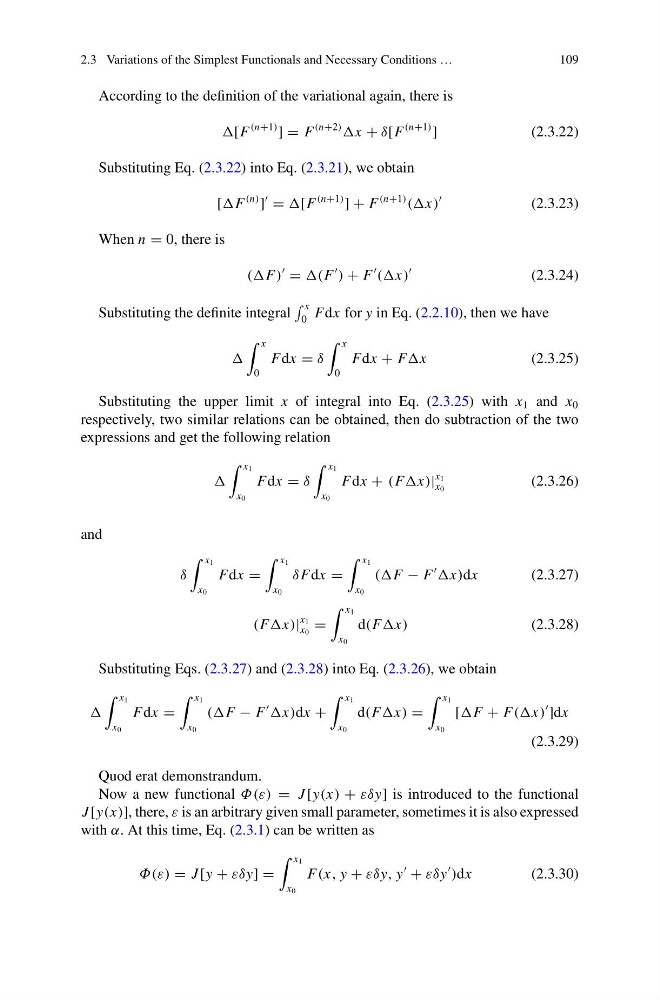
According to the definition of the variational again, there is
[F
(n+1)
] = F
(n+2)
x + δ[F
(n+1)
]
(2.3.22)
Substituting Eq. (2.3.22) into Eq. (2.3.21), we obtain
[F
(n)
]
= [F
(n+1)
] + F
(n+1)
((x)
(2.3.23)
When n = 0, there is
((F)
= (F
) + F
((x)
(2.3.24)
Substituting the definite integral
x
0 Fdx for y in Eq. (2.2.10), then we have
x
0
Fdx = δ
x
0
Fdx + Fx
(2.3.25)
Substituting the upper limit x of integral into Eq. (2.3.25) with x 1 and x 0
respectively, two similar relations can be obtained, then do subtraction of the two
expressions and get the following relation
x 1
x 0
Fdx = δ
x 1
x 0
Fdx + (Fx)|
x 1
x 0
(2.3.26)
and
δ
x 1
x 0
Fdx =
x 1
x 0
δ Fdx =
x 1
x 0
((F − F
x)dx
(2.3.27)
(Fx)|
x 1
x 0
=
x 1
x 0
d(Fx)
(2.3.28)
Substituting Eqs. (2.3.27) and (2.3.28) into Eq. (2.3.26), we obtain
x 1
x 0
Fdx =
x 1
x 0
((F − F
x)dx +
x 1
x 0
d(Fx) =
x 1
x 0
[F + F((x)
]dx
(2.3.29)
Quod erat demonstrandum.
Now a new functional Φ(ε) = J [y(x) + εδy] is introduced to the functional
J [y(x)], there, ε is an arbitrary given small parameter, sometimes it is also expressed
with α. At this time, Eq. (2.3.1) can be written as
Φ(ε) = J [y + εδy] =
x 1
x 0
F(x, y + εδy, y
+ εδy
)dx
(2.3.30)
109
According to the definition of the variational again, there is
[F
(n+1)
] = F
(n+2)
x + δ[F
(n+1)
]
(2.3.22)
Substituting Eq. (2.3.22) into Eq. (2.3.21), we obtain
[F
(n)
]
= [F
(n+1)
] + F
(n+1)
((x)
(2.3.23)
When n = 0, there is
((F)
= (F
) + F
((x)
(2.3.24)
Substituting the definite integral
x
0 Fdx for y in Eq. (2.2.10), then we have
x
0
Fdx = δ
x
0
Fdx + Fx
(2.3.25)
Substituting the upper limit x of integral into Eq. (2.3.25) with x 1 and x 0
respectively, two similar relations can be obtained, then do subtraction of the two
expressions and get the following relation
x 1
x 0
Fdx = δ
x 1
x 0
Fdx + (Fx)|
x 1
x 0
(2.3.26)
and
δ
x 1
x 0
Fdx =
x 1
x 0
δ Fdx =
x 1
x 0
((F − F
x)dx
(2.3.27)
(Fx)|
x 1
x 0
=
x 1
x 0
d(Fx)
(2.3.28)
Substituting Eqs. (2.3.27) and (2.3.28) into Eq. (2.3.26), we obtain
x 1
x 0
Fdx =
x 1
x 0
((F − F
x)dx +
x 1
x 0
d(Fx) =
x 1
x 0
[F + F((x)
]dx
(2.3.29)
Quod erat demonstrandum.
Now a new functional Φ(ε) = J [y(x) + εδy] is introduced to the functional
J [y(x)], there, ε is an arbitrary given small parameter, sometimes it is also expressed
with α. At this time, Eq. (2.3.1) can be written as
Φ(ε) = J [y + εδy] =
x 1
x 0
F(x, y + εδy, y
+ εδy
)dx
(2.3.30)