

2 Frustrated Lewis Pair Catalyzed Asymmetric Reactions
73
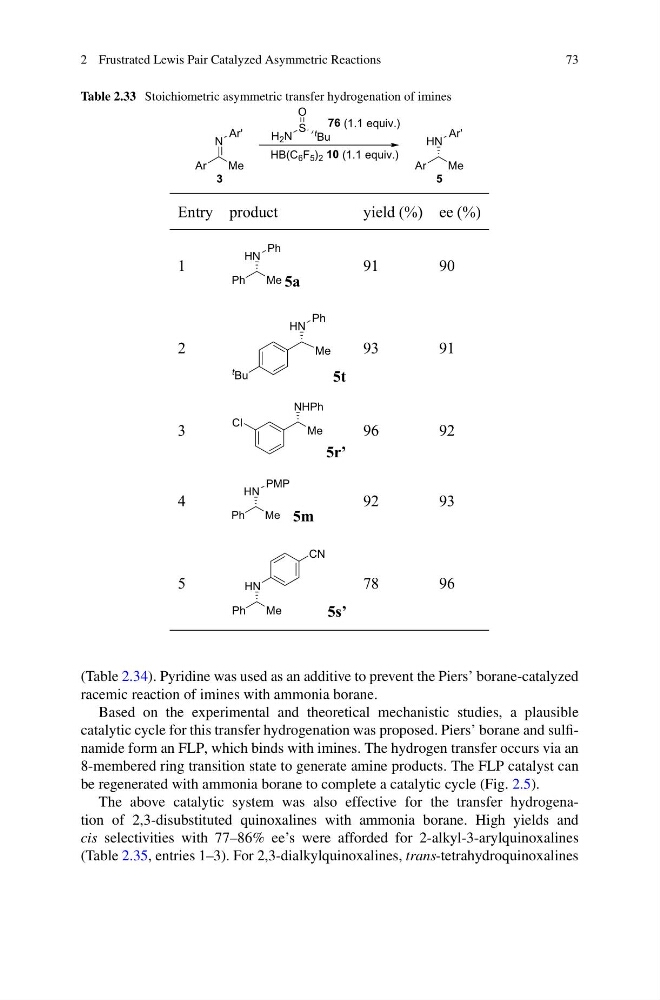
Table 2.33 Stoichiometric asymmetric transfer hydrogenation of imines
Ar
Me
N
Ar'
Ar
Me
HN
Ar'
HB(C 6 F 5 ) 2 10 (1.1 equiv.)
O
S t Bu
H 2 N
76 (1.1 equiv.)
3
5
Entry product
yield (%) ee (%)
1
5a
Ph
Me
HN
Ph
91
90
2
5t
Me
HN
Ph
t Bu
93
91
3
5r’
Me
NHPh
Cl
96
92
4
5m
Ph
Me
HN
PMP
92
93
5
5s’
Ph
Me
HN
CN
78
96
(Table 2.34). Pyridine was used as an additive to prevent the Piers’ borane-catalyzed
racemic reaction of imines with ammonia borane.
Based on the experimental and theoretical mechanistic studies, a plausible
catalytic cycle for this transfer hydrogenation was proposed. Piers’ borane and sulfinamide form an FLP, which binds with imines. The hydrogen transfer occurs via an
8-membered ring transition state to generate amine products. The FLP catalyst can
be regenerated with ammonia borane to complete a catalytic cycle (Fig. 2.5).
The above catalytic system was also effective for the transfer hydrogenation of 2,3-disubstituted quinoxalines with ammonia borane. High yields and
cis selectivities with 77–86% ee’s were afforded for 2-alkyl-3-arylquinoxalines
(Table 2.35, entries 1–3). For 2,3-dialkylquinoxalines, trans-tetrahydroquinoxalines
73
Table 2.33 Stoichiometric asymmetric transfer hydrogenation of imines
Ar
Me
N
Ar'
Ar
Me
HN
Ar'
HB(C 6 F 5 ) 2 10 (1.1 equiv.)
O
S t Bu
H 2 N
76 (1.1 equiv.)
3
5
Entry product
yield (%) ee (%)
1
5a
Ph
Me
HN
Ph
91
90
2
5t
Me
HN
Ph
t Bu
93
91
3
5r’
Me
NHPh
Cl
96
92
4
5m
Ph
Me
HN
PMP
92
93
5
5s’
Ph
Me
HN
CN
78
96
(Table 2.34). Pyridine was used as an additive to prevent the Piers’ borane-catalyzed
racemic reaction of imines with ammonia borane.
Based on the experimental and theoretical mechanistic studies, a plausible
catalytic cycle for this transfer hydrogenation was proposed. Piers’ borane and sulfinamide form an FLP, which binds with imines. The hydrogen transfer occurs via an
8-membered ring transition state to generate amine products. The FLP catalyst can
be regenerated with ammonia borane to complete a catalytic cycle (Fig. 2.5).
The above catalytic system was also effective for the transfer hydrogenation of 2,3-disubstituted quinoxalines with ammonia borane. High yields and
cis selectivities with 77–86% ee’s were afforded for 2-alkyl-3-arylquinoxalines
(Table 2.35, entries 1–3). For 2,3-dialkylquinoxalines, trans-tetrahydroquinoxalines