

2 Frustrated Lewis Pair Catalyzed Asymmetric Reactions
69
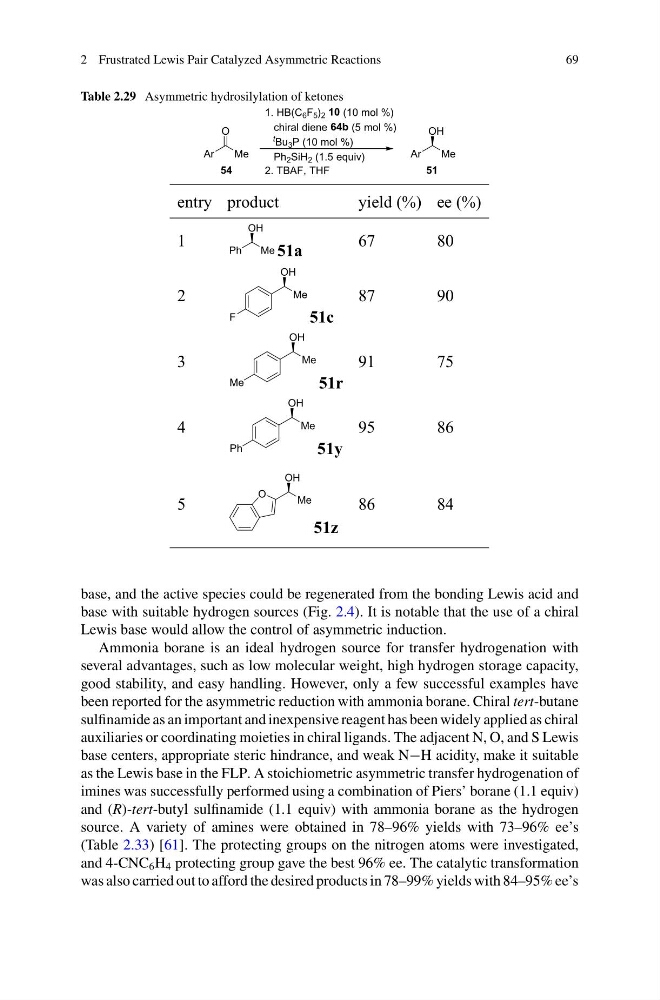
Table 2.29 Asymmetric hydrosilylation of ketones
Ar
Me
O
1. HB(C 6 F 5 ) 2 10 (10 mol %)
chiral diene 64b (5 mol %)
t Bu 3 P (10 mol %)
Ph 2 SiH 2 (1.5 equiv)
2. TBAF, THF
Ar
Me
OH
54
51
entry product
yield (%) ee (%)
1
51a
Ph
Me
OH
67
80
2
51c
Me
OH
F
87
90
3
51r
Me
Me
OH
91
75
4
51y
Me
OH
Ph
95
86
5
51z
Me
OH
O
86
84
base, and the active species could be regenerated from the bonding Lewis acid and
base with suitable hydrogen sources (Fig. 2.4). It is notable that the use of a chiral
Lewis base would allow the control of asymmetric induction.
Ammonia borane is an ideal hydrogen source for transfer hydrogenation with
several advantages, such as low molecular weight, high hydrogen storage capacity,
good stability, and easy handling. However, only a few successful examples have
been reported for the asymmetric reduction with ammonia borane. Chiral tert-butane
sulfinamide as an important and inexpensive reagent has been widely applied as chiral
auxiliaries or coordinating moieties in chiral ligands. The adjacent N, O, and S Lewis
base centers, appropriate steric hindrance, and weak N−H acidity, make it suitable
as the Lewis base in the FLP. A stoichiometric asymmetric transfer hydrogenation of
imines was successfully performed using a combination of Piers’ borane (1.1 equiv)
and (R)-tert-butyl sulfinamide (1.1 equiv) with ammonia borane as the hydrogen
source. A variety of amines were obtained in 78–96% yields with 73–96% ee’s
(Table 2.33) [61]. The protecting groups on the nitrogen atoms were investigated,
and 4-CNC 6 H 4 protecting group gave the best 96% ee. The catalytic transformation
was also carried out to afford the desired products in 78–99% yields with 84–95% ee’s
69
Table 2.29 Asymmetric hydrosilylation of ketones
Ar
Me
O
1. HB(C 6 F 5 ) 2 10 (10 mol %)
chiral diene 64b (5 mol %)
t Bu 3 P (10 mol %)
Ph 2 SiH 2 (1.5 equiv)
2. TBAF, THF
Ar
Me
OH
54
51
entry product
yield (%) ee (%)
1
51a
Ph
Me
OH
67
80
2
51c
Me
OH
F
87
90
3
51r
Me
Me
OH
91
75
4
51y
Me
OH
Ph
95
86
5
51z
Me
OH
O
86
84
base, and the active species could be regenerated from the bonding Lewis acid and
base with suitable hydrogen sources (Fig. 2.4). It is notable that the use of a chiral
Lewis base would allow the control of asymmetric induction.
Ammonia borane is an ideal hydrogen source for transfer hydrogenation with
several advantages, such as low molecular weight, high hydrogen storage capacity,
good stability, and easy handling. However, only a few successful examples have
been reported for the asymmetric reduction with ammonia borane. Chiral tert-butane
sulfinamide as an important and inexpensive reagent has been widely applied as chiral
auxiliaries or coordinating moieties in chiral ligands. The adjacent N, O, and S Lewis
base centers, appropriate steric hindrance, and weak N−H acidity, make it suitable
as the Lewis base in the FLP. A stoichiometric asymmetric transfer hydrogenation of
imines was successfully performed using a combination of Piers’ borane (1.1 equiv)
and (R)-tert-butyl sulfinamide (1.1 equiv) with ammonia borane as the hydrogen
source. A variety of amines were obtained in 78–96% yields with 73–96% ee’s
(Table 2.33) [61]. The protecting groups on the nitrogen atoms were investigated,
and 4-CNC 6 H 4 protecting group gave the best 96% ee. The catalytic transformation
was also carried out to afford the desired products in 78–99% yields with 84–95% ee’s