

68
X. Feng et al.
Pd(OAc) 2 , I 2
PhI(OAc) 2 , NaOAc
DMF, 100°C, 36 h
SOCl 2 , MeOH
reflux, 12 h
ArB(OH) 2 , Pd(OAc) 2
PPh 3 , K 2 CO 3
DMF, 90 °C, 12 h
Ph 3 PMeI
t BuOK
THF, 0 °C-rt
81-85%
64a: Ar = Ph
64b: Ar = 3,5- t Bu 2 C 6 H 3
64c: Ar = 3,5-(CF 3)2 C 6 H 3
64d: Ar = 4- i PrOC 6 H 4
64e: Ar = 2-naphthyl
1. DIBAL-H
toluene,
-78 °C-rt,12 h
2. PCC, Celite
DCM, rt, 4 h
65-72%
68-82%
42%
83%
Ar
Ar
65
COOH
COOH
66
COOH
COOH
I
I
67
COOMe
COOMe
I
I
68
COOMe
COOMe
Ar
Ar
69
CHO
CHO
Ar
Ar
64
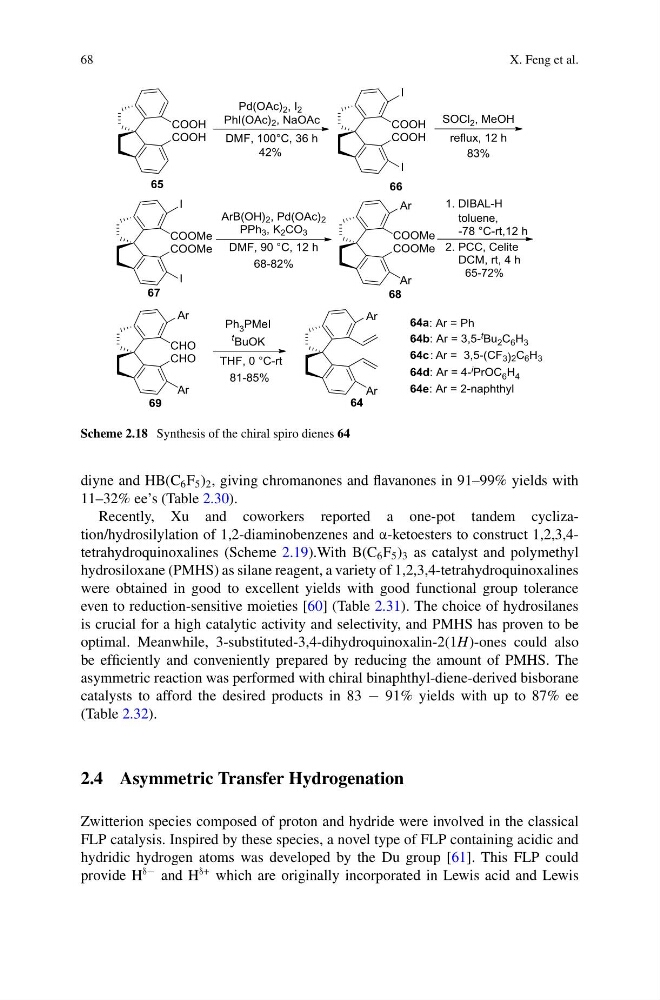
Scheme 2.18 Synthesis of the chiral spiro dienes 64
diyne and HB(C 6 F 5 ) 2 , giving chromanones and flavanones in 91–99% yields with
11–32% ee’s (Table 2.30).
Recently, Xu and coworkers reported a one-pot tandem cyclization/hydrosilylation of 1,2-diaminobenzenes and α-ketoesters to construct 1,2,3,4tetrahydroquinoxalines (Scheme 2.19).With B(C 6 F 5 ) 3 as catalyst and polymethyl
hydrosiloxane (PMHS) as silane reagent, a variety of 1,2,3,4-tetrahydroquinoxalines
were obtained in good to excellent yields with good functional group tolerance
even to reduction-sensitive moieties [60] (Table 2.31). The choice of hydrosilanes
is crucial for a high catalytic activity and selectivity, and PMHS has proven to be
optimal. Meanwhile, 3-substituted-3,4-dihydroquinoxalin-2(1H)-ones could also
be efficiently and conveniently prepared by reducing the amount of PMHS. The
asymmetric reaction was performed with chiral binaphthyl-diene-derived bisborane
catalysts to afford the desired products in 83 − 91% yields with up to 87% ee
(Table 2.32).
2.4 Asymmetric Transfer Hydrogenation
Zwitterion species composed of proton and hydride were involved in the classical
FLP catalysis. Inspired by these species, a novel type of FLP containing acidic and
hydridic hydrogen atoms was developed by the Du group [61]. This FLP could
provide H
δ− and H
δ+ which are originally incorporated in Lewis acid and Lewis
X. Feng et al.
Pd(OAc) 2 , I 2
PhI(OAc) 2 , NaOAc
DMF, 100°C, 36 h
SOCl 2 , MeOH
reflux, 12 h
ArB(OH) 2 , Pd(OAc) 2
PPh 3 , K 2 CO 3
DMF, 90 °C, 12 h
Ph 3 PMeI
t BuOK
THF, 0 °C-rt
81-85%
64a: Ar = Ph
64b: Ar = 3,5- t Bu 2 C 6 H 3
64c: Ar = 3,5-(CF 3)2 C 6 H 3
64d: Ar = 4- i PrOC 6 H 4
64e: Ar = 2-naphthyl
1. DIBAL-H
toluene,
-78 °C-rt,12 h
2. PCC, Celite
DCM, rt, 4 h
65-72%
68-82%
42%
83%
Ar
Ar
65
COOH
COOH
66
COOH
COOH
I
I
67
COOMe
COOMe
I
I
68
COOMe
COOMe
Ar
Ar
69
CHO
CHO
Ar
Ar
64
Scheme 2.18 Synthesis of the chiral spiro dienes 64
diyne and HB(C 6 F 5 ) 2 , giving chromanones and flavanones in 91–99% yields with
11–32% ee’s (Table 2.30).
Recently, Xu and coworkers reported a one-pot tandem cyclization/hydrosilylation of 1,2-diaminobenzenes and α-ketoesters to construct 1,2,3,4tetrahydroquinoxalines (Scheme 2.19).With B(C 6 F 5 ) 3 as catalyst and polymethyl
hydrosiloxane (PMHS) as silane reagent, a variety of 1,2,3,4-tetrahydroquinoxalines
were obtained in good to excellent yields with good functional group tolerance
even to reduction-sensitive moieties [60] (Table 2.31). The choice of hydrosilanes
is crucial for a high catalytic activity and selectivity, and PMHS has proven to be
optimal. Meanwhile, 3-substituted-3,4-dihydroquinoxalin-2(1H)-ones could also
be efficiently and conveniently prepared by reducing the amount of PMHS. The
asymmetric reaction was performed with chiral binaphthyl-diene-derived bisborane
catalysts to afford the desired products in 83 − 91% yields with up to 87% ee
(Table 2.32).
2.4 Asymmetric Transfer Hydrogenation
Zwitterion species composed of proton and hydride were involved in the classical
FLP catalysis. Inspired by these species, a novel type of FLP containing acidic and
hydridic hydrogen atoms was developed by the Du group [61]. This FLP could
provide H
δ− and H
δ+ which are originally incorporated in Lewis acid and Lewis