

2 Frustrated Lewis Pair Catalyzed Asymmetric Reactions
61
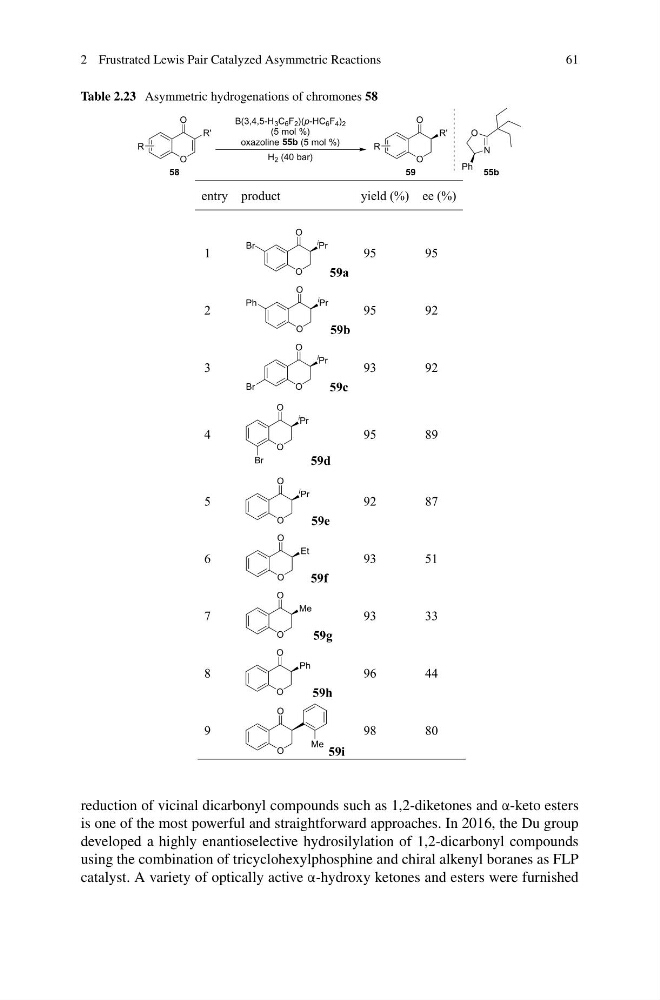
Table 2.23 Asymmetric hydrogenations of chromones 58
B(3,4,5-H 3 C 6 F 2 )(p-HC 6 F 4 ) 2
(5 mol %)
oxazoline 55b (5 mol %)
H 2 (40 bar)
N
O
Ph
O
O
R'
R
O
O
R'
R
58
59
55b
entry product
yield (%) ee (%)
1
59a
O
O
i Pr
Br
95
95
2
59b
O
O
i
Pr
Ph
95
92
3
59c
O
O
i Pr
Br
93
92
4
59d
O
O
i
Pr
Br
95
89
5
59e
O
O
i Pr
92
87
6
59f
O
O
Et
93
51
7
59g
O
O
Me
93
33
8
59h
O
O
Ph
96
44
9
59i
O
O
Me
98
80
reduction of vicinal dicarbonyl compounds such as 1,2-diketones and α-keto esters
is one of the most powerful and straightforward approaches. In 2016, the Du group
developed a highly enantioselective hydrosilylation of 1,2-dicarbonyl compounds
using the combination of tricyclohexylphosphine and chiral alkenyl boranes as FLP
catalyst. A variety of optically active α-hydroxy ketones and esters were furnished
61
Table 2.23 Asymmetric hydrogenations of chromones 58
B(3,4,5-H 3 C 6 F 2 )(p-HC 6 F 4 ) 2
(5 mol %)
oxazoline 55b (5 mol %)
H 2 (40 bar)
N
O
Ph
O
O
R'
R
O
O
R'
R
58
59
55b
entry product
yield (%) ee (%)
1
59a
O
O
i Pr
Br
95
95
2
59b
O
O
i
Pr
Ph
95
92
3
59c
O
O
i Pr
Br
93
92
4
59d
O
O
i
Pr
Br
95
89
5
59e
O
O
i Pr
92
87
6
59f
O
O
Et
93
51
7
59g
O
O
Me
93
33
8
59h
O
O
Ph
96
44
9
59i
O
O
Me
98
80
reduction of vicinal dicarbonyl compounds such as 1,2-diketones and α-keto esters
is one of the most powerful and straightforward approaches. In 2016, the Du group
developed a highly enantioselective hydrosilylation of 1,2-dicarbonyl compounds
using the combination of tricyclohexylphosphine and chiral alkenyl boranes as FLP
catalyst. A variety of optically active α-hydroxy ketones and esters were furnished