

392
T. C. Johnstone
and [AH]
– . Write out the new overall chemical reaction, provide a new thermodynamic cycle, and give a formula for H rxn incorporating the dissociation of
A–B into A and B, which has an enthalpy H dissociation .
(b) Given that A behaves as a Lewis acid and B behaves as a Lewis base, what will be
the signs (negative or positive) for the values of H B , H A , and H dissociation ?
Explain.
(c) In the limit of a very stable adduct A–B formed from strong, unhindered acid and
base, what limiting value does H dissociation approach? What is the implication
for the H rxn of the H 2 activation reaction?
(d) If the substituents on A and B were made larger, what effect would that have on
the H dissociation ?
(e) We can think of Frustrated Lewis Pair (FLP) chemistry as simply a limiting case
of the more general chemistry of acid–base adducts. In the limit of substituents
on A and B so large that A and B do not interact at all, what value does
H dissociation assume? What is the consequence of H rxn ?
(f) The answer from (e) might be surprising. Provide an explanation for why you
do not get an expression for H rxn equivalent to that obtained in Example 1.
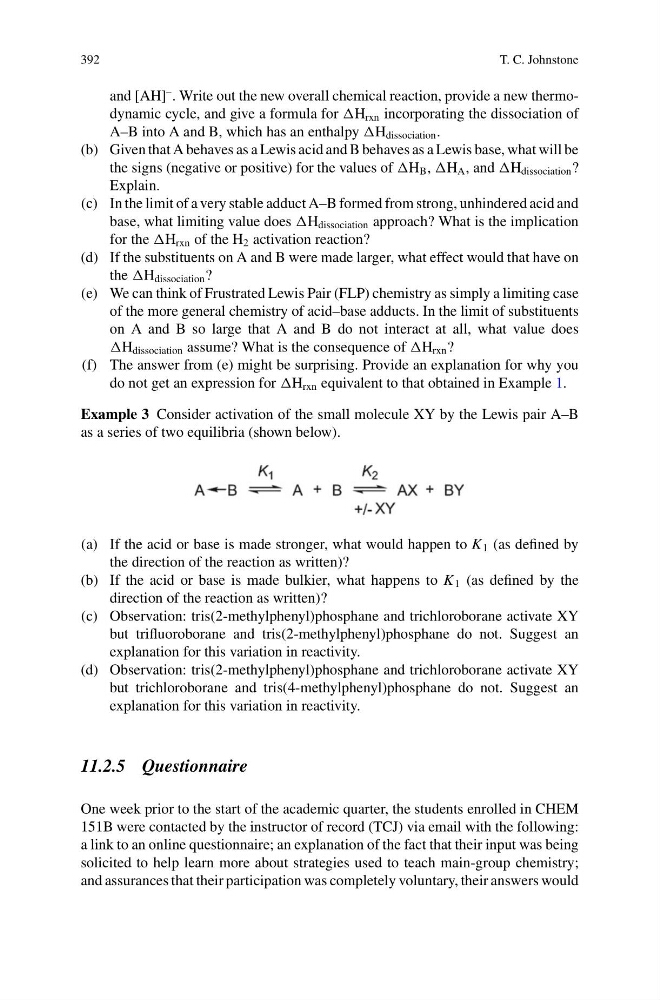
Example 3 Consider activation of the small molecule XY by the Lewis pair A–B
as a series of two equilibria (shown below).
(a) If the acid or base is made stronger, what would happen to K 1 (as defined by
the direction of the reaction as written)?
(b) If the acid or base is made bulkier, what happens to K 1 (as defined by the
direction of the reaction as written)?
(c) Observation: tris(2-methylphenyl)phosphane and trichloroborane activate XY
but trifluoroborane and tris(2-methylphenyl)phosphane do not. Suggest an
explanation for this variation in reactivity.
(d) Observation: tris(2-methylphenyl)phosphane and trichloroborane activate XY
but trichloroborane and tris(4-methylphenyl)phosphane do not. Suggest an
explanation for this variation in reactivity.
11.2.5 Questionnaire
One week prior to the start of the academic quarter, the students enrolled in CHEM
151B were contacted by the instructor of record (TCJ) via email with the following:
a link to an online questionnaire; an explanation of the fact that their input was being
solicited to help learn more about strategies used to teach main-group chemistry;
and assurances that their participation was completely voluntary, their answers would
T. C. Johnstone
and [AH]
– . Write out the new overall chemical reaction, provide a new thermodynamic cycle, and give a formula for H rxn incorporating the dissociation of
A–B into A and B, which has an enthalpy H dissociation .
(b) Given that A behaves as a Lewis acid and B behaves as a Lewis base, what will be
the signs (negative or positive) for the values of H B , H A , and H dissociation ?
Explain.
(c) In the limit of a very stable adduct A–B formed from strong, unhindered acid and
base, what limiting value does H dissociation approach? What is the implication
for the H rxn of the H 2 activation reaction?
(d) If the substituents on A and B were made larger, what effect would that have on
the H dissociation ?
(e) We can think of Frustrated Lewis Pair (FLP) chemistry as simply a limiting case
of the more general chemistry of acid–base adducts. In the limit of substituents
on A and B so large that A and B do not interact at all, what value does
H dissociation assume? What is the consequence of H rxn ?
(f) The answer from (e) might be surprising. Provide an explanation for why you
do not get an expression for H rxn equivalent to that obtained in Example 1.
Example 3 Consider activation of the small molecule XY by the Lewis pair A–B
as a series of two equilibria (shown below).
(a) If the acid or base is made stronger, what would happen to K 1 (as defined by
the direction of the reaction as written)?
(b) If the acid or base is made bulkier, what happens to K 1 (as defined by the
direction of the reaction as written)?
(c) Observation: tris(2-methylphenyl)phosphane and trichloroborane activate XY
but trifluoroborane and tris(2-methylphenyl)phosphane do not. Suggest an
explanation for this variation in reactivity.
(d) Observation: tris(2-methylphenyl)phosphane and trichloroborane activate XY
but trichloroborane and tris(4-methylphenyl)phosphane do not. Suggest an
explanation for this variation in reactivity.
11.2.5 Questionnaire
One week prior to the start of the academic quarter, the students enrolled in CHEM
151B were contacted by the instructor of record (TCJ) via email with the following:
a link to an online questionnaire; an explanation of the fact that their input was being
solicited to help learn more about strategies used to teach main-group chemistry;
and assurances that their participation was completely voluntary, their answers would