

390
T. C. Johnstone
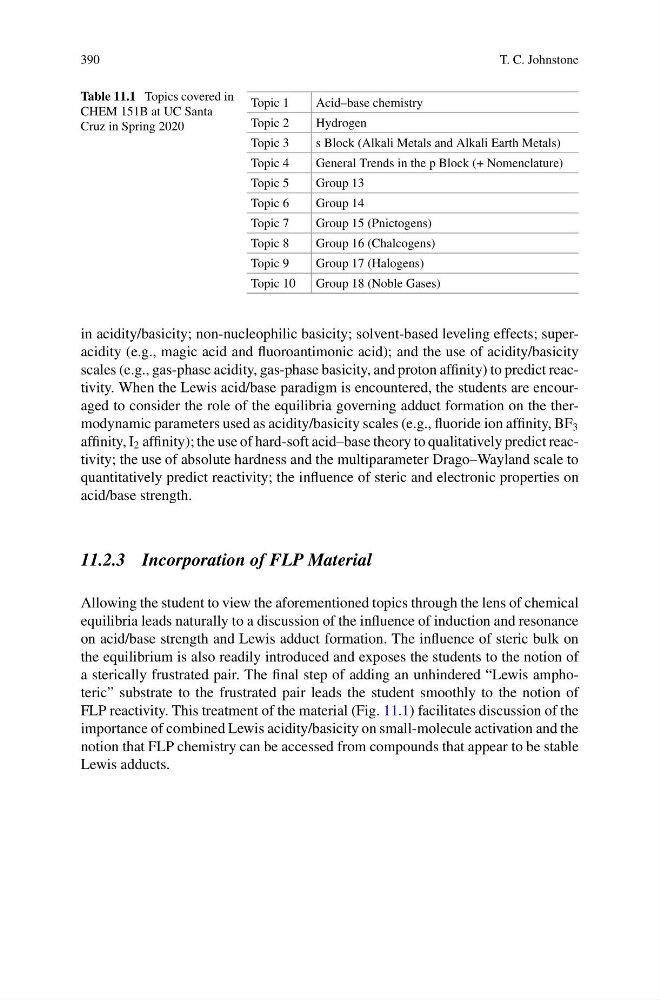
Table 11.1 Topics covered in
CHEM 151B at UC Santa
Cruz in Spring 2020
Topic 1
Acid–base chemistry
Topic 2
Hydrogen
Topic 3
s Block (Alkali Metals and Alkali Earth Metals)
Topic 4
General Trends in the p Block (+ Nomenclature)
Topic 5
Group 13
Topic 6
Group 14
Topic 7
Group 15 (Pnictogens)
Topic 8
Group 16 (Chalcogens)
Topic 9
Group 17 (Halogens)
Topic 10
Group 18 (Noble Gases)
in acidity/basicity; non-nucleophilic basicity; solvent-based leveling effects; superacidity (e.g., magic acid and fluoroantimonic acid); and the use of acidity/basicity
scales (e.g., gas-phase acidity, gas-phase basicity, and proton affinity) to predict reactivity. When the Lewis acid/base paradigm is encountered, the students are encouraged to consider the role of the equilibria governing adduct formation on the thermodynamic parameters used as acidity/basicity scales (e.g., fluoride ion affinity, BF 3
affinity, I 2 affinity); the use of hard-soft acid–base theory to qualitatively predict reactivity; the use of absolute hardness and the multiparameter Drago–Wayland scale to
quantitatively predict reactivity; the influence of steric and electronic properties on
acid/base strength.
11.2.3 Incorporation of FLP Material
Allowing the student to view the aforementioned topics through the lens of chemical
equilibria leads naturally to a discussion of the influence of induction and resonance
on acid/base strength and Lewis adduct formation. The influence of steric bulk on
the equilibrium is also readily introduced and exposes the students to the notion of
a sterically frustrated pair. The final step of adding an unhindered “Lewis amphoteric” substrate to the frustrated pair leads the student smoothly to the notion of
FLP reactivity. This treatment of the material (Fig. 11.1) facilitates discussion of the
importance of combined Lewis acidity/basicity on small-molecule activation and the
notion that FLP chemistry can be accessed from compounds that appear to be stable
Lewis adducts.
T. C. Johnstone
Table 11.1 Topics covered in
CHEM 151B at UC Santa
Cruz in Spring 2020
Topic 1
Acid–base chemistry
Topic 2
Hydrogen
Topic 3
s Block (Alkali Metals and Alkali Earth Metals)
Topic 4
General Trends in the p Block (+ Nomenclature)
Topic 5
Group 13
Topic 6
Group 14
Topic 7
Group 15 (Pnictogens)
Topic 8
Group 16 (Chalcogens)
Topic 9
Group 17 (Halogens)
Topic 10
Group 18 (Noble Gases)
in acidity/basicity; non-nucleophilic basicity; solvent-based leveling effects; superacidity (e.g., magic acid and fluoroantimonic acid); and the use of acidity/basicity
scales (e.g., gas-phase acidity, gas-phase basicity, and proton affinity) to predict reactivity. When the Lewis acid/base paradigm is encountered, the students are encouraged to consider the role of the equilibria governing adduct formation on the thermodynamic parameters used as acidity/basicity scales (e.g., fluoride ion affinity, BF 3
affinity, I 2 affinity); the use of hard-soft acid–base theory to qualitatively predict reactivity; the use of absolute hardness and the multiparameter Drago–Wayland scale to
quantitatively predict reactivity; the influence of steric and electronic properties on
acid/base strength.
11.2.3 Incorporation of FLP Material
Allowing the student to view the aforementioned topics through the lens of chemical
equilibria leads naturally to a discussion of the influence of induction and resonance
on acid/base strength and Lewis adduct formation. The influence of steric bulk on
the equilibrium is also readily introduced and exposes the students to the notion of
a sterically frustrated pair. The final step of adding an unhindered “Lewis amphoteric” substrate to the frustrated pair leads the student smoothly to the notion of
FLP reactivity. This treatment of the material (Fig. 11.1) facilitates discussion of the
importance of combined Lewis acidity/basicity on small-molecule activation and the
notion that FLP chemistry can be accessed from compounds that appear to be stable
Lewis adducts.