

9 Frustrated Lewis Pairs Based on Transition Metals
341
(PMe 2 Ar)Au(NTf 2 ) (37)
+
[Pt(P
t Bu 3 ) 2 ] (38)
R'
R'
R'
R'
P
Au
R
R
R'
R'
R'
R'
P
Au
R
R
H
NTf 2
-
+
Pt
P(
t Bu) 3
P(
t Bu) 3
H
R'
R'
R'
R'
P
Au
R
R
H
Pt
P(
t Bu) 3
P(
t Bu) 3
H
NTf 2
-
+
NTf 2
-
+
+
37b: H 2 (0.5 bar), C 6 D 6
-20 ºC, < 5 min
37c: H 2 (0.5 bar), C 6 D 6
25 ºC, 18 h
37b: 12 h, 25 ºC
37a: H 2 (0.5 bar),
C 6 D 6 , 25 ºC, 48 h
R'
R'
R'
R'
P
Au
R
R
H
Pt
P(
t Bu) 3
P(
t Bu) 3
H
NTf 2
TS1
37a: R = Me, R' = Me
37b: R = Me, R' =
i Pr
37c: R = Cyp, R' = Me
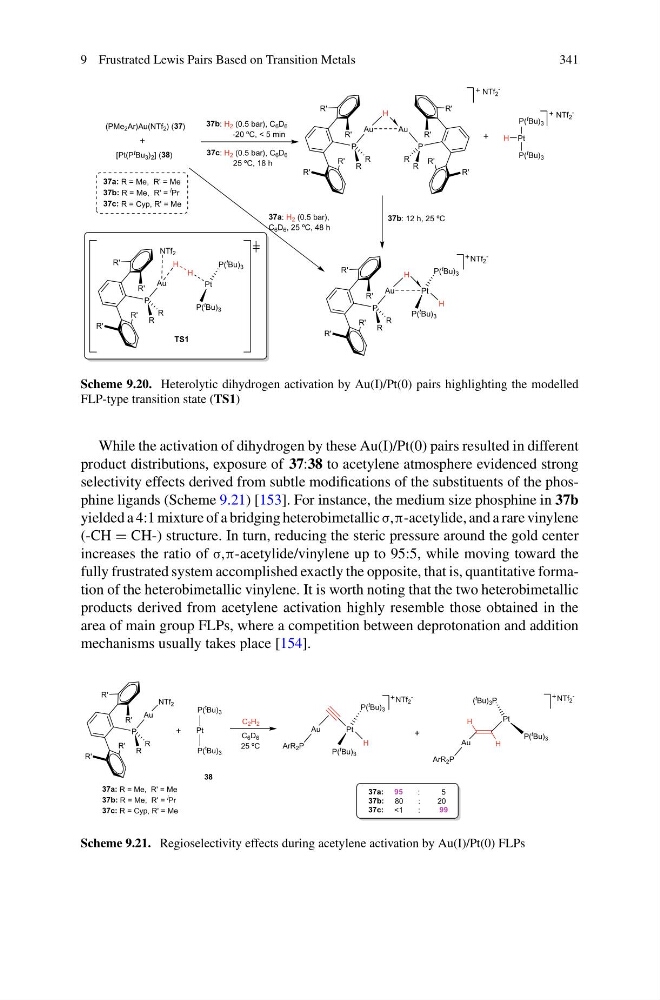
Scheme 9.20. Heterolytic dihydrogen activation by Au(I)/Pt(0) pairs highlighting the modelled
FLP-type transition state (TS1)
While the activation of dihydrogen by these Au(I)/Pt(0) pairs resulted in different
product distributions, exposure of 37:38 to acetylene atmosphere evidenced strong
selectivity effects derived from subtle modifications of the substituents of the phosphine ligands (Scheme 9.21) [153]. For instance, the medium size phosphine in 37b
yielded a 4:1 mixture of a bridging heterobimetallic σ,π-acetylide, and a rare vinylene
(-CH = CH-) structure. In turn, reducing the steric pressure around the gold center
increases the ratio of σ,π-acetylide/vinylene up to 95:5, while moving toward the
fully frustrated system accomplished exactly the opposite, that is, quantitative formation of the heterobimetallic vinylene. It is worth noting that the two heterobimetallic
products derived from acetylene activation highly resemble those obtained in the
area of main group FLPs, where a competition between deprotonation and addition
mechanisms usually takes place [154].
C 2 H 2
C 6 D 6
25 ºC
ArR 2 P
Au
Pt
(
t Bu) 3 P
P(
t Bu) 3
NTf 2
-
+
ArR 2 P
Au
Pt
P(
t Bu) 3
P(
t Bu) 3
H
NTf 2
-
+
H
H
+
+
37a: 95
:
5
37b: 80
:
20
37c: <1
:
99
R'
R'
R'
R'
P
Au
R
R
NTf 2
Pt
P( t Bu) 3
P( t Bu) 3
38
37a: R = Me, R' = Me
37b: R = Me, R' =
i Pr
37c: R = Cyp, R' = Me
Scheme 9.21. Regioselectivity effects during acetylene activation by Au(I)/Pt(0) FLPs
341
(PMe 2 Ar)Au(NTf 2 ) (37)
+
[Pt(P
t Bu 3 ) 2 ] (38)
R'
R'
R'
R'
P
Au
R
R
R'
R'
R'
R'
P
Au
R
R
H
NTf 2
-
+
Pt
P(
t Bu) 3
P(
t Bu) 3
H
R'
R'
R'
R'
P
Au
R
R
H
Pt
P(
t Bu) 3
P(
t Bu) 3
H
NTf 2
-
+
NTf 2
-
+
+
37b: H 2 (0.5 bar), C 6 D 6
-20 ºC, < 5 min
37c: H 2 (0.5 bar), C 6 D 6
25 ºC, 18 h
37b: 12 h, 25 ºC
37a: H 2 (0.5 bar),
C 6 D 6 , 25 ºC, 48 h
R'
R'
R'
R'
P
Au
R
R
H
Pt
P(
t Bu) 3
P(
t Bu) 3
H
NTf 2
TS1
37a: R = Me, R' = Me
37b: R = Me, R' =
i Pr
37c: R = Cyp, R' = Me
Scheme 9.20. Heterolytic dihydrogen activation by Au(I)/Pt(0) pairs highlighting the modelled
FLP-type transition state (TS1)
While the activation of dihydrogen by these Au(I)/Pt(0) pairs resulted in different
product distributions, exposure of 37:38 to acetylene atmosphere evidenced strong
selectivity effects derived from subtle modifications of the substituents of the phosphine ligands (Scheme 9.21) [153]. For instance, the medium size phosphine in 37b
yielded a 4:1 mixture of a bridging heterobimetallic σ,π-acetylide, and a rare vinylene
(-CH = CH-) structure. In turn, reducing the steric pressure around the gold center
increases the ratio of σ,π-acetylide/vinylene up to 95:5, while moving toward the
fully frustrated system accomplished exactly the opposite, that is, quantitative formation of the heterobimetallic vinylene. It is worth noting that the two heterobimetallic
products derived from acetylene activation highly resemble those obtained in the
area of main group FLPs, where a competition between deprotonation and addition
mechanisms usually takes place [154].
C 2 H 2
C 6 D 6
25 ºC
ArR 2 P
Au
Pt
(
t Bu) 3 P
P(
t Bu) 3
NTf 2
-
+
ArR 2 P
Au
Pt
P(
t Bu) 3
P(
t Bu) 3
H
NTf 2
-
+
H
H
+
+
37a: 95
:
5
37b: 80
:
20
37c: <1
:
99
R'
R'
R'
R'
P
Au
R
R
NTf 2
Pt
P( t Bu) 3
P( t Bu) 3
38
37a: R = Me, R' = Me
37b: R = Me, R' =
i Pr
37c: R = Cyp, R' = Me
Scheme 9.21. Regioselectivity effects during acetylene activation by Au(I)/Pt(0) FLPs