

340
N. Hidalgo et al.
(Ar
Xyl2
= C 6 H 3 -2,6-(C 6 H 3 -2,6-Me 2 ) 2 ) ligands [150]. The steric shielding provided
by the three investigated phosphines follows the order PCyp 2 Ar
Xyl2 > PMe 2 Ar
Dipp2
> PMe 2 Ar
Xyl2 , which has a direct impact on the equilibrium between metal adduct
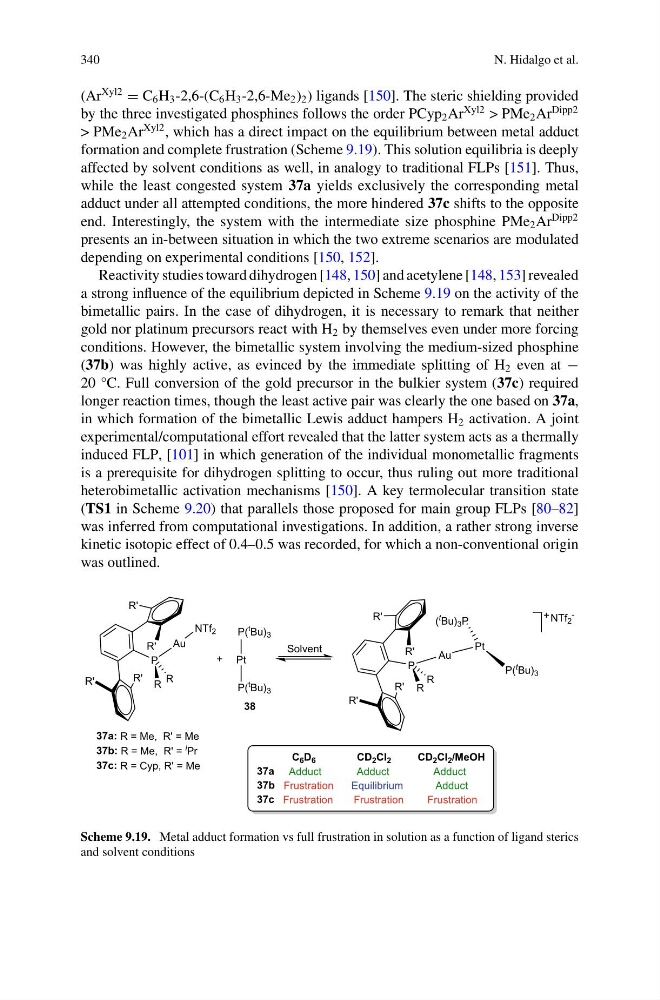
formation and complete frustration (Scheme 9.19). This solution equilibria is deeply
affected by solvent conditions as well, in analogy to traditional FLPs [151]. Thus,
while the least congested system 37a yields exclusively the corresponding metal
adduct under all attempted conditions, the more hindered 37c shifts to the opposite
end. Interestingly, the system with the intermediate size phosphine PMe 2 Ar
Dipp2
presents an in-between situation in which the two extreme scenarios are modulated
depending on experimental conditions [150, 152].
Reactivity studies toward dihydrogen [148, 150] and acetylene [148, 153] revealed
a strong influence of the equilibrium depicted in Scheme 9.19 on the activity of the
bimetallic pairs. In the case of dihydrogen, it is necessary to remark that neither
gold nor platinum precursors react with H 2 by themselves even under more forcing
conditions. However, the bimetallic system involving the medium-sized phosphine
(37b) was highly active, as evinced by the immediate splitting of H 2 even at −
20 °C. Full conversion of the gold precursor in the bulkier system (37c) required
longer reaction times, though the least active pair was clearly the one based on 37a,
in which formation of the bimetallic Lewis adduct hampers H 2 activation. A joint
experimental/computational effort revealed that the latter system acts as a thermally
induced FLP, [101] in which generation of the individual monometallic fragments
is a prerequisite for dihydrogen splitting to occur, thus ruling out more traditional
heterobimetallic activation mechanisms [150]. A key termolecular transition state
(TS1 in Scheme 9.20) that parallels those proposed for main group FLPs [80–82]
was inferred from computational investigations. In addition, a rather strong inverse
kinetic isotopic effect of 0.4–0.5 was recorded, for which a non-conventional origin
was outlined.
R'
R'
R'
R'
P
Au
R
R
37a: R = Me, R' = Me
37b: R = Me, R' =
i Pr
37c: R = Cyp, R' = Me
NTf 2
+
38
Solvent
R'
R'
R'
R'
P
Au
R
R
Pt
(
t Bu) 3 P
P(
t Bu) 3
NTf 2
-
+
Pt
P(
t Bu) 3
P(
t Bu) 3
C 6 D 6
CD 2 Cl 2
CD 2 Cl 2 /MeOH
37a Adduct
Adduct
Adduct
37b Frustration
Equilibrium
Adduct
37c Frustration
Frustration
Frustration
Scheme 9.19. Metal adduct formation vs full frustration in solution as a function of ligand sterics
and solvent conditions
N. Hidalgo et al.
(Ar
Xyl2
= C 6 H 3 -2,6-(C 6 H 3 -2,6-Me 2 ) 2 ) ligands [150]. The steric shielding provided
by the three investigated phosphines follows the order PCyp 2 Ar
Xyl2 > PMe 2 Ar
Dipp2
> PMe 2 Ar
Xyl2 , which has a direct impact on the equilibrium between metal adduct
formation and complete frustration (Scheme 9.19). This solution equilibria is deeply
affected by solvent conditions as well, in analogy to traditional FLPs [151]. Thus,
while the least congested system 37a yields exclusively the corresponding metal
adduct under all attempted conditions, the more hindered 37c shifts to the opposite
end. Interestingly, the system with the intermediate size phosphine PMe 2 Ar
Dipp2
presents an in-between situation in which the two extreme scenarios are modulated
depending on experimental conditions [150, 152].
Reactivity studies toward dihydrogen [148, 150] and acetylene [148, 153] revealed
a strong influence of the equilibrium depicted in Scheme 9.19 on the activity of the
bimetallic pairs. In the case of dihydrogen, it is necessary to remark that neither
gold nor platinum precursors react with H 2 by themselves even under more forcing
conditions. However, the bimetallic system involving the medium-sized phosphine
(37b) was highly active, as evinced by the immediate splitting of H 2 even at −
20 °C. Full conversion of the gold precursor in the bulkier system (37c) required
longer reaction times, though the least active pair was clearly the one based on 37a,
in which formation of the bimetallic Lewis adduct hampers H 2 activation. A joint
experimental/computational effort revealed that the latter system acts as a thermally
induced FLP, [101] in which generation of the individual monometallic fragments
is a prerequisite for dihydrogen splitting to occur, thus ruling out more traditional
heterobimetallic activation mechanisms [150]. A key termolecular transition state
(TS1 in Scheme 9.20) that parallels those proposed for main group FLPs [80–82]
was inferred from computational investigations. In addition, a rather strong inverse
kinetic isotopic effect of 0.4–0.5 was recorded, for which a non-conventional origin
was outlined.
R'
R'
R'
R'
P
Au
R
R
37a: R = Me, R' = Me
37b: R = Me, R' =
i Pr
37c: R = Cyp, R' = Me
NTf 2
+
38
Solvent
R'
R'
R'
R'
P
Au
R
R
Pt
(
t Bu) 3 P
P(
t Bu) 3
NTf 2
-
+
Pt
P(
t Bu) 3
P(
t Bu) 3
C 6 D 6
CD 2 Cl 2
CD 2 Cl 2 /MeOH
37a Adduct
Adduct
Adduct
37b Frustration
Equilibrium
Adduct
37c Frustration
Frustration
Frustration
Scheme 9.19. Metal adduct formation vs full frustration in solution as a function of ligand sterics
and solvent conditions