

338
N. Hidalgo et al.
An addition complex of that kind could even be structurally characterized by singlecrystal X-ray diffraction studies. An example of this reactivity based on a trisalkoxide
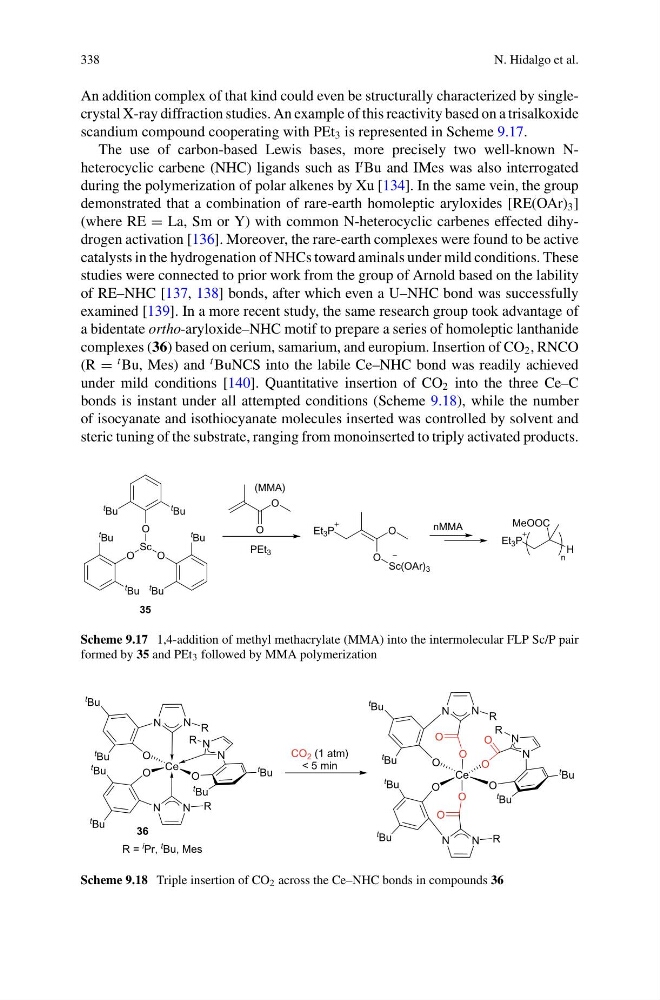
scandium compound cooperating with PEt 3 is represented in Scheme 9.17.
The use of carbon-based Lewis bases, more precisely two well-known Nheterocyclic carbene (NHC) ligands such as I
t Bu and IMes was also interrogated
during the polymerization of polar alkenes by Xu [134]. In the same vein, the group
demonstrated that a combination of rare-earth homoleptic aryloxides [RE(OAr) 3 ]
(where RE = La, Sm or Y) with common N-heterocyclic carbenes effected dihydrogen activation [136]. Moreover, the rare-earth complexes were found to be active
catalysts in the hydrogenation of NHCs toward aminals under mild conditions. These
studies were connected to prior work from the group of Arnold based on the lability
of RE–NHC [137, 138] bonds, after which even a U–NHC bond was successfully
examined [139]. In a more recent study, the same research group took advantage of
a bidentate ortho-aryloxide–NHC motif to prepare a series of homoleptic lanthanide
complexes (36) based on cerium, samarium, and europium. Insertion of CO 2 , RNCO
(R =
t Bu, Mes) and
t BuNCS into the labile Ce–NHC bond was readily achieved
under mild conditions [140]. Quantitative insertion of CO 2 into the three Ce–C
bonds is instant under all attempted conditions (Scheme 9.18), while the number
of isocyanate and isothiocyanate molecules inserted was controlled by solvent and
steric tuning of the substrate, ranging from monoinserted to triply activated products.
Sc
O
O
O
t Bu
t Bu
t Bu
t Bu
t Bu
t Bu
O
O
PEt 3
O
O
Sc(OAr) 3
Et 3 P
35
nMMA
(MMA)
MeOOC
Et 3 P
H
n
Scheme 9.17 1,4-addition of methyl methacrylate (MMA) into the intermolecular FLP Sc/P pair
formed by 35 and PEt 3 followed by MMA polymerization
N
N R
N
N
t Bu
t Bu
R
O
N
N
t Bu
t Bu
R
O
O
t Bu
t Bu
Ce
N
N R
N
N
t Bu
t Bu
R
O
N
N
t Bu
t Bu
R
O
O
t Bu
t Bu
Ce
O
O
O
O
O
O
CO 2 (1 atm)
< 5 min
R =
i Pr,
t Bu, Mes
36
Scheme 9.18 Triple insertion of CO 2 across the Ce–NHC bonds in compounds 36
N. Hidalgo et al.
An addition complex of that kind could even be structurally characterized by singlecrystal X-ray diffraction studies. An example of this reactivity based on a trisalkoxide
scandium compound cooperating with PEt 3 is represented in Scheme 9.17.
The use of carbon-based Lewis bases, more precisely two well-known Nheterocyclic carbene (NHC) ligands such as I
t Bu and IMes was also interrogated
during the polymerization of polar alkenes by Xu [134]. In the same vein, the group
demonstrated that a combination of rare-earth homoleptic aryloxides [RE(OAr) 3 ]
(where RE = La, Sm or Y) with common N-heterocyclic carbenes effected dihydrogen activation [136]. Moreover, the rare-earth complexes were found to be active
catalysts in the hydrogenation of NHCs toward aminals under mild conditions. These
studies were connected to prior work from the group of Arnold based on the lability
of RE–NHC [137, 138] bonds, after which even a U–NHC bond was successfully
examined [139]. In a more recent study, the same research group took advantage of
a bidentate ortho-aryloxide–NHC motif to prepare a series of homoleptic lanthanide
complexes (36) based on cerium, samarium, and europium. Insertion of CO 2 , RNCO
(R =
t Bu, Mes) and
t BuNCS into the labile Ce–NHC bond was readily achieved
under mild conditions [140]. Quantitative insertion of CO 2 into the three Ce–C
bonds is instant under all attempted conditions (Scheme 9.18), while the number
of isocyanate and isothiocyanate molecules inserted was controlled by solvent and
steric tuning of the substrate, ranging from monoinserted to triply activated products.
Sc
O
O
O
t Bu
t Bu
t Bu
t Bu
t Bu
t Bu
O
O
PEt 3
O
O
Sc(OAr) 3
Et 3 P
35
nMMA
(MMA)
MeOOC
Et 3 P
H
n
Scheme 9.17 1,4-addition of methyl methacrylate (MMA) into the intermolecular FLP Sc/P pair
formed by 35 and PEt 3 followed by MMA polymerization
N
N R
N
N
t Bu
t Bu
R
O
N
N
t Bu
t Bu
R
O
O
t Bu
t Bu
Ce
N
N R
N
N
t Bu
t Bu
R
O
N
N
t Bu
t Bu
R
O
O
t Bu
t Bu
Ce
O
O
O
O
O
O
CO 2 (1 atm)
< 5 min
R =
i Pr,
t Bu, Mes
36
Scheme 9.18 Triple insertion of CO 2 across the Ce–NHC bonds in compounds 36