

326
N. Hidalgo et al.
The potential for catalysis is likely the most appealing benefit of extending the
concept of frustration to transition metals. This became obvious since the publication
of the aforementioned original works. For instance, while compound 14 promotes
the catalytic dimerization of alkynes, zirconocene 12 mediates the dehydrogenation
of amine boranes, the latter being the first example of such transformation in the
FLP arena [52–55]. This has been lately explored in deeper detail by testing several
intramolecular Zr
+ /P complexes constructed around a variety of cyclopentadienyl and
phosphinoaryloxide ligands [56]. These compounds are active in dimethylamineborane (Me 2 NH·BH 3 ) dehydrogenation toward cyclic diborazane [Me 2 N–BH 2 ] 2 .
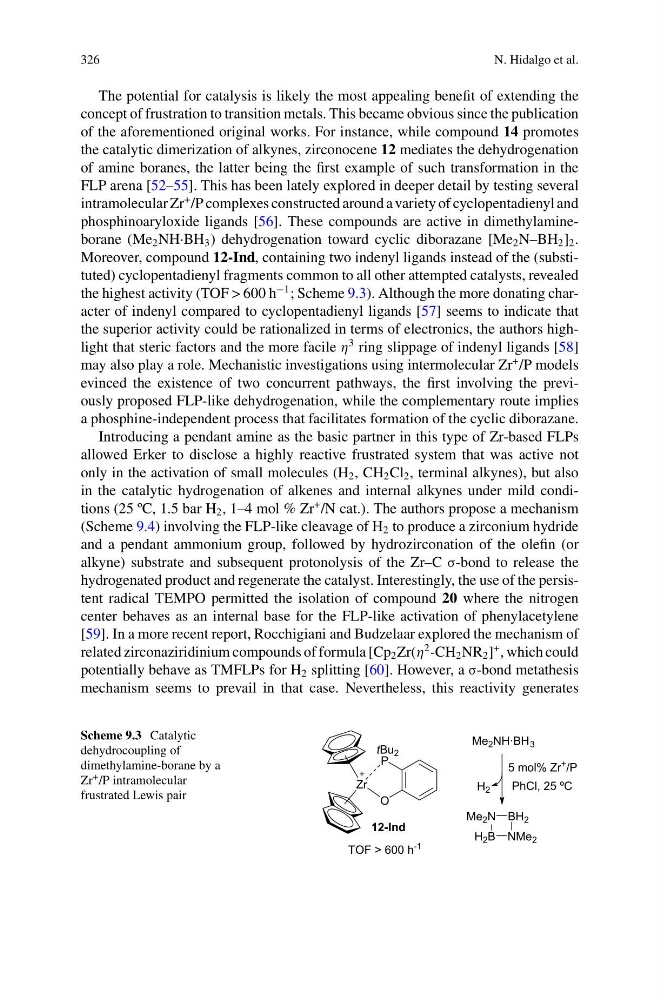
Moreover, compound 12-Ind, containing two indenyl ligands instead of the (substituted) cyclopentadienyl fragments common to all other attempted catalysts, revealed
the highest activity (TOF > 600 h
−1 ; Scheme 9.3). Although the more donating character of indenyl compared to cyclopentadienyl ligands [57] seems to indicate that
the superior activity could be rationalized in terms of electronics, the authors highlight that steric factors and the more facile η
3 ring slippage of indenyl ligands [58]
may also play a role. Mechanistic investigations using intermolecular Zr
+ /P models
evinced the existence of two concurrent pathways, the first involving the previously proposed FLP-like dehydrogenation, while the complementary route implies
a phosphine-independent process that facilitates formation of the cyclic diborazane.
Introducing a pendant amine as the basic partner in this type of Zr-based FLPs
allowed Erker to disclose a highly reactive frustrated system that was active not
only in the activation of small molecules (H 2 , CH 2 Cl 2 , terminal alkynes), but also
in the catalytic hydrogenation of alkenes and internal alkynes under mild conditions (25 ºC, 1.5 bar H 2 , 1–4 mol % Zr
+ /N cat.). The authors propose a mechanism
(Scheme 9.4) involving the FLP-like cleavage of H 2 to produce a zirconium hydride
and a pendant ammonium group, followed by hydrozirconation of the olefin (or
alkyne) substrate and subsequent protonolysis of the Zr–C σ-bond to release the
hydrogenated product and regenerate the catalyst. Interestingly, the use of the persistent radical TEMPO permitted the isolation of compound 20 where the nitrogen
center behaves as an internal base for the FLP-like activation of phenylacetylene
[59]. In a more recent report, Rocchigiani and Budzelaar explored the mechanism of
related zirconaziridinium compounds of formula [Cp 2 Zr(η
2 -CH 2 NR 2 ]
+ , which could
potentially behave as TMFLPs for H 2 splitting [60]. However, a σ-bond metathesis
mechanism seems to prevail in that case. Nevertheless, this reactivity generates
Scheme 9.3 Catalytic
dehydrocoupling of
dimethylamine-borane by a
Zr + /P intramolecular
frustrated Lewis pair
O
P
Zr
tBu 2
12-Ind
Me 2 N
H 2 B
BH 2
NMe 2
5 mol% Zr
+ /P
H 2
PhCl, 25 ºC
TOF > 600 h
-1
Me 2 NH·BH 3
N. Hidalgo et al.
The potential for catalysis is likely the most appealing benefit of extending the
concept of frustration to transition metals. This became obvious since the publication
of the aforementioned original works. For instance, while compound 14 promotes
the catalytic dimerization of alkynes, zirconocene 12 mediates the dehydrogenation
of amine boranes, the latter being the first example of such transformation in the
FLP arena [52–55]. This has been lately explored in deeper detail by testing several
intramolecular Zr
+ /P complexes constructed around a variety of cyclopentadienyl and
phosphinoaryloxide ligands [56]. These compounds are active in dimethylamineborane (Me 2 NH·BH 3 ) dehydrogenation toward cyclic diborazane [Me 2 N–BH 2 ] 2 .
Moreover, compound 12-Ind, containing two indenyl ligands instead of the (substituted) cyclopentadienyl fragments common to all other attempted catalysts, revealed
the highest activity (TOF > 600 h
−1 ; Scheme 9.3). Although the more donating character of indenyl compared to cyclopentadienyl ligands [57] seems to indicate that
the superior activity could be rationalized in terms of electronics, the authors highlight that steric factors and the more facile η
3 ring slippage of indenyl ligands [58]
may also play a role. Mechanistic investigations using intermolecular Zr
+ /P models
evinced the existence of two concurrent pathways, the first involving the previously proposed FLP-like dehydrogenation, while the complementary route implies
a phosphine-independent process that facilitates formation of the cyclic diborazane.
Introducing a pendant amine as the basic partner in this type of Zr-based FLPs
allowed Erker to disclose a highly reactive frustrated system that was active not
only in the activation of small molecules (H 2 , CH 2 Cl 2 , terminal alkynes), but also
in the catalytic hydrogenation of alkenes and internal alkynes under mild conditions (25 ºC, 1.5 bar H 2 , 1–4 mol % Zr
+ /N cat.). The authors propose a mechanism
(Scheme 9.4) involving the FLP-like cleavage of H 2 to produce a zirconium hydride
and a pendant ammonium group, followed by hydrozirconation of the olefin (or
alkyne) substrate and subsequent protonolysis of the Zr–C σ-bond to release the
hydrogenated product and regenerate the catalyst. Interestingly, the use of the persistent radical TEMPO permitted the isolation of compound 20 where the nitrogen
center behaves as an internal base for the FLP-like activation of phenylacetylene
[59]. In a more recent report, Rocchigiani and Budzelaar explored the mechanism of
related zirconaziridinium compounds of formula [Cp 2 Zr(η
2 -CH 2 NR 2 ]
+ , which could
potentially behave as TMFLPs for H 2 splitting [60]. However, a σ-bond metathesis
mechanism seems to prevail in that case. Nevertheless, this reactivity generates
Scheme 9.3 Catalytic
dehydrocoupling of
dimethylamine-borane by a
Zr + /P intramolecular
frustrated Lewis pair
O
P
Zr
tBu 2
12-Ind
Me 2 N
H 2 B
BH 2
NMe 2
5 mol% Zr
+ /P
H 2
PhCl, 25 ºC
TOF > 600 h
-1
Me 2 NH·BH 3