

9 Frustrated Lewis Pairs Based on Transition Metals
325
evinced the phosphorus center playing a key role that remains under investigation.
The same group reported a year later a similar d
0 titanium complex stabilized by a
Cp,O,N ligand (10, Scheme 9.2b) [49]. The pendant amine enabled the activation
of C–halogen bonds, including C(sp
3 )–F bonds, of different substrates under mild
conditions, while compounds of type 6 were inactive.
The introduction of zirconium as the acidic component in FLP systems precedes
and inspired the titanium pairs just described. Zirconium has been the most extensively investigated transition metal in the field of FLPs and set the basis for subsequent
progress after the pioneering work of Wass [9–11] and Erker [12, 13]. As stated in
the introduction, this Chapter mainly focuses on the developments of the last five
years, since early examples have already been thoroughly discussed elsewhere [14,
15]. Some comments on the earliest systems are, however, required. The cationic
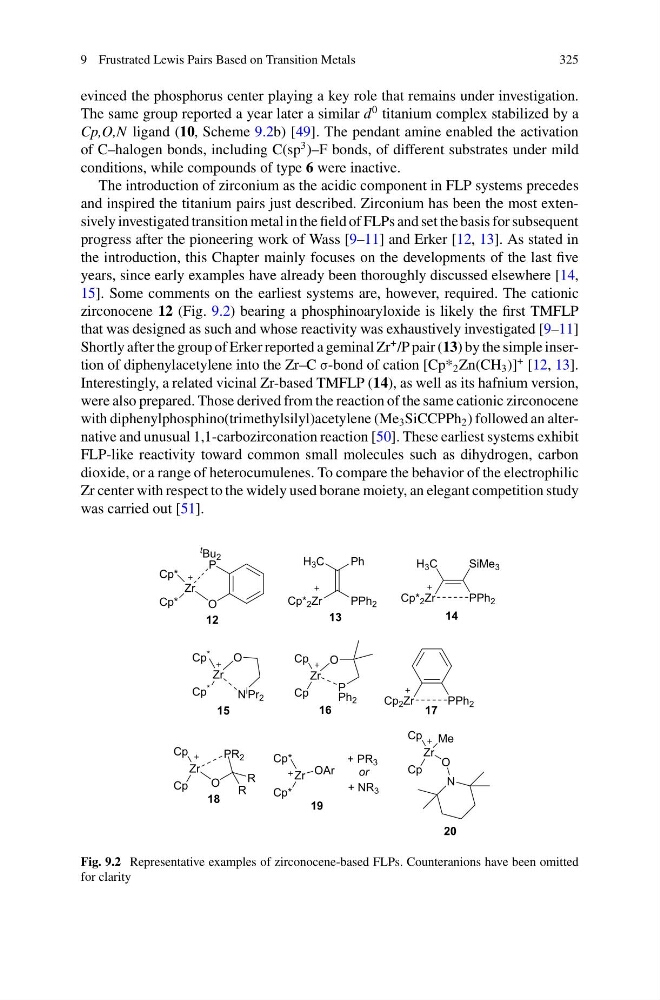
zirconocene 12 (Fig. 9.2) bearing a phosphinoaryloxide is likely the first TMFLP
that was designed as such and whose reactivity was exhaustively investigated [9–11]
Shortly after the group of Erker reported a geminal Zr
+ /P pair (13) by the simple insertion of diphenylacetylene into the Zr–C σ-bond of cation [Cp* 2 Zn(CH 3 )]
+ [12, 13].
Interestingly, a related vicinal Zr-based TMFLP (14), as well as its hafnium version,
were also prepared. Those derived from the reaction of the same cationic zirconocene
with diphenylphosphino(trimethylsilyl)acetylene (Me 3 SiCCPPh 2 ) followed an alternative and unusual 1,1-carbozirconation reaction [50]. These earliest systems exhibit
FLP-like reactivity toward common small molecules such as dihydrogen, carbon
dioxide, or a range of heterocumulenes. To compare the behavior of the electrophilic
Zr center with respect to the widely used borane moiety, an elegant competition study
was carried out [51].
H 3 C
SiMe 3
Cp* 2 Zr
PPh 2
Cp 2 Zr
PPh 2
Cp
Zr
Cp
O
P
Ph 2
Cp
Zr
Cp
Me
O
N
Cp
Zr
Cp
O
PR 2
R
R
+ NR 3
Cp*
Zr
Cp*
OAr
+ PR 3
O
P
Zr
H 3 C
Ph
PPh 2
Cp* 2 Zr
Cp*
Cp*
t Bu 2
12
13
14
Cp
*
Zr
Cp
*
O
N
i Pr 2
15
or
16
18
17
19
20
Fig. 9.2 Representative examples of zirconocene-based FLPs. Counteranions have been omitted
for clarity
325
evinced the phosphorus center playing a key role that remains under investigation.
The same group reported a year later a similar d
0 titanium complex stabilized by a
Cp,O,N ligand (10, Scheme 9.2b) [49]. The pendant amine enabled the activation
of C–halogen bonds, including C(sp
3 )–F bonds, of different substrates under mild
conditions, while compounds of type 6 were inactive.
The introduction of zirconium as the acidic component in FLP systems precedes
and inspired the titanium pairs just described. Zirconium has been the most extensively investigated transition metal in the field of FLPs and set the basis for subsequent
progress after the pioneering work of Wass [9–11] and Erker [12, 13]. As stated in
the introduction, this Chapter mainly focuses on the developments of the last five
years, since early examples have already been thoroughly discussed elsewhere [14,
15]. Some comments on the earliest systems are, however, required. The cationic
zirconocene 12 (Fig. 9.2) bearing a phosphinoaryloxide is likely the first TMFLP
that was designed as such and whose reactivity was exhaustively investigated [9–11]
Shortly after the group of Erker reported a geminal Zr
+ /P pair (13) by the simple insertion of diphenylacetylene into the Zr–C σ-bond of cation [Cp* 2 Zn(CH 3 )]
+ [12, 13].
Interestingly, a related vicinal Zr-based TMFLP (14), as well as its hafnium version,
were also prepared. Those derived from the reaction of the same cationic zirconocene
with diphenylphosphino(trimethylsilyl)acetylene (Me 3 SiCCPPh 2 ) followed an alternative and unusual 1,1-carbozirconation reaction [50]. These earliest systems exhibit
FLP-like reactivity toward common small molecules such as dihydrogen, carbon
dioxide, or a range of heterocumulenes. To compare the behavior of the electrophilic
Zr center with respect to the widely used borane moiety, an elegant competition study
was carried out [51].
H 3 C
SiMe 3
Cp* 2 Zr
PPh 2
Cp 2 Zr
PPh 2
Cp
Zr
Cp
O
P
Ph 2
Cp
Zr
Cp
Me
O
N
Cp
Zr
Cp
O
PR 2
R
R
+ NR 3
Cp*
Zr
Cp*
OAr
+ PR 3
O
P
Zr
H 3 C
Ph
PPh 2
Cp* 2 Zr
Cp*
Cp*
t Bu 2
12
13
14
Cp
*
Zr
Cp
*
O
N
i Pr 2
15
or
16
18
17
19
20
Fig. 9.2 Representative examples of zirconocene-based FLPs. Counteranions have been omitted
for clarity