

320
N. Hidalgo et al.
9.1 Introduction
The concept of ‘frustrated Lewis pair’ (FLP) represented a landmark discovery in
the chemistry of main group elements when Stephan demonstrated in 2006 that the
cooperative action of a phosphine and a borane was capable of the heterolytic cleavage
of dihydrogen [1]. This achievement parallels in time the independent work of Power
[2] and Bertrand [3] on multiply bonded and sub-valent main group compounds
that also accomplished dihydrogen splitting. Altogether, these and related findings
have revolutionized the way by which chemists look at the P-block. It has now
become clear that main group elements can behave as transition metals under certain
conditions, and this also applies to their reactivity toward small molecules [4]. In
fact, the mechanism followed by transition metals, sub-valent and multiply bonded
main group systems, or FLPs to activate small molecules is the result of a precise
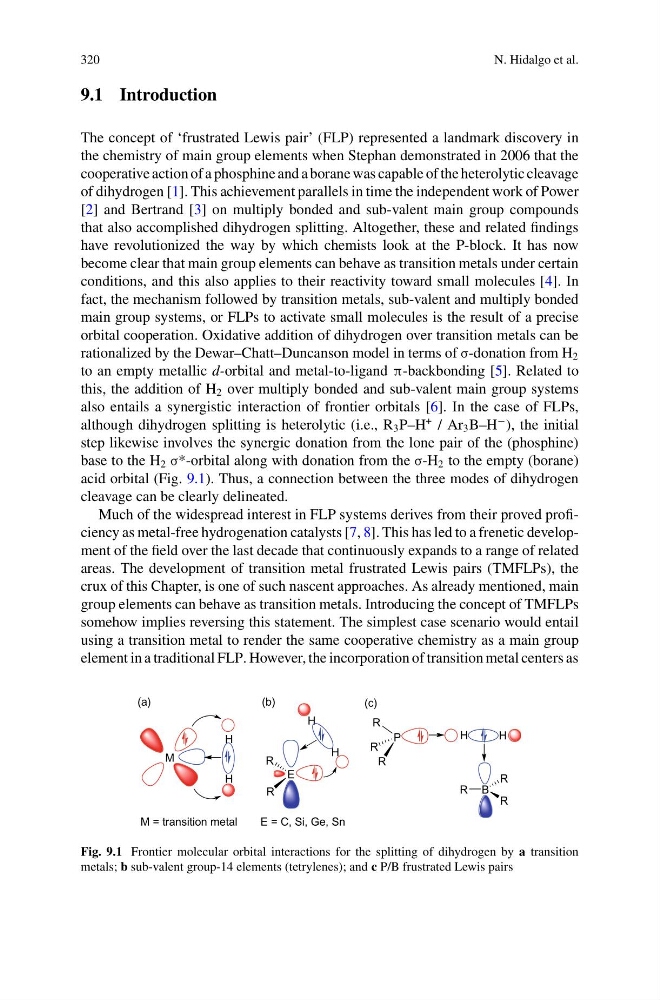
orbital cooperation. Oxidative addition of dihydrogen over transition metals can be
rationalized by the Dewar–Chatt–Duncanson model in terms of σ-donation from H 2
to an empty metallic d-orbital and metal-to-ligand π-backbonding [5]. Related to
this, the addition of H 2 over multiply bonded and sub-valent main group systems
also entails a synergistic interaction of frontier orbitals [6]. In the case of FLPs,
although dihydrogen splitting is heterolytic (i.e., R 3 P–H
+ / Ar 3 B–H
− ), the initial
step likewise involves the synergic donation from the lone pair of the (phosphine)
base to the H 2 σ*-orbital along with donation from the σ-H 2 to the empty (borane)
acid orbital (Fig. 9.1). Thus, a connection between the three modes of dihydrogen
cleavage can be clearly delineated.
Much of the widespread interest in FLP systems derives from their proved proficiency as metal-free hydrogenation catalysts [7, 8]. This has led to a frenetic development of the field over the last decade that continuously expands to a range of related
areas. The development of transition metal frustrated Lewis pairs (TMFLPs), the
crux of this Chapter, is one of such nascent approaches. As already mentioned, main
group elements can behave as transition metals. Introducing the concept of TMFLPs
somehow implies reversing this statement. The simplest case scenario would entail
using a transition metal to render the same cooperative chemistry as a main group
element in a traditional FLP. However, the incorporation of transition metal centers as
M
H
H
E
H
H
R
R
M = transition metal
E = C, Si, Ge, Sn
H
H
P
R
R
R
B
R
R
R
(a)
(b)
(c)
Fig. 9.1 Frontier molecular orbital interactions for the splitting of dihydrogen by a transition
metals; b sub-valent group-14 elements (tetrylenes); and c P/B frustrated Lewis pairs
N. Hidalgo et al.
9.1 Introduction
The concept of ‘frustrated Lewis pair’ (FLP) represented a landmark discovery in
the chemistry of main group elements when Stephan demonstrated in 2006 that the
cooperative action of a phosphine and a borane was capable of the heterolytic cleavage
of dihydrogen [1]. This achievement parallels in time the independent work of Power
[2] and Bertrand [3] on multiply bonded and sub-valent main group compounds
that also accomplished dihydrogen splitting. Altogether, these and related findings
have revolutionized the way by which chemists look at the P-block. It has now
become clear that main group elements can behave as transition metals under certain
conditions, and this also applies to their reactivity toward small molecules [4]. In
fact, the mechanism followed by transition metals, sub-valent and multiply bonded
main group systems, or FLPs to activate small molecules is the result of a precise
orbital cooperation. Oxidative addition of dihydrogen over transition metals can be
rationalized by the Dewar–Chatt–Duncanson model in terms of σ-donation from H 2
to an empty metallic d-orbital and metal-to-ligand π-backbonding [5]. Related to
this, the addition of H 2 over multiply bonded and sub-valent main group systems
also entails a synergistic interaction of frontier orbitals [6]. In the case of FLPs,
although dihydrogen splitting is heterolytic (i.e., R 3 P–H
+ / Ar 3 B–H
− ), the initial
step likewise involves the synergic donation from the lone pair of the (phosphine)
base to the H 2 σ*-orbital along with donation from the σ-H 2 to the empty (borane)
acid orbital (Fig. 9.1). Thus, a connection between the three modes of dihydrogen
cleavage can be clearly delineated.
Much of the widespread interest in FLP systems derives from their proved proficiency as metal-free hydrogenation catalysts [7, 8]. This has led to a frenetic development of the field over the last decade that continuously expands to a range of related
areas. The development of transition metal frustrated Lewis pairs (TMFLPs), the
crux of this Chapter, is one of such nascent approaches. As already mentioned, main
group elements can behave as transition metals. Introducing the concept of TMFLPs
somehow implies reversing this statement. The simplest case scenario would entail
using a transition metal to render the same cooperative chemistry as a main group
element in a traditional FLP. However, the incorporation of transition metal centers as
M
H
H
E
H
H
R
R
M = transition metal
E = C, Si, Ge, Sn
H
H
P
R
R
R
B
R
R
R
(a)
(b)
(c)
Fig. 9.1 Frontier molecular orbital interactions for the splitting of dihydrogen by a transition
metals; b sub-valent group-14 elements (tetrylenes); and c P/B frustrated Lewis pairs