

8 Lewis Acid−Base Pairs for Polymerization Catalysis …
311
N
N
:
N
N
R'
O
ClLi
O
C
N
R
LiCl
C
O
N
R
O
N
O
R'
R
O
LiCl
R'
LiCl
N
N
R'
O
LiCl
N
N
:
O
C
N
R
LiCl
O
LiCl
R'
N
N
C
N
R
O
ClLi
O LiCl
R'
N
N
C
N
R
O
ClLi
OCN
NCO
O
O
O
O
O
O
O
O
HDI
BADGE
BDE
NCO
NCO
OCN
NCO
NCO
OCN
NCO
OCN
TDIH
MDI
H 12 MDI
IPDI
Diisocyanates:
Diepoxides:
O
N
O
R'
R
R
OCN
NCO
R'
O
O
R'
N
O
O
N
O
O
R
n
O
N
O
N
O
O
R'
R'
R
R
N
N
N
O
O
O
R
R
R
4-Oxa
5-Oxa
+
LP
Isocyanurate
N
N
O
O
5u-Me-CO 2
S
O
O
Sulfolane
Sulfolane
a
b
c
d
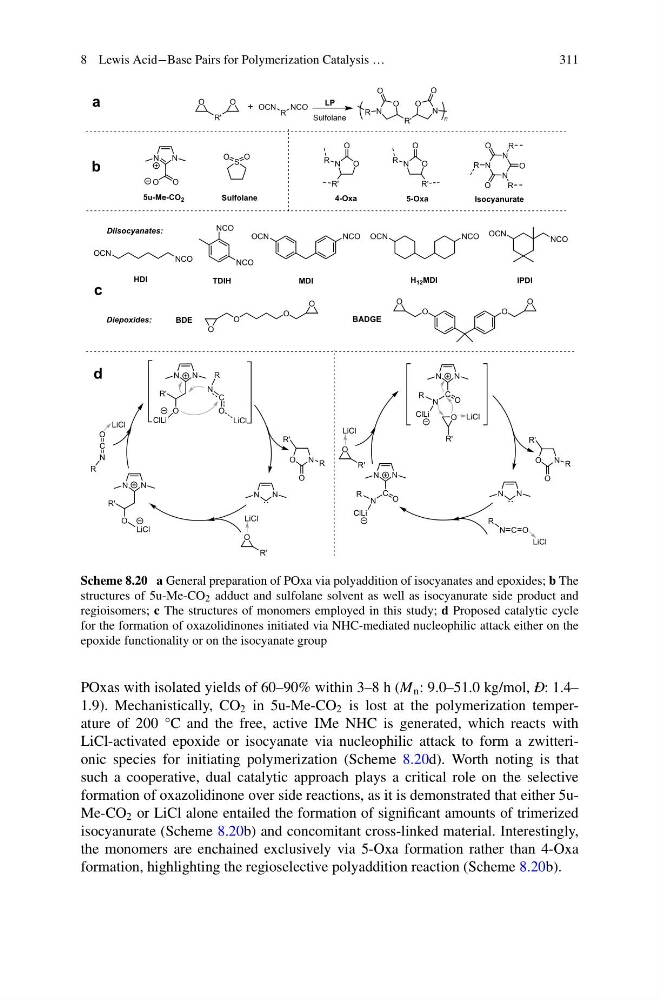
Scheme 8.20 a General preparation of POxa via polyaddition of isocyanates and epoxides; b The
structures of 5u-Me-CO 2 adduct and sulfolane solvent as well as isocyanurate side product and
regioisomers; c The structures of monomers employed in this study; d Proposed catalytic cycle
for the formation of oxazolidinones initiated via NHC-mediated nucleophilic attack either on the
epoxide functionality or on the isocyanate group
POxas with isolated yields of 60–90% within 3–8 h (M n : 9.0–51.0 kg/mol, Ð: 1.4–
1.9). Mechanistically, CO 2 in 5u-Me-CO 2 is lost at the polymerization temperature of 200 °C and the free, active IMe NHC is generated, which reacts with
LiCl-activated epoxide or isocyanate via nucleophilic attack to form a zwitterionic species for initiating polymerization (Scheme 8.20d). Worth noting is that
such a cooperative, dual catalytic approach plays a critical role on the selective
formation of oxazolidinone over side reactions, as it is demonstrated that either 5uMe-CO 2 or LiCl alone entailed the formation of significant amounts of trimerized
isocyanurate (Scheme 8.20b) and concomitant cross-linked material. Interestingly,
the monomers are enchained exclusively via 5-Oxa formation rather than 4-Oxa
formation, highlighting the regioselective polyaddition reaction (Scheme 8.20b).
311
N
N
:
N
N
R'
O
ClLi
O
C
N
R
LiCl
C
O
N
R
O
N
O
R'
R
O
LiCl
R'
LiCl
N
N
R'
O
LiCl
N
N
:
O
C
N
R
LiCl
O
LiCl
R'
N
N
C
N
R
O
ClLi
O LiCl
R'
N
N
C
N
R
O
ClLi
OCN
NCO
O
O
O
O
O
O
O
O
HDI
BADGE
BDE
NCO
NCO
OCN
NCO
NCO
OCN
NCO
OCN
TDIH
MDI
H 12 MDI
IPDI
Diisocyanates:
Diepoxides:
O
N
O
R'
R
R
OCN
NCO
R'
O
O
R'
N
O
O
N
O
O
R
n
O
N
O
N
O
O
R'
R'
R
R
N
N
N
O
O
O
R
R
R
4-Oxa
5-Oxa
+
LP
Isocyanurate
N
N
O
O
5u-Me-CO 2
S
O
O
Sulfolane
Sulfolane
a
b
c
d
Scheme 8.20 a General preparation of POxa via polyaddition of isocyanates and epoxides; b The
structures of 5u-Me-CO 2 adduct and sulfolane solvent as well as isocyanurate side product and
regioisomers; c The structures of monomers employed in this study; d Proposed catalytic cycle
for the formation of oxazolidinones initiated via NHC-mediated nucleophilic attack either on the
epoxide functionality or on the isocyanate group
POxas with isolated yields of 60–90% within 3–8 h (M n : 9.0–51.0 kg/mol, Ð: 1.4–
1.9). Mechanistically, CO 2 in 5u-Me-CO 2 is lost at the polymerization temperature of 200 °C and the free, active IMe NHC is generated, which reacts with
LiCl-activated epoxide or isocyanate via nucleophilic attack to form a zwitterionic species for initiating polymerization (Scheme 8.20d). Worth noting is that
such a cooperative, dual catalytic approach plays a critical role on the selective
formation of oxazolidinone over side reactions, as it is demonstrated that either 5uMe-CO 2 or LiCl alone entailed the formation of significant amounts of trimerized
isocyanurate (Scheme 8.20b) and concomitant cross-linked material. Interestingly,
the monomers are enchained exclusively via 5-Oxa formation rather than 4-Oxa
formation, highlighting the regioselective polyaddition reaction (Scheme 8.20b).