

306
M. Hong
products, water was used as the simple initiator and phosphazene superbase
t BuP 1 was selected as the LB to pair with BEt 3 for ROP of ethylene oxide (EO)
(Schemes 8.15 and 8.16). At a relatively high initiator loading ([EO] 0 :[H 2 O] 0 :[
t BuP 1 ] 0 :[BEt 3 ] 0 = 24000:10:1:3),
t Bu-P 1 /BEt 3 exhibited controlled bulk polymerization toward EO with a predictable M n of 96.6 kg/mol and a low Ð value
of 1.26. Reducing the initiator loading to a very low level ([EO] 0 :[H 2 O] 0 :[
t BuP 1 ] 0 :[BEt 3 ] 0 = 24000:1:1:3) can provide PEOs with high M n up to 632.5 kg/mol
after 7 h polymerization, despite broad MW distribution (Ð = 2.98). The utilization of THF as the solvent rendered more controlled polymerization (Ð = 1.06–
1.12). Importantly, after removal of THF solvent, these unquenched PEO products
are noncytotoxic toward a variety of cell lines regardless of the amount of
t BuP 1 used. A short α-allyl-ω-hydroxyl bifunctional PEO (M n = 1.4 kg/mol, Ð =
1.12) and 4-arm hydroxyl-terminated PEO (M n = 18.8 kg/mol, Ð = 1.15) were
also synthesized in the presence of 2-allyloxyethanol (AOE) and pentaerythritol
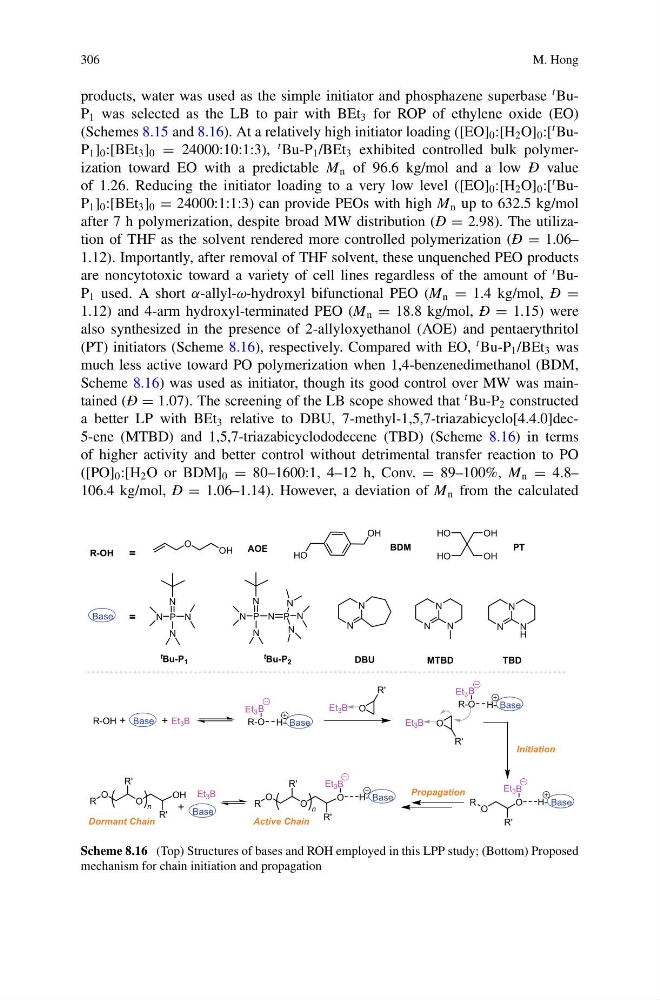
(PT) initiators (Scheme 8.16), respectively. Compared with EO,
t Bu-P 1 /BEt 3 was
much less active toward PO polymerization when 1,4-benzenedimethanol (BDM,
Scheme 8.16) was used as initiator, though its good control over MW was maintained (Ð = 1.07). The screening of the LB scope showed that
t Bu-P 2 constructed
a better LP with BEt 3 relative to DBU, 7-methyl-1,5,7-triazabicyclo[4.4.0]dec5-ene (MTBD) and 1,5,7-triazabicyclododecene (TBD) (Scheme 8.16) in terms
of higher activity and better control without detrimental transfer reaction to PO
([PO] 0 :[H 2 O or BDM] 0 = 80–1600:1, 4–12 h, Conv. = 89–100%, M n = 4.8–
106.4 kg/mol, Ð = 1.06–1.14). However, a deviation of M n from the calculated
Propagation
n
R-OH
Base
Et 3 B
+
R-O
Base
B
Et 3
HO
Et 3 B
R'
R-O
Base
B
Et 3
HO
Et 3 B
R'
Initiation
R O
O
R'
B
Et 3
Base
HEt 3
O
B
Base
HR
O
O
R'
R'
n
OH
Base
R
O
O
R'
R'
Et 3 B
+
+
Active Chain
Dormant Chain
P
N
N
N
N P
N
N
N
P
N
N
N
N
=
t Bu-P 1
t Bu-P 2
Base
N
N
N
N
N
N
N
N
H
DBU
MTBD
TBD
O
OH
HO
OH
OH
HO
OH
HO
R-OH
=
AOE
BDM
PT
Scheme 8.16 (Top) Structures of bases and ROH employed in this LPP study; (Bottom) Proposed
mechanism for chain initiation and propagation
M. Hong
products, water was used as the simple initiator and phosphazene superbase
t BuP 1 was selected as the LB to pair with BEt 3 for ROP of ethylene oxide (EO)
(Schemes 8.15 and 8.16). At a relatively high initiator loading ([EO] 0 :[H 2 O] 0 :[
t BuP 1 ] 0 :[BEt 3 ] 0 = 24000:10:1:3),
t Bu-P 1 /BEt 3 exhibited controlled bulk polymerization toward EO with a predictable M n of 96.6 kg/mol and a low Ð value
of 1.26. Reducing the initiator loading to a very low level ([EO] 0 :[H 2 O] 0 :[
t BuP 1 ] 0 :[BEt 3 ] 0 = 24000:1:1:3) can provide PEOs with high M n up to 632.5 kg/mol
after 7 h polymerization, despite broad MW distribution (Ð = 2.98). The utilization of THF as the solvent rendered more controlled polymerization (Ð = 1.06–
1.12). Importantly, after removal of THF solvent, these unquenched PEO products
are noncytotoxic toward a variety of cell lines regardless of the amount of
t BuP 1 used. A short α-allyl-ω-hydroxyl bifunctional PEO (M n = 1.4 kg/mol, Ð =
1.12) and 4-arm hydroxyl-terminated PEO (M n = 18.8 kg/mol, Ð = 1.15) were
also synthesized in the presence of 2-allyloxyethanol (AOE) and pentaerythritol
(PT) initiators (Scheme 8.16), respectively. Compared with EO,
t Bu-P 1 /BEt 3 was
much less active toward PO polymerization when 1,4-benzenedimethanol (BDM,
Scheme 8.16) was used as initiator, though its good control over MW was maintained (Ð = 1.07). The screening of the LB scope showed that
t Bu-P 2 constructed
a better LP with BEt 3 relative to DBU, 7-methyl-1,5,7-triazabicyclo[4.4.0]dec5-ene (MTBD) and 1,5,7-triazabicyclododecene (TBD) (Scheme 8.16) in terms
of higher activity and better control without detrimental transfer reaction to PO
([PO] 0 :[H 2 O or BDM] 0 = 80–1600:1, 4–12 h, Conv. = 89–100%, M n = 4.8–
106.4 kg/mol, Ð = 1.06–1.14). However, a deviation of M n from the calculated
Propagation
n
R-OH
Base
Et 3 B
+
R-O
Base
B
Et 3
HO
Et 3 B
R'
R-O
Base
B
Et 3
HO
Et 3 B
R'
Initiation
R O
O
R'
B
Et 3
Base
HEt 3
O
B
Base
HR
O
O
R'
R'
n
OH
Base
R
O
O
R'
R'
Et 3 B
+
+
Active Chain
Dormant Chain
P
N
N
N
N P
N
N
N
P
N
N
N
N
=
t Bu-P 1
t Bu-P 2
Base
N
N
N
N
N
N
N
N
H
DBU
MTBD
TBD
O
OH
HO
OH
OH
HO
OH
HO
R-OH
=
AOE
BDM
PT
Scheme 8.16 (Top) Structures of bases and ROH employed in this LPP study; (Bottom) Proposed
mechanism for chain initiation and propagation