

8 Lewis Acid−Base Pairs for Polymerization Catalysis …
305
Initiation
O
O
O
O
O
O
R'
=
EO
PO
BO
TBGE
O
O
Ph
SO
CHO
N
N
N
N
N
N
NHO-9
NHO-10
NHO-11
N
N
O
Mg(HMDS) 2
N
N
Mg
N
N
Me 3 Si
SiMe 3
SiMe 3
SiMe 3
+
N
N
Mg
N
N
Me 3 Si
SiMe 3
SiMe 3
SiMe 3
O
N
N
O
N
N
O
Mg(HMDS) 2
Propagation
O Mg(HMDS) 2
O
O
O
H
O
OH
O
M
M
+
O
O
NBGE
O
O
AGE
O
ECH
Cl
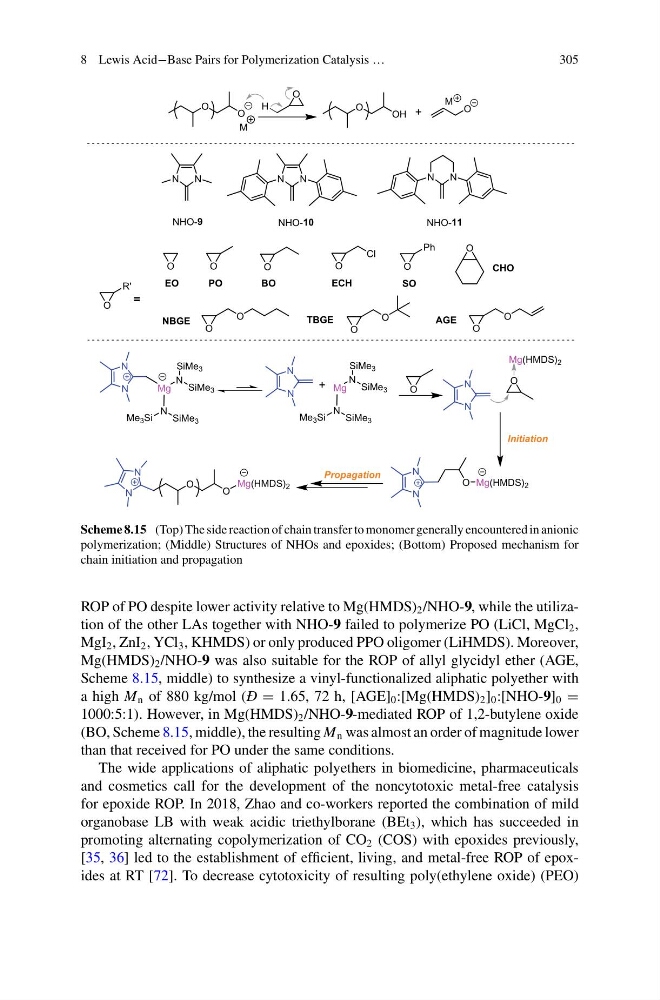
Scheme 8.15 (Top) The side reaction of chain transfer to monomer generally encountered in anionic
polymerization; (Middle) Structures of NHOs and epoxides; (Bottom) Proposed mechanism for
chain initiation and propagation
ROP of PO despite lower activity relative to Mg(HMDS) 2 /NHO-9, while the utilization of the other LAs together with NHO-9 failed to polymerize PO (LiCl, MgCl 2 ,
MgI 2 , ZnI 2 , YCl 3 , KHMDS) or only produced PPO oligomer (LiHMDS). Moreover,
Mg(HMDS) 2 /NHO-9 was also suitable for the ROP of allyl glycidyl ether (AGE,
Scheme 8.15, middle) to synthesize a vinyl-functionalized aliphatic polyether with
a high M n of 880 kg/mol (Ð = 1.65, 72 h, [AGE] 0 :[Mg(HMDS) 2 ] 0 :[NHO-9] 0 =
1000:5:1). However, in Mg(HMDS) 2 /NHO-9-mediated ROP of 1,2-butylene oxide
(BO, Scheme 8.15, middle), the resulting M n was almost an order of magnitude lower
than that received for PO under the same conditions.
The wide applications of aliphatic polyethers in biomedicine, pharmaceuticals
and cosmetics call for the development of the noncytotoxic metal-free catalysis
for epoxide ROP. In 2018, Zhao and co-workers reported the combination of mild
organobase LB with weak acidic triethylborane (BEt 3 ), which has succeeded in
promoting alternating copolymerization of CO 2 (COS) with epoxides previously,
[35, 36] led to the establishment of efficient, living, and metal-free ROP of epoxides at RT [72]. To decrease cytotoxicity of resulting poly(ethylene oxide) (PEO)
305
Initiation
O
O
O
O
O
O
R'
=
EO
PO
BO
TBGE
O
O
Ph
SO
CHO
N
N
N
N
N
N
NHO-9
NHO-10
NHO-11
N
N
O
Mg(HMDS) 2
N
N
Mg
N
N
Me 3 Si
SiMe 3
SiMe 3
SiMe 3
+
N
N
Mg
N
N
Me 3 Si
SiMe 3
SiMe 3
SiMe 3
O
N
N
O
N
N
O
Mg(HMDS) 2
Propagation
O Mg(HMDS) 2
O
O
O
H
O
OH
O
M
M
+
O
O
NBGE
O
O
AGE
O
ECH
Cl
Scheme 8.15 (Top) The side reaction of chain transfer to monomer generally encountered in anionic
polymerization; (Middle) Structures of NHOs and epoxides; (Bottom) Proposed mechanism for
chain initiation and propagation
ROP of PO despite lower activity relative to Mg(HMDS) 2 /NHO-9, while the utilization of the other LAs together with NHO-9 failed to polymerize PO (LiCl, MgCl 2 ,
MgI 2 , ZnI 2 , YCl 3 , KHMDS) or only produced PPO oligomer (LiHMDS). Moreover,
Mg(HMDS) 2 /NHO-9 was also suitable for the ROP of allyl glycidyl ether (AGE,
Scheme 8.15, middle) to synthesize a vinyl-functionalized aliphatic polyether with
a high M n of 880 kg/mol (Ð = 1.65, 72 h, [AGE] 0 :[Mg(HMDS) 2 ] 0 :[NHO-9] 0 =
1000:5:1). However, in Mg(HMDS) 2 /NHO-9-mediated ROP of 1,2-butylene oxide
(BO, Scheme 8.15, middle), the resulting M n was almost an order of magnitude lower
than that received for PO under the same conditions.
The wide applications of aliphatic polyethers in biomedicine, pharmaceuticals
and cosmetics call for the development of the noncytotoxic metal-free catalysis
for epoxide ROP. In 2018, Zhao and co-workers reported the combination of mild
organobase LB with weak acidic triethylborane (BEt 3 ), which has succeeded in
promoting alternating copolymerization of CO 2 (COS) with epoxides previously,
[35, 36] led to the establishment of efficient, living, and metal-free ROP of epoxides at RT [72]. To decrease cytotoxicity of resulting poly(ethylene oxide) (PEO)