

294
M. Hong
monomer conversion can be accomplished by this LP catalyst within 60–180 min,
affording UHMW SFPMAs with very low Ðs (PHFBMA: M n = 1300 kg/mol, Ð
= 1.03, I
*
= 87.0%; PTFEMA: M n = 919.2 kg/mol, Ð = 1.05, I
*
= 82.2%). The
livingness of MeAl(BHT) 2 /I
t Bu-mediated polymerizations of HFBMA or TFEMA
at RT has been unequivocally established, which relies on the fast chain initiation
without induction period, the stability of imidazolium enolaluminate active species,
and complete suppression of detrimental side reaction [e.g., proton abstraction of
–C(H)F– group by LB]. Despite the fact that NHO-3/MeAl(BHT) 2 FLP has proven
to promote a living polymerization of MMA with high to quantitative I
* value, [28]
the activity and I
* value of HFBMA polymerization by such LP catalytic system
were about one half of that by I
t Bu/MeAl(BHT) 2 , which is presumably caused by
the instability of NHO-3 in HFBMA monomer. Noteworthily, at –78 °C, the polymerization of TFEMA by MeAl(BHT) 2 /I
t Bu not only showed good control over
the MW (M n = 46.7 kg/mol, Ð = 1.16), but was also highly syndiospecific ([rr]
= 92.0%). The resulting highly syndioregular PTFEMA (st-PTFEMA) can readily
form supramolecular stereocomplex with isotactic poly(methyl methacrylate) (itPMMA), thus converting amorphous st-PTFEMA (glass transition temperature: T g
= 85.2 °C) and it-PMMA (T g = 59.8 °C) into a robust fluorinated crystalline material
with a high melting temperature (T m ) up to 175 °C (Scheme 8.6, top).
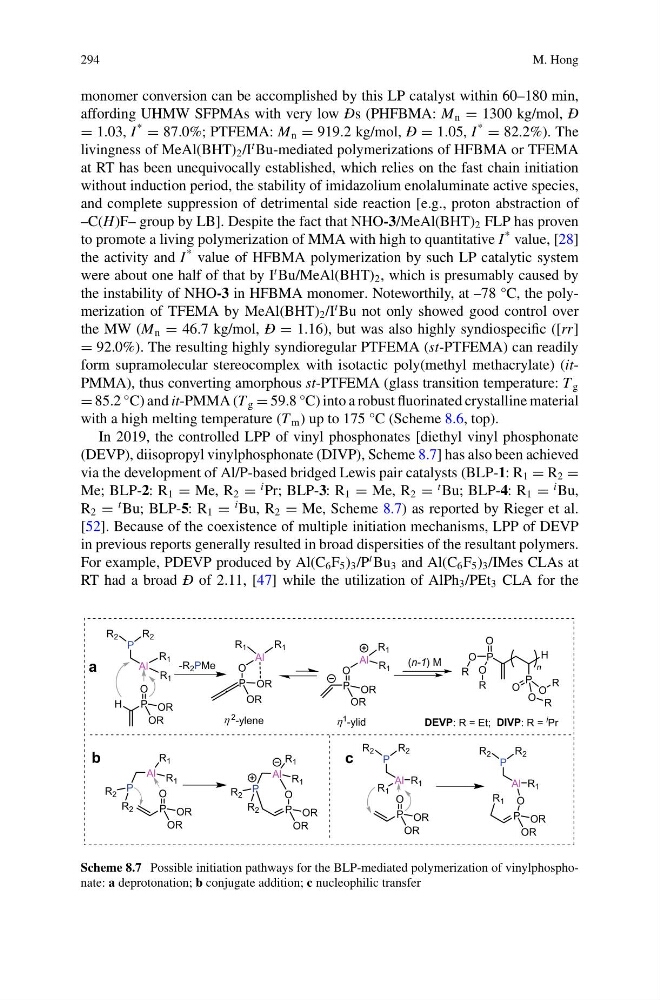
In 2019, the controlled LPP of vinyl phosphonates [diethyl vinyl phosphonate
(DEVP), diisopropyl vinylphosphonate (DIVP), Scheme 8.7] has also been achieved
via the development of Al/P-based bridged Lewis pair catalysts (BLP-1: R 1 = R 2 =
Me; BLP-2: R 1 = Me, R 2 =
i Pr; BLP-3: R 1 = Me, R 2 =
t Bu; BLP-4: R 1 =
i Bu,
R 2 =
t Bu; BLP-5: R 1 =
i Bu, R 2 = Me, Scheme 8.7) as reported by Rieger et al.
[52]. Because of the coexistence of multiple initiation mechanisms, LPP of DEVP
in previous reports generally resulted in broad dispersities of the resultant polymers.
For example, PDEVP produced by Al(C 6 F 5 ) 3 /P
t Bu 3 and Al(C 6 F 5 ) 3 /IMes CLAs at
RT had a broad Ð of 2.11, [47] while the utilization of AlPh 3 /PEt 3 CLA for the
P
Al
R 2
R 2
R 1
R 1
H
P OR
O
OR
-R 2 PMe
P OR
OR
.
O
Al
R 1
R 1
P OR
OR
O
Al
R 1
R 1
(n-1) M
P
H
n
O
O
O
R
R
P
O
O
R
R
O
2 -ylene
1 -ylid
P OR
O
OR
Al
P
R 1
R 1
R 2
R 2
P OR
O
OR
Al
P
R 1
R 1
R 2
R 2
P
Al
R 2
R 2
R 1
R 1
P OR
O
OR
P
Al
R 2
R 2
R 1
R 1
P OR
O
OR
a
b
c
DEVP: R = Et; DIVP: R =
i Pr
Scheme 8.7 Possible initiation pathways for the BLP-mediated polymerization of vinylphosphonate: a deprotonation; b conjugate addition; c nucleophilic transfer
M. Hong
monomer conversion can be accomplished by this LP catalyst within 60–180 min,
affording UHMW SFPMAs with very low Ðs (PHFBMA: M n = 1300 kg/mol, Ð
= 1.03, I
*
= 87.0%; PTFEMA: M n = 919.2 kg/mol, Ð = 1.05, I
*
= 82.2%). The
livingness of MeAl(BHT) 2 /I
t Bu-mediated polymerizations of HFBMA or TFEMA
at RT has been unequivocally established, which relies on the fast chain initiation
without induction period, the stability of imidazolium enolaluminate active species,
and complete suppression of detrimental side reaction [e.g., proton abstraction of
–C(H)F– group by LB]. Despite the fact that NHO-3/MeAl(BHT) 2 FLP has proven
to promote a living polymerization of MMA with high to quantitative I
* value, [28]
the activity and I
* value of HFBMA polymerization by such LP catalytic system
were about one half of that by I
t Bu/MeAl(BHT) 2 , which is presumably caused by
the instability of NHO-3 in HFBMA monomer. Noteworthily, at –78 °C, the polymerization of TFEMA by MeAl(BHT) 2 /I
t Bu not only showed good control over
the MW (M n = 46.7 kg/mol, Ð = 1.16), but was also highly syndiospecific ([rr]
= 92.0%). The resulting highly syndioregular PTFEMA (st-PTFEMA) can readily
form supramolecular stereocomplex with isotactic poly(methyl methacrylate) (itPMMA), thus converting amorphous st-PTFEMA (glass transition temperature: T g
= 85.2 °C) and it-PMMA (T g = 59.8 °C) into a robust fluorinated crystalline material
with a high melting temperature (T m ) up to 175 °C (Scheme 8.6, top).
In 2019, the controlled LPP of vinyl phosphonates [diethyl vinyl phosphonate
(DEVP), diisopropyl vinylphosphonate (DIVP), Scheme 8.7] has also been achieved
via the development of Al/P-based bridged Lewis pair catalysts (BLP-1: R 1 = R 2 =
Me; BLP-2: R 1 = Me, R 2 =
i Pr; BLP-3: R 1 = Me, R 2 =
t Bu; BLP-4: R 1 =
i Bu,
R 2 =
t Bu; BLP-5: R 1 =
i Bu, R 2 = Me, Scheme 8.7) as reported by Rieger et al.
[52]. Because of the coexistence of multiple initiation mechanisms, LPP of DEVP
in previous reports generally resulted in broad dispersities of the resultant polymers.
For example, PDEVP produced by Al(C 6 F 5 ) 3 /P
t Bu 3 and Al(C 6 F 5 ) 3 /IMes CLAs at
RT had a broad Ð of 2.11, [47] while the utilization of AlPh 3 /PEt 3 CLA for the
P
Al
R 2
R 2
R 1
R 1
H
P OR
O
OR
-R 2 PMe
P OR
OR
.
O
Al
R 1
R 1
P OR
OR
O
Al
R 1
R 1
(n-1) M
P
H
n
O
O
O
R
R
P
O
O
R
R
O
2 -ylene
1 -ylid
P OR
O
OR
Al
P
R 1
R 1
R 2
R 2
P OR
O
OR
Al
P
R 1
R 1
R 2
R 2
P
Al
R 2
R 2
R 1
R 1
P OR
O
OR
P
Al
R 2
R 2
R 1
R 1
P OR
O
OR
a
b
c
DEVP: R = Et; DIVP: R =
i Pr
Scheme 8.7 Possible initiation pathways for the BLP-mediated polymerization of vinylphosphonate: a deprotonation; b conjugate addition; c nucleophilic transfer