

8 Lewis Acid−Base Pairs for Polymerization Catalysis …
293
well-defined diblock and triblock copolymers with narrow Ð values were thereby
successfully synthesized through the sequential addition method regardless of the
monomer addition order. In contrast, fixing NHO-1 as an LB, the utilization of
superacidic and sterically encumbered Al(C 6 F 5 ) 3 led to a rapid polymerization with
a high I
* value (TOF = 96000 h
−1 , M n = 101 kg/mol, Ð = 1.08, I
*
= 78%) but
it was not a living process due to the existence of backbiting termination, while the
employment of the most sterically encumbered but less acidic MeAl(BHT) 2 [relative
to Al(C 6 F 5 ) 3 ] as an LA resulted in a slow (TOF = 80 h
−1 ) and uncontrolled LPP by
producing polymers with a bimodal distribution.
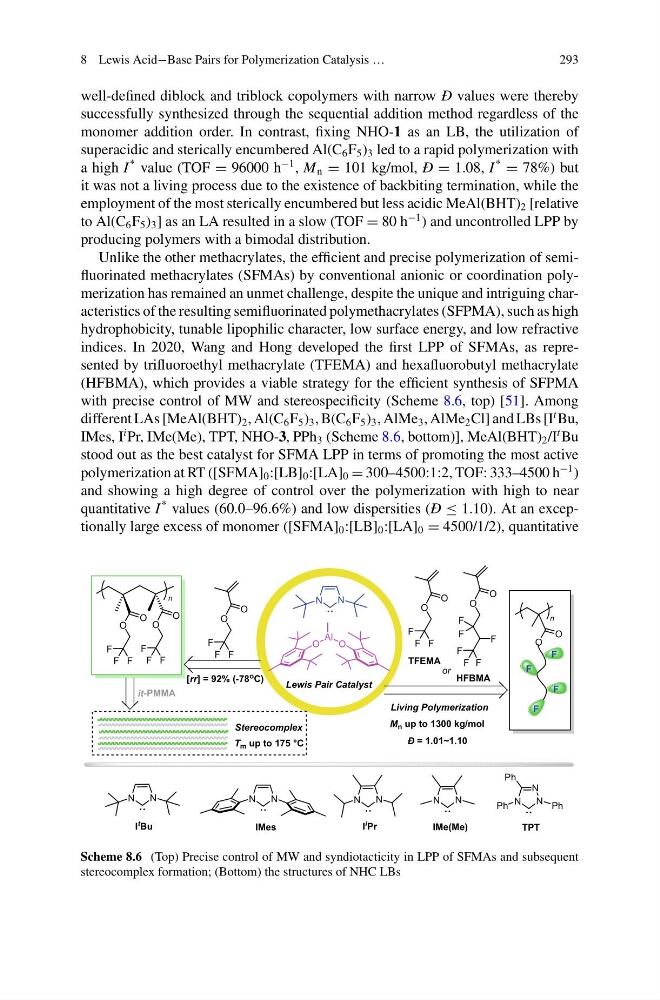
Unlike the other methacrylates, the efficient and precise polymerization of semifluorinated methacrylates (SFMAs) by conventional anionic or coordination polymerization has remained an unmet challenge, despite the unique and intriguing characteristics of the resulting semifluorinated polymethacrylates (SFPMA), such as high
hydrophobicity, tunable lipophilic character, low surface energy, and low refractive
indices. In 2020, Wang and Hong developed the first LPP of SFMAs, as represented by trifluoroethyl methacrylate (TFEMA) and hexafluorobutyl methacrylate
(HFBMA), which provides a viable strategy for the efficient synthesis of SFPMA
with precise control of MW and stereospecificity (Scheme 8.6, top) [51]. Among
different LAs [MeAl(BHT) 2 , Al(C 6 F 5 ) 3 , B(C 6 F 5 ) 3 , AlMe 3 , AlMe 2 Cl] and LBs [I
t Bu,
IMes, I
i Pr, IMe(Me), TPT, NHO-3, PPh 3 (Scheme 8.6, bottom)], MeAl(BHT) 2 /I
t Bu
stood out as the best catalyst for SFMA LPP in terms of promoting the most active
polymerization at RT ([SFMA] 0 :[LB] 0 :[LA] 0 = 300–4500:1:2, TOF: 333–4500 h
−1 )
and showing a high degree of control over the polymerization with high to near
quantitative I
* values (60.0–96.6%) and low dispersities (Ð ≤ 1.10). At an exceptionally large excess of monomer ([SFMA] 0 :[LB] 0 :[LA] 0 = 4500/1/2), quantitative
T m up to 175 °C
Lewis Pair Catalyst
O
O
n
F
F
F
F
O
O
O
F
F
F
O
O
F
F
F
O
F
F
F
n
Living Polymerization
it-PMMA
M n up to 1300 kg/mol
Ð = 1.01~1.10
Stereocomplex
[rr] = 92% (-78
o C)
Al O
O
N
N
O
O
F
F
F
O
O
F
F
F
F
F F
TFEMA
HFBMA
or
N
N
IMes
N
N
N
Ph
Ph
Ph
TPT
N
N
N
N
I
t Bu
I
i Pr
N
N
IMe(Me)
Scheme 8.6 (Top) Precise control of MW and syndiotacticity in LPP of SFMAs and subsequent
stereocomplex formation; (Bottom) the structures of NHC LBs
293
well-defined diblock and triblock copolymers with narrow Ð values were thereby
successfully synthesized through the sequential addition method regardless of the
monomer addition order. In contrast, fixing NHO-1 as an LB, the utilization of
superacidic and sterically encumbered Al(C 6 F 5 ) 3 led to a rapid polymerization with
a high I
* value (TOF = 96000 h
−1 , M n = 101 kg/mol, Ð = 1.08, I
*
= 78%) but
it was not a living process due to the existence of backbiting termination, while the
employment of the most sterically encumbered but less acidic MeAl(BHT) 2 [relative
to Al(C 6 F 5 ) 3 ] as an LA resulted in a slow (TOF = 80 h
−1 ) and uncontrolled LPP by
producing polymers with a bimodal distribution.
Unlike the other methacrylates, the efficient and precise polymerization of semifluorinated methacrylates (SFMAs) by conventional anionic or coordination polymerization has remained an unmet challenge, despite the unique and intriguing characteristics of the resulting semifluorinated polymethacrylates (SFPMA), such as high
hydrophobicity, tunable lipophilic character, low surface energy, and low refractive
indices. In 2020, Wang and Hong developed the first LPP of SFMAs, as represented by trifluoroethyl methacrylate (TFEMA) and hexafluorobutyl methacrylate
(HFBMA), which provides a viable strategy for the efficient synthesis of SFPMA
with precise control of MW and stereospecificity (Scheme 8.6, top) [51]. Among
different LAs [MeAl(BHT) 2 , Al(C 6 F 5 ) 3 , B(C 6 F 5 ) 3 , AlMe 3 , AlMe 2 Cl] and LBs [I
t Bu,
IMes, I
i Pr, IMe(Me), TPT, NHO-3, PPh 3 (Scheme 8.6, bottom)], MeAl(BHT) 2 /I
t Bu
stood out as the best catalyst for SFMA LPP in terms of promoting the most active
polymerization at RT ([SFMA] 0 :[LB] 0 :[LA] 0 = 300–4500:1:2, TOF: 333–4500 h
−1 )
and showing a high degree of control over the polymerization with high to near
quantitative I
* values (60.0–96.6%) and low dispersities (Ð ≤ 1.10). At an exceptionally large excess of monomer ([SFMA] 0 :[LB] 0 :[LA] 0 = 4500/1/2), quantitative
T m up to 175 °C
Lewis Pair Catalyst
O
O
n
F
F
F
F
O
O
O
F
F
F
O
O
F
F
F
O
F
F
F
n
Living Polymerization
it-PMMA
M n up to 1300 kg/mol
Ð = 1.01~1.10
Stereocomplex
[rr] = 92% (-78
o C)
Al O
O
N
N
O
O
F
F
F
O
O
F
F
F
F
F F
TFEMA
HFBMA
or
N
N
IMes
N
N
N
Ph
Ph
Ph
TPT
N
N
N
N
I
t Bu
I
i Pr
N
N
IMe(Me)
Scheme 8.6 (Top) Precise control of MW and syndiotacticity in LPP of SFMAs and subsequent
stereocomplex formation; (Bottom) the structures of NHC LBs