

260
A. R. Jupp
a)
b)
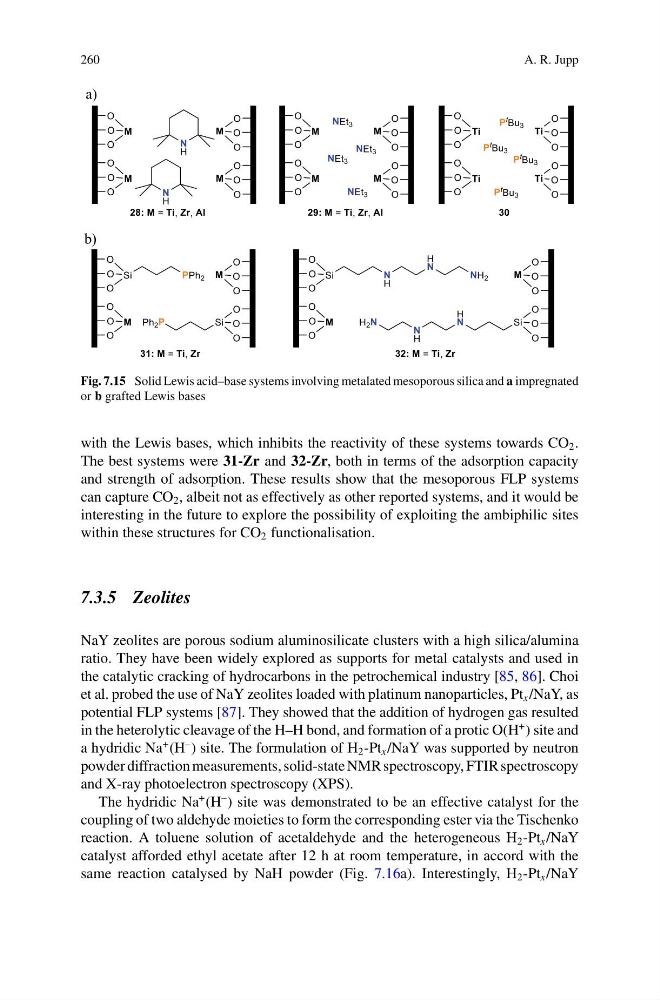
Fig. 7.15 Solid Lewis acid–base systems involving metalated mesoporous silica and a impregnated
or b grafted Lewis bases
with the Lewis bases, which inhibits the reactivity of these systems towards CO 2 .
The best systems were 31-Zr and 32-Zr, both in terms of the adsorption capacity
and strength of adsorption. These results show that the mesoporous FLP systems
can capture CO 2 , albeit not as effectively as other reported systems, and it would be
interesting in the future to explore the possibility of exploiting the ambiphilic sites
within these structures for CO 2 functionalisation.
7.3.5 Zeolites
NaY zeolites are porous sodium aluminosilicate clusters with a high silica/alumina
ratio. They have been widely explored as supports for metal catalysts and used in
the catalytic cracking of hydrocarbons in the petrochemical industry [85, 86]. Choi
et al. probed the use of NaY zeolites loaded with platinum nanoparticles, Pt x /NaY, as
potential FLP systems [87]. They showed that the addition of hydrogen gas resulted
in the heterolytic cleavage of the H–H bond, and formation of a protic O(H
+ ) site and
a hydridic Na
+ (H
– ) site. The formulation of H 2 -Pt x /NaY was supported by neutron
powder diffraction measurements, solid-state NMR spectroscopy, FTIR spectroscopy
and X-ray photoelectron spectroscopy (XPS).
The hydridic Na
+ (H
– ) site was demonstrated to be an effective catalyst for the
coupling of two aldehyde moieties to form the corresponding ester via the Tischenko
reaction. A toluene solution of acetaldehyde and the heterogeneous H 2 -Pt x /NaY
catalyst afforded ethyl acetate after 12 h at room temperature, in accord with the
same reaction catalysed by NaH powder (Fig. 7.16a). Interestingly, H 2 -Pt x /NaY
A. R. Jupp
a)
b)
Fig. 7.15 Solid Lewis acid–base systems involving metalated mesoporous silica and a impregnated
or b grafted Lewis bases
with the Lewis bases, which inhibits the reactivity of these systems towards CO 2 .
The best systems were 31-Zr and 32-Zr, both in terms of the adsorption capacity
and strength of adsorption. These results show that the mesoporous FLP systems
can capture CO 2 , albeit not as effectively as other reported systems, and it would be
interesting in the future to explore the possibility of exploiting the ambiphilic sites
within these structures for CO 2 functionalisation.
7.3.5 Zeolites
NaY zeolites are porous sodium aluminosilicate clusters with a high silica/alumina
ratio. They have been widely explored as supports for metal catalysts and used in
the catalytic cracking of hydrocarbons in the petrochemical industry [85, 86]. Choi
et al. probed the use of NaY zeolites loaded with platinum nanoparticles, Pt x /NaY, as
potential FLP systems [87]. They showed that the addition of hydrogen gas resulted
in the heterolytic cleavage of the H–H bond, and formation of a protic O(H
+ ) site and
a hydridic Na
+ (H
– ) site. The formulation of H 2 -Pt x /NaY was supported by neutron
powder diffraction measurements, solid-state NMR spectroscopy, FTIR spectroscopy
and X-ray photoelectron spectroscopy (XPS).
The hydridic Na
+ (H
– ) site was demonstrated to be an effective catalyst for the
coupling of two aldehyde moieties to form the corresponding ester via the Tischenko
reaction. A toluene solution of acetaldehyde and the heterogeneous H 2 -Pt x /NaY
catalyst afforded ethyl acetate after 12 h at room temperature, in accord with the
same reaction catalysed by NaH powder (Fig. 7.16a). Interestingly, H 2 -Pt x /NaY