

252
A. R. Jupp
further optimisation is required to increase the catalytic activity to be competitive
with the homogeneous systems.
7.3.2 Solid Lewis Acid and Base
A lot of bulky Lewis acids and bases used in FLP chemistry are solids at ambient
temperatures and pressures, which are then normally dissolved in a suitable solvent
for homogeneous reactivity. Erker et al. took an innovative approach to exploring
heterogeneous catalysis by exploring the reactivity of solid acids and bases without
any solvent [67]. This is beneficial as certain combinations of acids and bases can react
with each other in solution, and be deactivated for further chemistry. For example,
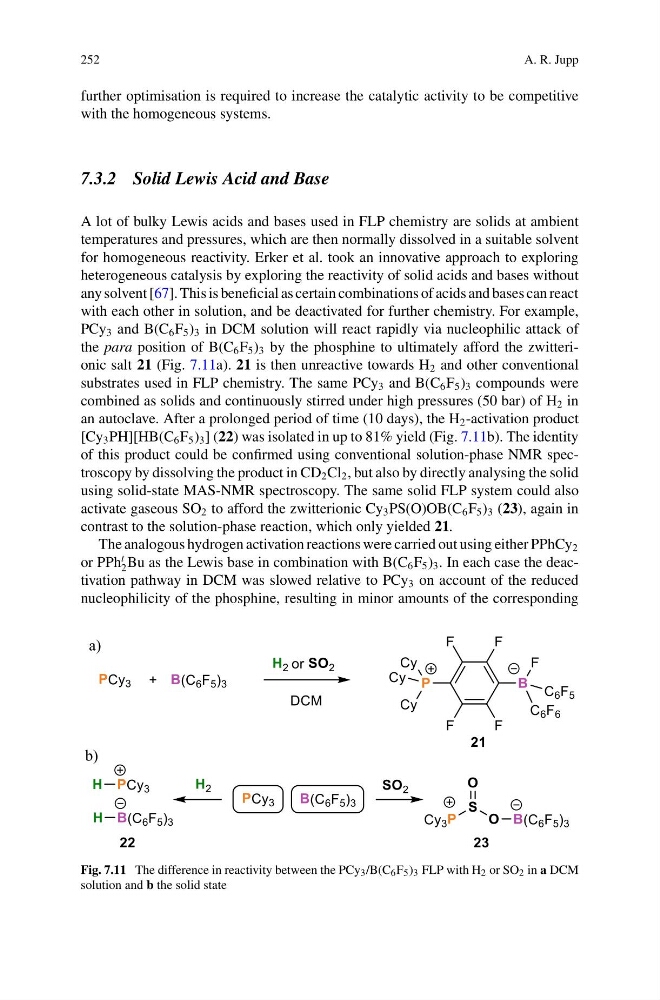
PCy 3 and B(C 6 F 5 ) 3 in DCM solution will react rapidly via nucleophilic attack of
the para position of B(C 6 F 5 ) 3 by the phosphine to ultimately afford the zwitterionic salt 21 (Fig. 7.11a). 21 is then unreactive towards H 2 and other conventional
substrates used in FLP chemistry. The same PCy 3 and B(C 6 F 5 ) 3 compounds were
combined as solids and continuously stirred under high pressures (50 bar) of H 2 in
an autoclave. After a prolonged period of time (10 days), the H 2 -activation product
[Cy 3 PH][HB(C 6 F 5 ) 3 ] (22) was isolated in up to 81% yield (Fig. 7.11b). The identity
of this product could be confirmed using conventional solution-phase NMR spectroscopy by dissolving the product in CD 2 Cl 2 , but also by directly analysing the solid
using solid-state MAS-NMR spectroscopy. The same solid FLP system could also
activate gaseous SO 2 to afford the zwitterionic Cy 3 PS(O)OB(C 6 F 5 ) 3 (23), again in
contrast to the solution-phase reaction, which only yielded 21.
The analogous hydrogen activation reactions were carried out using either PPhCy 2
or PPh
t
2 Bu as the Lewis base in combination with B(C 6 F 5 ) 3 . In each case the deactivation pathway in DCM was slowed relative to PCy 3 on account of the reduced
nucleophilicity of the phosphine, resulting in minor amounts of the corresponding
a)
b)
Fig. 7.11 The difference in reactivity between the PCy 3 /B(C 6 F 5 ) 3 FLP with H 2 or SO 2 in a DCM
solution and b the solid state
A. R. Jupp
further optimisation is required to increase the catalytic activity to be competitive
with the homogeneous systems.
7.3.2 Solid Lewis Acid and Base
A lot of bulky Lewis acids and bases used in FLP chemistry are solids at ambient
temperatures and pressures, which are then normally dissolved in a suitable solvent
for homogeneous reactivity. Erker et al. took an innovative approach to exploring
heterogeneous catalysis by exploring the reactivity of solid acids and bases without
any solvent [67]. This is beneficial as certain combinations of acids and bases can react
with each other in solution, and be deactivated for further chemistry. For example,
PCy 3 and B(C 6 F 5 ) 3 in DCM solution will react rapidly via nucleophilic attack of
the para position of B(C 6 F 5 ) 3 by the phosphine to ultimately afford the zwitterionic salt 21 (Fig. 7.11a). 21 is then unreactive towards H 2 and other conventional
substrates used in FLP chemistry. The same PCy 3 and B(C 6 F 5 ) 3 compounds were
combined as solids and continuously stirred under high pressures (50 bar) of H 2 in
an autoclave. After a prolonged period of time (10 days), the H 2 -activation product
[Cy 3 PH][HB(C 6 F 5 ) 3 ] (22) was isolated in up to 81% yield (Fig. 7.11b). The identity
of this product could be confirmed using conventional solution-phase NMR spectroscopy by dissolving the product in CD 2 Cl 2 , but also by directly analysing the solid
using solid-state MAS-NMR spectroscopy. The same solid FLP system could also
activate gaseous SO 2 to afford the zwitterionic Cy 3 PS(O)OB(C 6 F 5 ) 3 (23), again in
contrast to the solution-phase reaction, which only yielded 21.
The analogous hydrogen activation reactions were carried out using either PPhCy 2
or PPh
t
2 Bu as the Lewis base in combination with B(C 6 F 5 ) 3 . In each case the deactivation pathway in DCM was slowed relative to PCy 3 on account of the reduced
nucleophilicity of the phosphine, resulting in minor amounts of the corresponding
a)
b)
Fig. 7.11 The difference in reactivity between the PCy 3 /B(C 6 F 5 ) 3 FLP with H 2 or SO 2 in a DCM
solution and b the solid state