

7 Heterogeneous Catalysis by Frustrated Lewis Pairs
251
a)
b)
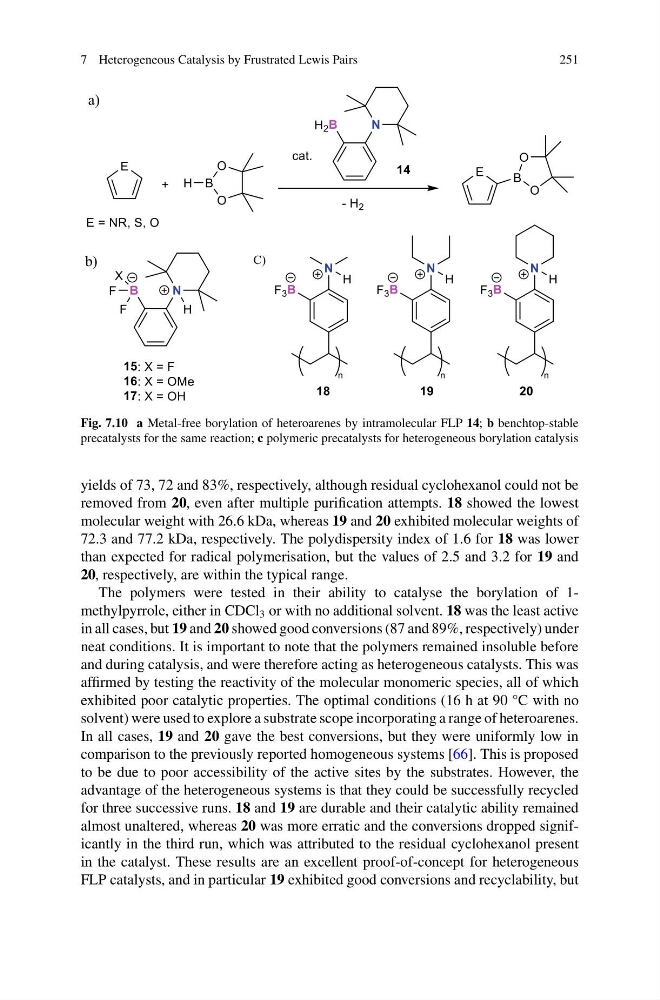
Fig. 7.10 a Metal-free borylation of heteroarenes by intramolecular FLP 14; b benchtop-stable
precatalysts for the same reaction; c polymeric precatalysts for heterogeneous borylation catalysis
yields of 73, 72 and 83%, respectively, although residual cyclohexanol could not be
removed from 20, even after multiple purification attempts. 18 showed the lowest
molecular weight with 26.6 kDa, whereas 19 and 20 exhibited molecular weights of
72.3 and 77.2 kDa, respectively. The polydispersity index of 1.6 for 18 was lower
than expected for radical polymerisation, but the values of 2.5 and 3.2 for 19 and
20, respectively, are within the typical range.
The polymers were tested in their ability to catalyse the borylation of 1methylpyrrole, either in CDCl 3 or with no additional solvent. 18 was the least active
in all cases, but 19 and 20 showed good conversions (87 and 89%, respectively) under
neat conditions. It is important to note that the polymers remained insoluble before
and during catalysis, and were therefore acting as heterogeneous catalysts. This was
affirmed by testing the reactivity of the molecular monomeric species, all of which
exhibited poor catalytic properties. The optimal conditions (16 h at 90 °C with no
solvent) were used to explore a substrate scope incorporating a range of heteroarenes.
In all cases, 19 and 20 gave the best conversions, but they were uniformly low in
comparison to the previously reported homogeneous systems [66]. This is proposed
to be due to poor accessibility of the active sites by the substrates. However, the
advantage of the heterogeneous systems is that they could be successfully recycled
for three successive runs. 18 and 19 are durable and their catalytic ability remained
almost unaltered, whereas 20 was more erratic and the conversions dropped significantly in the third run, which was attributed to the residual cyclohexanol present
in the catalyst. These results are an excellent proof-of-concept for heterogeneous
FLP catalysts, and in particular 19 exhibited good conversions and recyclability, but
251
a)
b)
Fig. 7.10 a Metal-free borylation of heteroarenes by intramolecular FLP 14; b benchtop-stable
precatalysts for the same reaction; c polymeric precatalysts for heterogeneous borylation catalysis
yields of 73, 72 and 83%, respectively, although residual cyclohexanol could not be
removed from 20, even after multiple purification attempts. 18 showed the lowest
molecular weight with 26.6 kDa, whereas 19 and 20 exhibited molecular weights of
72.3 and 77.2 kDa, respectively. The polydispersity index of 1.6 for 18 was lower
than expected for radical polymerisation, but the values of 2.5 and 3.2 for 19 and
20, respectively, are within the typical range.
The polymers were tested in their ability to catalyse the borylation of 1methylpyrrole, either in CDCl 3 or with no additional solvent. 18 was the least active
in all cases, but 19 and 20 showed good conversions (87 and 89%, respectively) under
neat conditions. It is important to note that the polymers remained insoluble before
and during catalysis, and were therefore acting as heterogeneous catalysts. This was
affirmed by testing the reactivity of the molecular monomeric species, all of which
exhibited poor catalytic properties. The optimal conditions (16 h at 90 °C with no
solvent) were used to explore a substrate scope incorporating a range of heteroarenes.
In all cases, 19 and 20 gave the best conversions, but they were uniformly low in
comparison to the previously reported homogeneous systems [66]. This is proposed
to be due to poor accessibility of the active sites by the substrates. However, the
advantage of the heterogeneous systems is that they could be successfully recycled
for three successive runs. 18 and 19 are durable and their catalytic ability remained
almost unaltered, whereas 20 was more erratic and the conversions dropped significantly in the third run, which was attributed to the residual cyclohexanol present
in the catalyst. These results are an excellent proof-of-concept for heterogeneous
FLP catalysts, and in particular 19 exhibited good conversions and recyclability, but