

244
A. R. Jupp
was demonstrated using ATR-IR spectroscopy, where a new absorption band corresponding to the N–B stretching mode was observed at 1276 cm
−1 . The FLP combination was successfully used as a heterogeneous catalyst for the hydrogenation of
diethyl benzylidenemalonate, achieving 100% yield after 24 h with a H 2 pressure
of 20 bar (Fig. 7.4b). This is by direct analogy with the homogeneous FLP system
comprising 1,4-diazabicyclo[2.2.2]octane (DABCO) and B(C 6 F 5 ) 3 [36].
An impressive result in the realm of homogeneous FLP catalysis was the hydrogenation of ketones and aldehydes to the corresponding alcohols, discovered independently by the groups of Stephan and Ashley [37, 38]. In both cases, the success
was due to the weakly basic ethereal solvent being employed as the Lewis base,
which served to stabilise the protonated carbonyl intermediate, and also meant that the
resulting alcohol was not subsequently deprotonated by the Lewis base component of
the FLP. Mahdi and Stephan furthered their finding by employing oxygen-containing
materials, specifically 4 Å molecular sieves (MS) and α-cyclodextrin (α-CD), as weak
heterogeneous Lewis bases to carry out analogous reactivity [39]. These two materials
have very different structures. 4 Å MS are zeolites, which are porous aluminosilicate
materials that are commonly used in the laboratory as adsorbents, usually to remove
unwanted water. α-CD is a cyclic hexamer of glucose, usually studied for its host–
guest interactions. Despite these structural differences, the presence of the weakly
basic oxygen centres enabled both of these materials to function as a solid component
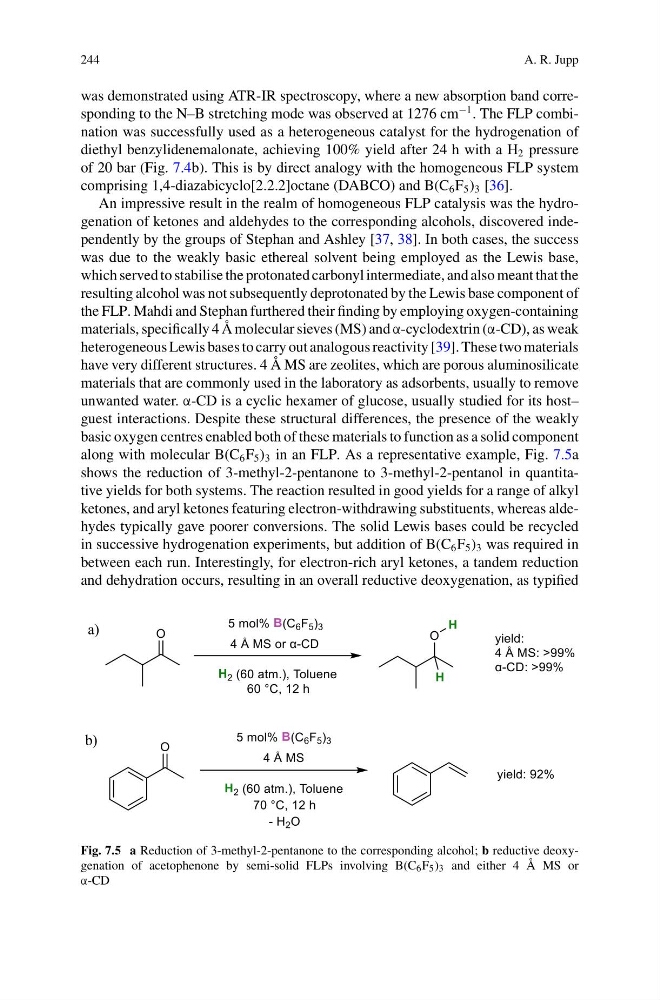
along with molecular B(C 6 F 5 ) 3 in an FLP. As a representative example, Fig. 7.5a
shows the reduction of 3-methyl-2-pentanone to 3-methyl-2-pentanol in quantitative yields for both systems. The reaction resulted in good yields for a range of alkyl
ketones, and aryl ketones featuring electron-withdrawing substituents, whereas aldehydes typically gave poorer conversions. The solid Lewis bases could be recycled
in successive hydrogenation experiments, but addition of B(C 6 F 5 ) 3 was required in
between each run. Interestingly, for electron-rich aryl ketones, a tandem reduction
and dehydration occurs, resulting in an overall reductive deoxygenation, as typified
a)
b)
Fig. 7.5 a Reduction of 3-methyl-2-pentanone to the corresponding alcohol; b reductive deoxygenation of acetophenone by semi-solid FLPs involving B(C 6 F 5 ) 3 and either 4 Å MS or
α-CD
A. R. Jupp
was demonstrated using ATR-IR spectroscopy, where a new absorption band corresponding to the N–B stretching mode was observed at 1276 cm
−1 . The FLP combination was successfully used as a heterogeneous catalyst for the hydrogenation of
diethyl benzylidenemalonate, achieving 100% yield after 24 h with a H 2 pressure
of 20 bar (Fig. 7.4b). This is by direct analogy with the homogeneous FLP system
comprising 1,4-diazabicyclo[2.2.2]octane (DABCO) and B(C 6 F 5 ) 3 [36].
An impressive result in the realm of homogeneous FLP catalysis was the hydrogenation of ketones and aldehydes to the corresponding alcohols, discovered independently by the groups of Stephan and Ashley [37, 38]. In both cases, the success
was due to the weakly basic ethereal solvent being employed as the Lewis base,
which served to stabilise the protonated carbonyl intermediate, and also meant that the
resulting alcohol was not subsequently deprotonated by the Lewis base component of
the FLP. Mahdi and Stephan furthered their finding by employing oxygen-containing
materials, specifically 4 Å molecular sieves (MS) and α-cyclodextrin (α-CD), as weak
heterogeneous Lewis bases to carry out analogous reactivity [39]. These two materials
have very different structures. 4 Å MS are zeolites, which are porous aluminosilicate
materials that are commonly used in the laboratory as adsorbents, usually to remove
unwanted water. α-CD is a cyclic hexamer of glucose, usually studied for its host–
guest interactions. Despite these structural differences, the presence of the weakly
basic oxygen centres enabled both of these materials to function as a solid component
along with molecular B(C 6 F 5 ) 3 in an FLP. As a representative example, Fig. 7.5a
shows the reduction of 3-methyl-2-pentanone to 3-methyl-2-pentanol in quantitative yields for both systems. The reaction resulted in good yields for a range of alkyl
ketones, and aryl ketones featuring electron-withdrawing substituents, whereas aldehydes typically gave poorer conversions. The solid Lewis bases could be recycled
in successive hydrogenation experiments, but addition of B(C 6 F 5 ) 3 was required in
between each run. Interestingly, for electron-rich aryl ketones, a tandem reduction
and dehydration occurs, resulting in an overall reductive deoxygenation, as typified
a)
b)
Fig. 7.5 a Reduction of 3-methyl-2-pentanone to the corresponding alcohol; b reductive deoxygenation of acetophenone by semi-solid FLPs involving B(C 6 F 5 ) 3 and either 4 Å MS or
α-CD