

226
T. A. Gazis et al.
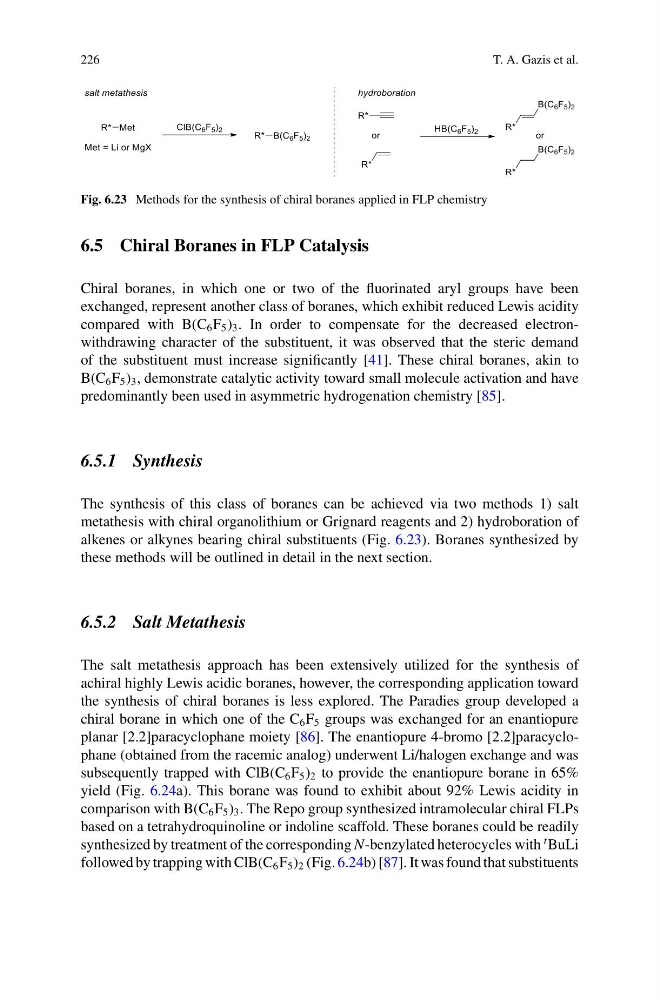
Fig. 6.23 Methods for the synthesis of chiral boranes applied in FLP chemistry
6.5 Chiral Boranes in FLP Catalysis
Chiral boranes, in which one or two of the fluorinated aryl groups have been
exchanged, represent another class of boranes, which exhibit reduced Lewis acidity
compared with B(C 6 F 5 ) 3 . In order to compensate for the decreased electronwithdrawing character of the substituent, it was observed that the steric demand
of the substituent must increase significantly [41]. These chiral boranes, akin to
B(C 6 F 5 ) 3 , demonstrate catalytic activity toward small molecule activation and have
predominantly been used in asymmetric hydrogenation chemistry [85].
6.5.1 Synthesis
The synthesis of this class of boranes can be achieved via two methods 1) salt
metathesis with chiral organolithium or Grignard reagents and 2) hydroboration of
alkenes or alkynes bearing chiral substituents (Fig. 6.23). Boranes synthesized by
these methods will be outlined in detail in the next section.
6.5.2 Salt Metathesis
The salt metathesis approach has been extensively utilized for the synthesis of
achiral highly Lewis acidic boranes, however, the corresponding application toward
the synthesis of chiral boranes is less explored. The Paradies group developed a
chiral borane in which one of the C 6 F 5 groups was exchanged for an enantiopure
planar [2.2]paracyclophane moiety [86]. The enantiopure 4-bromo [2.2]paracyclophane (obtained from the racemic analog) underwent Li/halogen exchange and was
subsequently trapped with ClB(C 6 F 5 ) 2 to provide the enantiopure borane in 65%
yield (Fig. 6.24a). This borane was found to exhibit about 92% Lewis acidity in
comparison with B(C 6 F 5 ) 3 . The Repo group synthesized intramolecular chiral FLPs
based on a tetrahydroquinoline or indoline scaffold. These boranes could be readily
synthesized by treatment of the corresponding N-benzylated heterocycles with
t BuLi
followed by trapping with ClB(C 6 F 5 ) 2 (Fig. 6.24b) [87]. It was found that substituents
T. A. Gazis et al.
Fig. 6.23 Methods for the synthesis of chiral boranes applied in FLP chemistry
6.5 Chiral Boranes in FLP Catalysis
Chiral boranes, in which one or two of the fluorinated aryl groups have been
exchanged, represent another class of boranes, which exhibit reduced Lewis acidity
compared with B(C 6 F 5 ) 3 . In order to compensate for the decreased electronwithdrawing character of the substituent, it was observed that the steric demand
of the substituent must increase significantly [41]. These chiral boranes, akin to
B(C 6 F 5 ) 3 , demonstrate catalytic activity toward small molecule activation and have
predominantly been used in asymmetric hydrogenation chemistry [85].
6.5.1 Synthesis
The synthesis of this class of boranes can be achieved via two methods 1) salt
metathesis with chiral organolithium or Grignard reagents and 2) hydroboration of
alkenes or alkynes bearing chiral substituents (Fig. 6.23). Boranes synthesized by
these methods will be outlined in detail in the next section.
6.5.2 Salt Metathesis
The salt metathesis approach has been extensively utilized for the synthesis of
achiral highly Lewis acidic boranes, however, the corresponding application toward
the synthesis of chiral boranes is less explored. The Paradies group developed a
chiral borane in which one of the C 6 F 5 groups was exchanged for an enantiopure
planar [2.2]paracyclophane moiety [86]. The enantiopure 4-bromo [2.2]paracyclophane (obtained from the racemic analog) underwent Li/halogen exchange and was
subsequently trapped with ClB(C 6 F 5 ) 2 to provide the enantiopure borane in 65%
yield (Fig. 6.24a). This borane was found to exhibit about 92% Lewis acidity in
comparison with B(C 6 F 5 ) 3 . The Repo group synthesized intramolecular chiral FLPs
based on a tetrahydroquinoline or indoline scaffold. These boranes could be readily
synthesized by treatment of the corresponding N-benzylated heterocycles with
t BuLi
followed by trapping with ClB(C 6 F 5 ) 2 (Fig. 6.24b) [87]. It was found that substituents