

5 Mechanistic Insight into the Hydrogen Activation by Frustrated Lewis Pairs
169
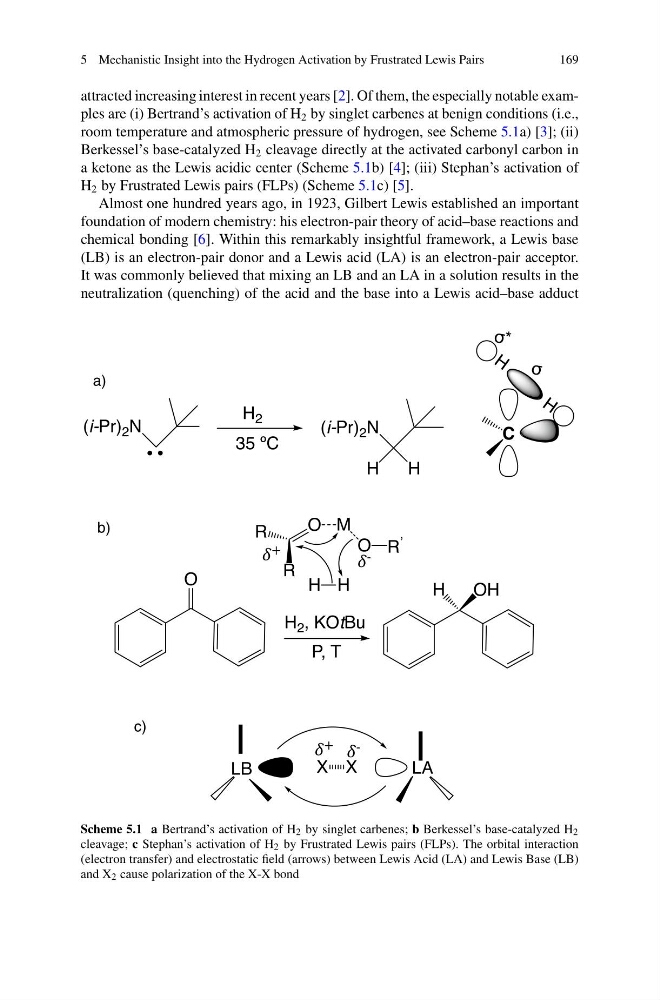
attracted increasing interest in recent years [2]. Of them, the especially notable examples are (i) Bertrand’s activation of H 2 by singlet carbenes at benign conditions (i.e.,
room temperature and atmospheric pressure of hydrogen, see Scheme 5.1a) [3]; (ii)
Berkessel’s base-catalyzed H 2 cleavage directly at the activated carbonyl carbon in
a ketone as the Lewis acidic center (Scheme 5.1b) [4]; (iii) Stephan’s activation of
H 2 by Frustrated Lewis pairs (FLPs) (Scheme 5.1c) [5].
Almost one hundred years ago, in 1923, Gilbert Lewis established an important
foundation of modern chemistry: his electron-pair theory of acid–base reactions and
chemical bonding [6]. Within this remarkably insightful framework, a Lewis base
(LB) is an electron-pair donor and a Lewis acid (LA) is an electron-pair acceptor.
It was commonly believed that mixing an LB and an LA in a solution results in the
neutralization (quenching) of the acid and the base into a Lewis acid–base adduct
a)
b)
c)
Scheme 5.1 a Bertrand’s activation of H 2 by singlet carbenes; b Berkessel’s base-catalyzed H 2
cleavage; c Stephan’s activation of H 2 by Frustrated Lewis pairs (FLPs). The orbital interaction
(electron transfer) and electrostatic field (arrows) between Lewis Acid (LA) and Lewis Base (LB)
and X 2 cause polarization of the X-X bond
169
attracted increasing interest in recent years [2]. Of them, the especially notable examples are (i) Bertrand’s activation of H 2 by singlet carbenes at benign conditions (i.e.,
room temperature and atmospheric pressure of hydrogen, see Scheme 5.1a) [3]; (ii)
Berkessel’s base-catalyzed H 2 cleavage directly at the activated carbonyl carbon in
a ketone as the Lewis acidic center (Scheme 5.1b) [4]; (iii) Stephan’s activation of
H 2 by Frustrated Lewis pairs (FLPs) (Scheme 5.1c) [5].
Almost one hundred years ago, in 1923, Gilbert Lewis established an important
foundation of modern chemistry: his electron-pair theory of acid–base reactions and
chemical bonding [6]. Within this remarkably insightful framework, a Lewis base
(LB) is an electron-pair donor and a Lewis acid (LA) is an electron-pair acceptor.
It was commonly believed that mixing an LB and an LA in a solution results in the
neutralization (quenching) of the acid and the base into a Lewis acid–base adduct
a)
b)
c)
Scheme 5.1 a Bertrand’s activation of H 2 by singlet carbenes; b Berkessel’s base-catalyzed H 2
cleavage; c Stephan’s activation of H 2 by Frustrated Lewis pairs (FLPs). The orbital interaction
(electron transfer) and electrostatic field (arrows) between Lewis Acid (LA) and Lewis Base (LB)
and X 2 cause polarization of the X-X bond