

156
Y. Soltani and F.-G. Fontaine
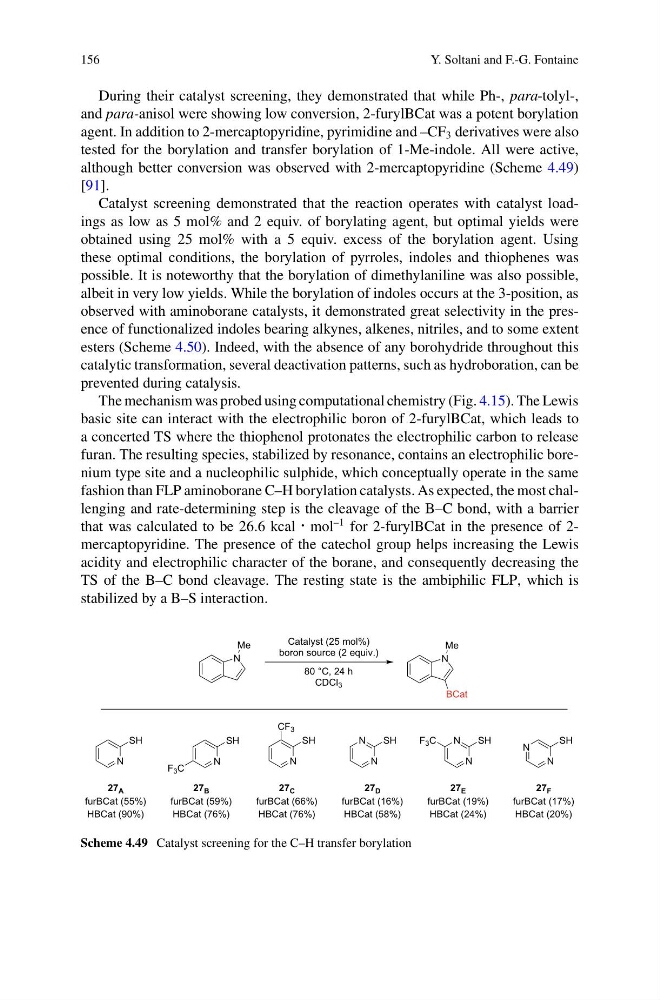
During their catalyst screening, they demonstrated that while Ph-, para-tolyl-,
and para-anisol were showing low conversion, 2-furylBCat was a potent borylation
agent. In addition to 2-mercaptopyridine, pyrimidine and –CF 3 derivatives were also
tested for the borylation and transfer borylation of 1-Me-indole. All were active,
although better conversion was observed with 2-mercaptopyridine (Scheme 4.49)
[91].
Catalyst screening demonstrated that the reaction operates with catalyst loadings as low as 5 mol% and 2 equiv. of borylating agent, but optimal yields were
obtained using 25 mol% with a 5 equiv. excess of the borylation agent. Using
these optimal conditions, the borylation of pyrroles, indoles and thiophenes was
possible. It is noteworthy that the borylation of dimethylaniline was also possible,
albeit in very low yields. While the borylation of indoles occurs at the 3-position, as
observed with aminoborane catalysts, it demonstrated great selectivity in the presence of functionalized indoles bearing alkynes, alkenes, nitriles, and to some extent
esters (Scheme 4.50). Indeed, with the absence of any borohydride throughout this
catalytic transformation, several deactivation patterns, such as hydroboration, can be
prevented during catalysis.
The mechanism was probed using computational chemistry (Fig. 4.15). The Lewis
basic site can interact with the electrophilic boron of 2-furylBCat, which leads to
a concerted TS where the thiophenol protonates the electrophilic carbon to release
furan. The resulting species, stabilized by resonance, contains an electrophilic borenium type site and a nucleophilic sulphide, which conceptually operate in the same
fashion than FLP aminoborane C–H borylation catalysts. As expected, the most challenging and rate-determining step is the cleavage of the B–C bond, with a barrier
that was calculated to be 26.6 kcal‧mol
–1 for 2-furylBCat in the presence of 2mercaptopyridine. The presence of the catechol group helps increasing the Lewis
acidity and electrophilic character of the borane, and consequently decreasing the
TS of the B–C bond cleavage. The resting state is the ambiphilic FLP, which is
stabilized by a B–S interaction.
N
Me
Catalyst (25 mol%)
boron source (2 equiv.)
80 °C, 24 h
CDCl 3
N
Me
BCat
N
SH
N
SH
N
SH
N
N
SH
N
N
SH
N
N
SH
F 3 C
CF 3
F 3 C
27 A
furBCat (55%)
HBCat (90%)
27 B
furBCat (59%)
HBCat (76%)
27 C
furBCat (66%)
HBCat (76%)
27 D
furBCat (16%)
HBCat (58%)
27 E
furBCat (19%)
HBCat (24%)
27 F
furBCat (17%)
HBCat (20%)
Scheme 4.49 Catalyst screening for the C–H transfer borylation
Y. Soltani and F.-G. Fontaine
During their catalyst screening, they demonstrated that while Ph-, para-tolyl-,
and para-anisol were showing low conversion, 2-furylBCat was a potent borylation
agent. In addition to 2-mercaptopyridine, pyrimidine and –CF 3 derivatives were also
tested for the borylation and transfer borylation of 1-Me-indole. All were active,
although better conversion was observed with 2-mercaptopyridine (Scheme 4.49)
[91].
Catalyst screening demonstrated that the reaction operates with catalyst loadings as low as 5 mol% and 2 equiv. of borylating agent, but optimal yields were
obtained using 25 mol% with a 5 equiv. excess of the borylation agent. Using
these optimal conditions, the borylation of pyrroles, indoles and thiophenes was
possible. It is noteworthy that the borylation of dimethylaniline was also possible,
albeit in very low yields. While the borylation of indoles occurs at the 3-position, as
observed with aminoborane catalysts, it demonstrated great selectivity in the presence of functionalized indoles bearing alkynes, alkenes, nitriles, and to some extent
esters (Scheme 4.50). Indeed, with the absence of any borohydride throughout this
catalytic transformation, several deactivation patterns, such as hydroboration, can be
prevented during catalysis.
The mechanism was probed using computational chemistry (Fig. 4.15). The Lewis
basic site can interact with the electrophilic boron of 2-furylBCat, which leads to
a concerted TS where the thiophenol protonates the electrophilic carbon to release
furan. The resulting species, stabilized by resonance, contains an electrophilic borenium type site and a nucleophilic sulphide, which conceptually operate in the same
fashion than FLP aminoborane C–H borylation catalysts. As expected, the most challenging and rate-determining step is the cleavage of the B–C bond, with a barrier
that was calculated to be 26.6 kcal‧mol
–1 for 2-furylBCat in the presence of 2mercaptopyridine. The presence of the catechol group helps increasing the Lewis
acidity and electrophilic character of the borane, and consequently decreasing the
TS of the B–C bond cleavage. The resting state is the ambiphilic FLP, which is
stabilized by a B–S interaction.
N
Me
Catalyst (25 mol%)
boron source (2 equiv.)
80 °C, 24 h
CDCl 3
N
Me
BCat
N
SH
N
SH
N
SH
N
N
SH
N
N
SH
N
N
SH
F 3 C
CF 3
F 3 C
27 A
furBCat (55%)
HBCat (90%)
27 B
furBCat (59%)
HBCat (76%)
27 C
furBCat (66%)
HBCat (76%)
27 D
furBCat (16%)
HBCat (58%)
27 E
furBCat (19%)
HBCat (24%)
27 F
furBCat (17%)
HBCat (20%)
Scheme 4.49 Catalyst screening for the C–H transfer borylation