

4 FLP-Mediated C–H-Activation
151
4.6.2 Towards Practical Metal-Free C–H Borylation
Methodologies
One of the major limitations in the use of aminoborane catalysts for the C–H borylation lies in their instability towards moisture. Fontaine et al. looked for protection
strategies to increase the air stability of these molecules. Alkyl- and arylfluoroborate salts, which are known to be air stable while remaining active for Suzuki-type
coupling reactions [87], were prepared for the [1-NR 2 -2-BH 2 -C 6 H 4 ] 2 analogues and
gave zwitterionic 1-HN
+ R 2 -2-BF 2 R
– -C 6 H 4 (R = F, OMe, OH). In a first report, they
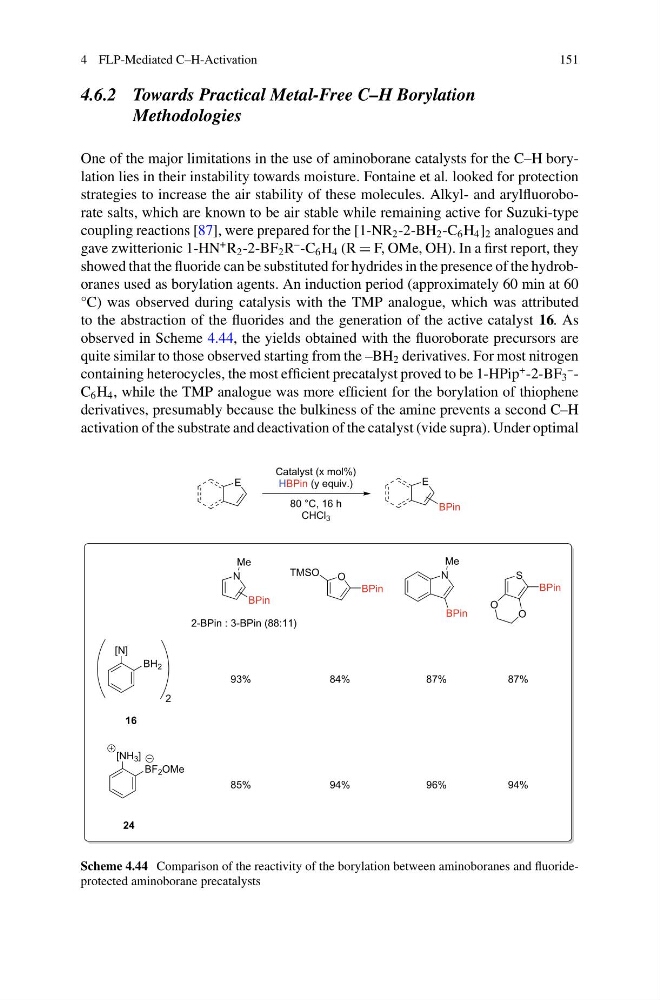
showed that the fluoride can be substituted for hydrides in the presence of the hydroboranes used as borylation agents. An induction period (approximately 60 min at 60
°C) was observed during catalysis with the TMP analogue, which was attributed
to the abstraction of the fluorides and the generation of the active catalyst 16. As
observed in Scheme 4.44, the yields obtained with the fluoroborate precursors are
quite similar to those observed starting from the –BH 2 derivatives. For most nitrogen
containing heterocycles, the most efficient precatalyst proved to be 1-HPip
+ -2-BF 3
– -
C 6 H 4 , while the TMP analogue was more efficient for the borylation of thiophene
derivatives, presumably because the bulkiness of the amine prevents a second C–H
activation of the substrate and deactivation of the catalyst (vide supra). Under optimal
E
Catalyst (x mol%)
HBPin (y equiv.)
80 °C, 16 h
CHCl 3
E
BPin
N
BPin
Me
O
S
N
Me
BPin
TMSO
BPin
BPin
O
O
BH 2
[N]
BF 2 OMe
[NH 3 ]
2
16
24
93%
85%
84%
94%
2-BPin : 3-BPin (88:11)
87%
96%
87%
94%
Scheme 4.44 Comparison of the reactivity of the borylation between aminoboranes and fluorideprotected aminoborane precatalysts
151
4.6.2 Towards Practical Metal-Free C–H Borylation
Methodologies
One of the major limitations in the use of aminoborane catalysts for the C–H borylation lies in their instability towards moisture. Fontaine et al. looked for protection
strategies to increase the air stability of these molecules. Alkyl- and arylfluoroborate salts, which are known to be air stable while remaining active for Suzuki-type
coupling reactions [87], were prepared for the [1-NR 2 -2-BH 2 -C 6 H 4 ] 2 analogues and
gave zwitterionic 1-HN
+ R 2 -2-BF 2 R
– -C 6 H 4 (R = F, OMe, OH). In a first report, they
showed that the fluoride can be substituted for hydrides in the presence of the hydroboranes used as borylation agents. An induction period (approximately 60 min at 60
°C) was observed during catalysis with the TMP analogue, which was attributed
to the abstraction of the fluorides and the generation of the active catalyst 16. As
observed in Scheme 4.44, the yields obtained with the fluoroborate precursors are
quite similar to those observed starting from the –BH 2 derivatives. For most nitrogen
containing heterocycles, the most efficient precatalyst proved to be 1-HPip
+ -2-BF 3
– -
C 6 H 4 , while the TMP analogue was more efficient for the borylation of thiophene
derivatives, presumably because the bulkiness of the amine prevents a second C–H
activation of the substrate and deactivation of the catalyst (vide supra). Under optimal
E
Catalyst (x mol%)
HBPin (y equiv.)
80 °C, 16 h
CHCl 3
E
BPin
N
BPin
Me
O
S
N
Me
BPin
TMSO
BPin
BPin
O
O
BH 2
[N]
BF 2 OMe
[NH 3 ]
2
16
24
93%
85%
84%
94%
2-BPin : 3-BPin (88:11)
87%
96%
87%
94%
Scheme 4.44 Comparison of the reactivity of the borylation between aminoboranes and fluorideprotected aminoborane precatalysts