

150
Y. Soltani and F.-G. Fontaine
smaller amines is rather a dimer where one B–H bond is activated by the FLP N–B
pair of another fragment (Fig. 4.12b). The asymmetry in the latter structure (the
1 H
resonances are different for each fragment) allowed measuring a 20.5 ± 3.1 kcal
‧mol
–1 dissociation energy for 21 using spin saturation transfer NMR techniques,
[84] which is consistent with the DFT results that put that dissociation at 20.7 kcal
‧mol
–1 . Therefore, the rate of the C–H activation with smaller aminoboranes is
limited by the accessibility to the frustrated Lewis pair (dissociation), and the ability
of the zwitterionic intermediate to release H 2 [81]. While piperidine and diethylamine
proved to be quite efficient at C–H borylation of heteroarenes, the dimethyl analogue
[1-NMe 2 -2-BH 2 -C 6 H 4 ] 2 exhibited very poor activity. A stronger dimeric structure
is expected with a smaller amine, which will limit the catalytic activity. In addition,
degradation pathways were observed with 22. It was found that it could easily release
dihydrogen upon mild heating to generate diboranes, which is promoted by the
presence of the –NMe 2 moiety that can remove a proton from the borane, reducing
B(III) to B(II) [85].
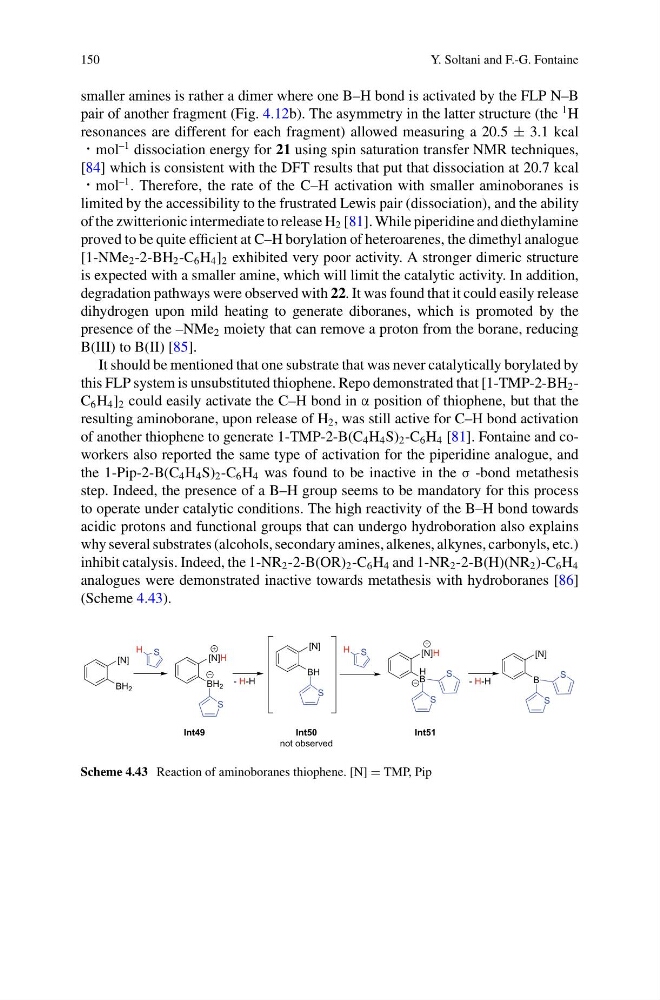
It should be mentioned that one substrate that was never catalytically borylated by
this FLP system is unsubstituted thiophene. Repo demonstrated that [1-TMP-2-BH 2 -
C 6 H 4 ] 2 could easily activate the C–H bond in α position of thiophene, but that the
resulting aminoborane, upon release of H 2 , was still active for C–H bond activation
of another thiophene to generate 1-TMP-2-B(C 4 H 4 S) 2 -C 6 H 4 [81]. Fontaine and coworkers also reported the same type of activation for the piperidine analogue, and
the 1-Pip-2-B(C 4 H 4 S) 2 -C 6 H 4 was found to be inactive in the σ -bond metathesis
step. Indeed, the presence of a B–H group seems to be mandatory for this process
to operate under catalytic conditions. The high reactivity of the B–H bond towards
acidic protons and functional groups that can undergo hydroboration also explains
why several substrates (alcohols, secondary amines, alkenes, alkynes, carbonyls, etc.)
inhibit catalysis. Indeed, the 1-NR 2 -2-B(OR) 2 -C 6 H 4 and 1-NR 2 -2-B(H)(NR 2 )-C 6 H 4
analogues were demonstrated inactive towards metathesis with hydroboranes [86]
(Scheme 4.43).
[N]
BH 2
[N]H
BH 2
S
- H-H
[N]
BH
S
S
[N]H
H
B
S
S
[N]
B
S
S
Int50
not observed
H
- H-H
Int49
Int51
S
H
Scheme 4.43 Reaction of aminoboranes thiophene. [N] = TMP, Pip
Y. Soltani and F.-G. Fontaine
smaller amines is rather a dimer where one B–H bond is activated by the FLP N–B
pair of another fragment (Fig. 4.12b). The asymmetry in the latter structure (the
1 H
resonances are different for each fragment) allowed measuring a 20.5 ± 3.1 kcal
‧mol
–1 dissociation energy for 21 using spin saturation transfer NMR techniques,
[84] which is consistent with the DFT results that put that dissociation at 20.7 kcal
‧mol
–1 . Therefore, the rate of the C–H activation with smaller aminoboranes is
limited by the accessibility to the frustrated Lewis pair (dissociation), and the ability
of the zwitterionic intermediate to release H 2 [81]. While piperidine and diethylamine
proved to be quite efficient at C–H borylation of heteroarenes, the dimethyl analogue
[1-NMe 2 -2-BH 2 -C 6 H 4 ] 2 exhibited very poor activity. A stronger dimeric structure
is expected with a smaller amine, which will limit the catalytic activity. In addition,
degradation pathways were observed with 22. It was found that it could easily release
dihydrogen upon mild heating to generate diboranes, which is promoted by the
presence of the –NMe 2 moiety that can remove a proton from the borane, reducing
B(III) to B(II) [85].
It should be mentioned that one substrate that was never catalytically borylated by
this FLP system is unsubstituted thiophene. Repo demonstrated that [1-TMP-2-BH 2 -
C 6 H 4 ] 2 could easily activate the C–H bond in α position of thiophene, but that the
resulting aminoborane, upon release of H 2 , was still active for C–H bond activation
of another thiophene to generate 1-TMP-2-B(C 4 H 4 S) 2 -C 6 H 4 [81]. Fontaine and coworkers also reported the same type of activation for the piperidine analogue, and
the 1-Pip-2-B(C 4 H 4 S) 2 -C 6 H 4 was found to be inactive in the σ -bond metathesis
step. Indeed, the presence of a B–H group seems to be mandatory for this process
to operate under catalytic conditions. The high reactivity of the B–H bond towards
acidic protons and functional groups that can undergo hydroboration also explains
why several substrates (alcohols, secondary amines, alkenes, alkynes, carbonyls, etc.)
inhibit catalysis. Indeed, the 1-NR 2 -2-B(OR) 2 -C 6 H 4 and 1-NR 2 -2-B(H)(NR 2 )-C 6 H 4
analogues were demonstrated inactive towards metathesis with hydroboranes [86]
(Scheme 4.43).
[N]
BH 2
[N]H
BH 2
S
- H-H
[N]
BH
S
S
[N]H
H
B
S
S
[N]
B
S
S
Int50
not observed
H
- H-H
Int49
Int51
S
H
Scheme 4.43 Reaction of aminoboranes thiophene. [N] = TMP, Pip