

148
Y. Soltani and F.-G. Fontaine
0
0.1
0.2
0.3
0.4
0.5
0.6
0.7
0.8
0.9
1
0
1 0
2 0
3 0
4 0
5 0
6 0
7 0
8 0
9 0
[pyrrolle] / [pyrrolle]
0
Ɵme [min]
16
21
22
N
Et
Et
23
N
Me
N
Me
BPin
CDCl 3 , 60 C
HBpin
H-H
NR 2
BH 2
2
(2.5 mol%)
+
+
o
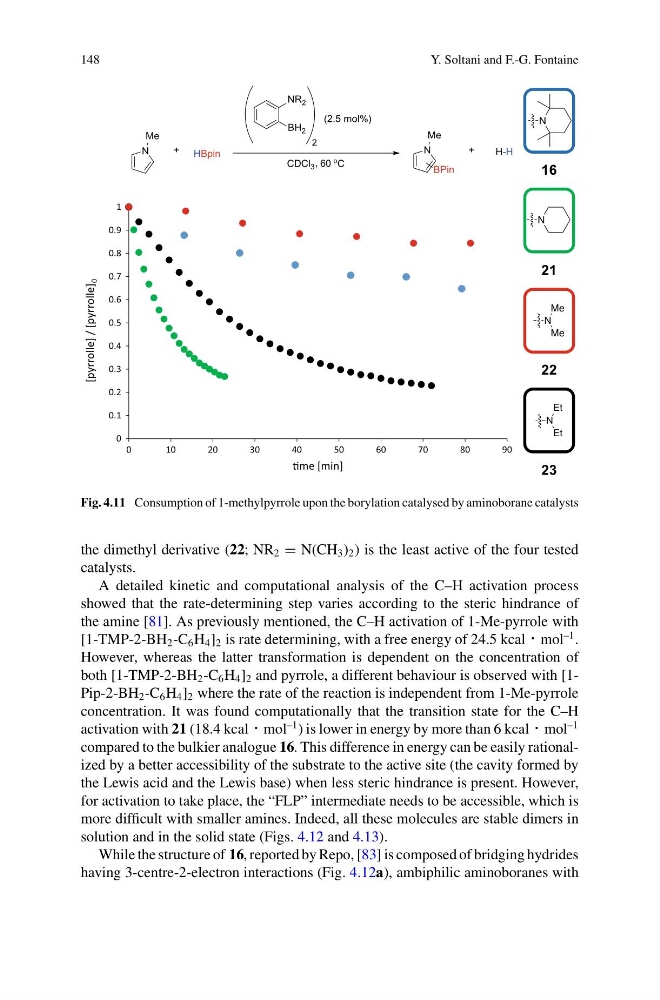
Fig. 4.11 Consumption of 1-methylpyrrole upon the borylation catalysed by aminoborane catalysts
the dimethyl derivative (22; NR 2 = N(CH 3 ) 2 ) is the least active of the four tested
catalysts.
A detailed kinetic and computational analysis of the C–H activation process
showed that the rate-determining step varies according to the steric hindrance of
the amine [81]. As previously mentioned, the C–H activation of 1-Me-pyrrole with
[1-TMP-2-BH 2 -C 6 H 4 ] 2 is rate determining, with a free energy of 24.5 kcal‧mol
–1 .
However, whereas the latter transformation is dependent on the concentration of
both [1-TMP-2-BH 2 -C 6 H 4 ] 2 and pyrrole, a different behaviour is observed with [1Pip-2-BH 2 -C 6 H 4 ] 2 where the rate of the reaction is independent from 1-Me-pyrrole
concentration. It was found computationally that the transition state for the C–H
activation with 21 (18.4 kcal‧mol
–1 ) is lower in energy by more than 6 kcal‧mol
–1
compared to the bulkier analogue 16. This difference in energy can be easily rationalized by a better accessibility of the substrate to the active site (the cavity formed by
the Lewis acid and the Lewis base) when less steric hindrance is present. However,
for activation to take place, the “FLP” intermediate needs to be accessible, which is
more difficult with smaller amines. Indeed, all these molecules are stable dimers in
solution and in the solid state (Figs. 4.12 and 4.13).
While the structure of 16, reported by Repo, [83] is composed of bridging hydrides
having 3-centre-2-electron interactions (Fig. 4.12a), ambiphilic aminoboranes with
Y. Soltani and F.-G. Fontaine
0
0.1
0.2
0.3
0.4
0.5
0.6
0.7
0.8
0.9
1
0
1 0
2 0
3 0
4 0
5 0
6 0
7 0
8 0
9 0
[pyrrolle] / [pyrrolle]
0
Ɵme [min]
16
21
22
N
Et
Et
23
N
Me
N
Me
BPin
CDCl 3 , 60 C
HBpin
H-H
NR 2
BH 2
2
(2.5 mol%)
+
+
o
Fig. 4.11 Consumption of 1-methylpyrrole upon the borylation catalysed by aminoborane catalysts
the dimethyl derivative (22; NR 2 = N(CH 3 ) 2 ) is the least active of the four tested
catalysts.
A detailed kinetic and computational analysis of the C–H activation process
showed that the rate-determining step varies according to the steric hindrance of
the amine [81]. As previously mentioned, the C–H activation of 1-Me-pyrrole with
[1-TMP-2-BH 2 -C 6 H 4 ] 2 is rate determining, with a free energy of 24.5 kcal‧mol
–1 .
However, whereas the latter transformation is dependent on the concentration of
both [1-TMP-2-BH 2 -C 6 H 4 ] 2 and pyrrole, a different behaviour is observed with [1Pip-2-BH 2 -C 6 H 4 ] 2 where the rate of the reaction is independent from 1-Me-pyrrole
concentration. It was found computationally that the transition state for the C–H
activation with 21 (18.4 kcal‧mol
–1 ) is lower in energy by more than 6 kcal‧mol
–1
compared to the bulkier analogue 16. This difference in energy can be easily rationalized by a better accessibility of the substrate to the active site (the cavity formed by
the Lewis acid and the Lewis base) when less steric hindrance is present. However,
for activation to take place, the “FLP” intermediate needs to be accessible, which is
more difficult with smaller amines. Indeed, all these molecules are stable dimers in
solution and in the solid state (Figs. 4.12 and 4.13).
While the structure of 16, reported by Repo, [83] is composed of bridging hydrides
having 3-centre-2-electron interactions (Fig. 4.12a), ambiphilic aminoboranes with