

136
Y. Soltani and F.-G. Fontaine
N
Me Al(C 6 F 5 ) 3
N
Me
Si
Ph
Ph
H H
Al(C 6 F 5 ) 3
NH
Me
HAl(C 6 F 5 ) 3
N
Me
SiPh 2 H
HAl(C 6 F 5 ) 3
H-H
N
Me
N
Me
Ph 2 SiH 2
rt
Ph 2 SiH 2
120 °C
Int30
Int29
Int32
In31
N
Me
N
Me
SiPh 2 H
N
Me
R
Al(C 6 F 5 ) 3 (5 mol%)
Ph 2 SiH 2 (2 equiv.)
120 °C, C 6 D 6
N
Me
R
SiPh 2 H
12 examples
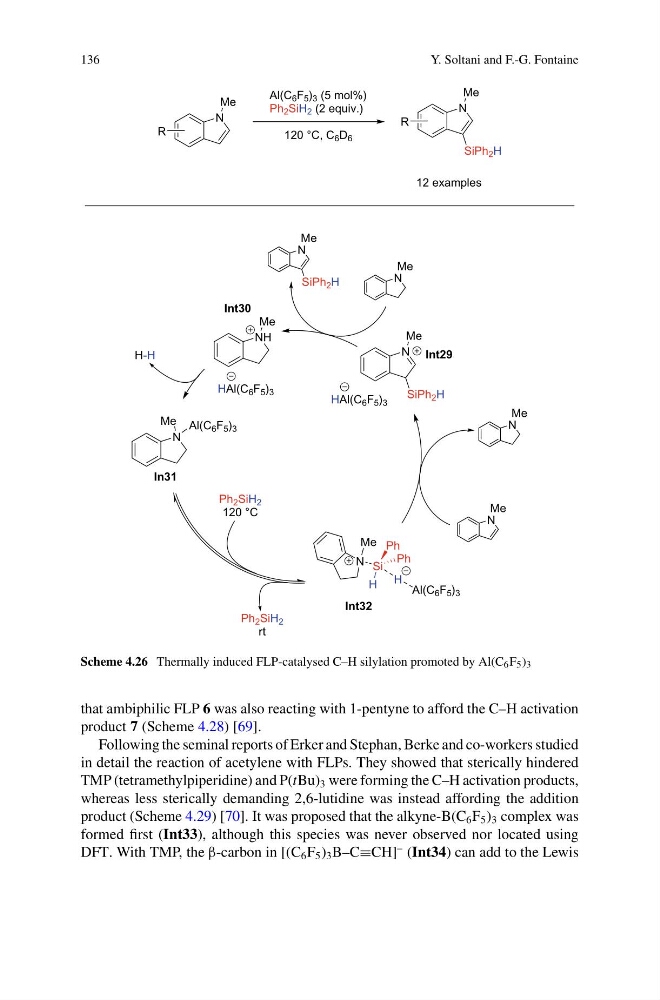
Scheme 4.26 Thermally induced FLP-catalysed C–H silylation promoted by Al(C 6 F 5 ) 3
that ambiphilic FLP 6 was also reacting with 1-pentyne to afford the C–H activation
product 7 (Scheme 4.28) [69].
Following the seminal reports of Erker and Stephan, Berke and co-workers studied
in detail the reaction of acetylene with FLPs. They showed that sterically hindered
TMP (tetramethylpiperidine) and P(tBu) 3 were forming the C–H activation products,
whereas less sterically demanding 2,6-lutidine was instead affording the addition
product (Scheme 4.29) [70]. It was proposed that the alkyne-B(C 6 F 5 ) 3 complex was
formed first (Int33), although this species was never observed nor located using
DFT. With TMP, the β-carbon in [(C 6 F 5 ) 3 B–C≡CH]
– (Int34) can add to the Lewis
Y. Soltani and F.-G. Fontaine
N
Me Al(C 6 F 5 ) 3
N
Me
Si
Ph
Ph
H H
Al(C 6 F 5 ) 3
NH
Me
HAl(C 6 F 5 ) 3
N
Me
SiPh 2 H
HAl(C 6 F 5 ) 3
H-H
N
Me
N
Me
Ph 2 SiH 2
rt
Ph 2 SiH 2
120 °C
Int30
Int29
Int32
In31
N
Me
N
Me
SiPh 2 H
N
Me
R
Al(C 6 F 5 ) 3 (5 mol%)
Ph 2 SiH 2 (2 equiv.)
120 °C, C 6 D 6
N
Me
R
SiPh 2 H
12 examples
Scheme 4.26 Thermally induced FLP-catalysed C–H silylation promoted by Al(C 6 F 5 ) 3
that ambiphilic FLP 6 was also reacting with 1-pentyne to afford the C–H activation
product 7 (Scheme 4.28) [69].
Following the seminal reports of Erker and Stephan, Berke and co-workers studied
in detail the reaction of acetylene with FLPs. They showed that sterically hindered
TMP (tetramethylpiperidine) and P(tBu) 3 were forming the C–H activation products,
whereas less sterically demanding 2,6-lutidine was instead affording the addition
product (Scheme 4.29) [70]. It was proposed that the alkyne-B(C 6 F 5 ) 3 complex was
formed first (Int33), although this species was never observed nor located using
DFT. With TMP, the β-carbon in [(C 6 F 5 ) 3 B–C≡CH]
– (Int34) can add to the Lewis