

68
5 Affine Connections and Geodesics
¨
x
α
+
α
βγ ˙
x
β
˙
x
γ
= 0, ˙
x
α
≡
dx
α
ds
.
(5.28)
We will find this form of the equation and the notation to be useful when we consider
extremum curves and some ideas of classical mechanics below.
There is a caveat to mention concerning the above analysis. In our approach to
general relativity we use a signature (1, −1, −1, −1) so the line element ds
2 can
be positive for some curves, negative for others, and zero for others. For timelike
curves, ds
2 positive, the above analysis is valid; for spacelike curves, ds
2 negative,
we need merely substitute the absolute value
ds 2
for ds and the analysis remains
valid (see Exercise 5.6). Our choice of the signature makes the arc length equal to
the proper time along the trajectory of a particle. This is a convenient choice but as
we discussed previously there is no universal agreement about the overall sign of the
signature We defer discussion of curves for which ds
2 is zero until later.
There is a useful and interesting property of parallel displacement along a
geodesic: in a space with a positive definite metric, that is with signature (1 … 1),
the angle between any vector V and the geodesic tangent vector t may be defined as
cos θ =
V
k t
j g jk
|V ||t|
, |V | ≡
V k V j g jk , |t| ≡
t k t j g jk .
(5.29)
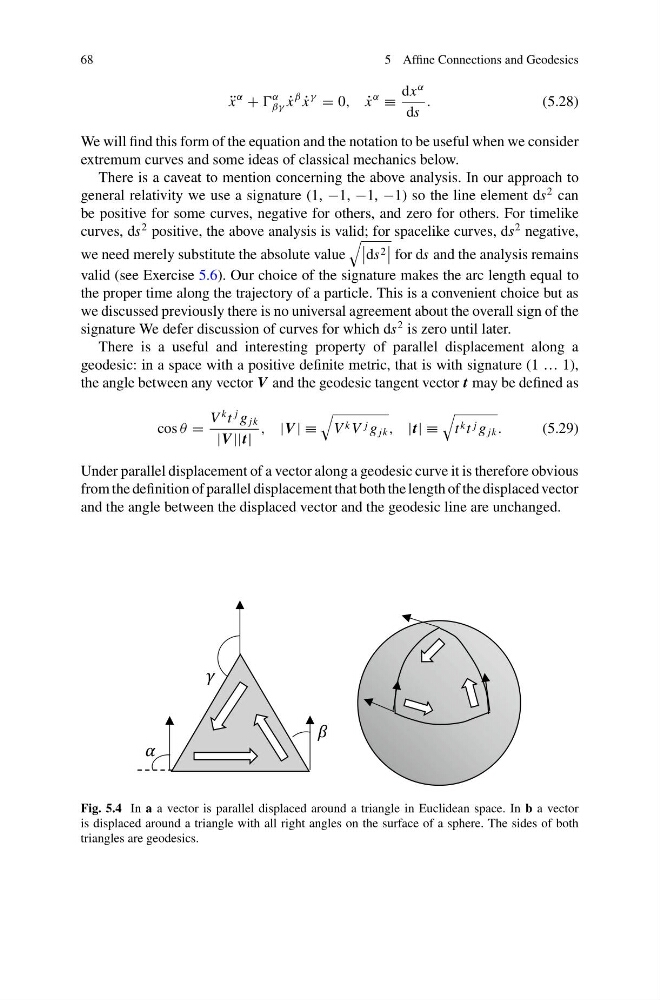
Under parallel displacement of a vector along a geodesic curve it is therefore obvious
from the definition of parallel displacement that both the length of the displaced vector
and the angle between the displaced vector and the geodesic line are unchanged.
Fig. 5.4 In a a vector is parallel displaced around a triangle in Euclidean space. In b a vector
is displaced around a triangle with all right angles on the surface of a sphere. The sides of both
triangles are geodesics.
5 Affine Connections and Geodesics
¨
x
α
+
α
βγ ˙
x
β
˙
x
γ
= 0, ˙
x
α
≡
dx
α
ds
.
(5.28)
We will find this form of the equation and the notation to be useful when we consider
extremum curves and some ideas of classical mechanics below.
There is a caveat to mention concerning the above analysis. In our approach to
general relativity we use a signature (1, −1, −1, −1) so the line element ds
2 can
be positive for some curves, negative for others, and zero for others. For timelike
curves, ds
2 positive, the above analysis is valid; for spacelike curves, ds
2 negative,
we need merely substitute the absolute value
ds 2
for ds and the analysis remains
valid (see Exercise 5.6). Our choice of the signature makes the arc length equal to
the proper time along the trajectory of a particle. This is a convenient choice but as
we discussed previously there is no universal agreement about the overall sign of the
signature We defer discussion of curves for which ds
2 is zero until later.
There is a useful and interesting property of parallel displacement along a
geodesic: in a space with a positive definite metric, that is with signature (1 … 1),
the angle between any vector V and the geodesic tangent vector t may be defined as
cos θ =
V
k t
j g jk
|V ||t|
, |V | ≡
V k V j g jk , |t| ≡
t k t j g jk .
(5.29)
Under parallel displacement of a vector along a geodesic curve it is therefore obvious
from the definition of parallel displacement that both the length of the displaced vector
and the angle between the displaced vector and the geodesic line are unchanged.
Fig. 5.4 In a a vector is parallel displaced around a triangle in Euclidean space. In b a vector
is displaced around a triangle with all right angles on the surface of a sphere. The sides of both
triangles are geodesics.