

5.1 Affine Connections, Component View
61
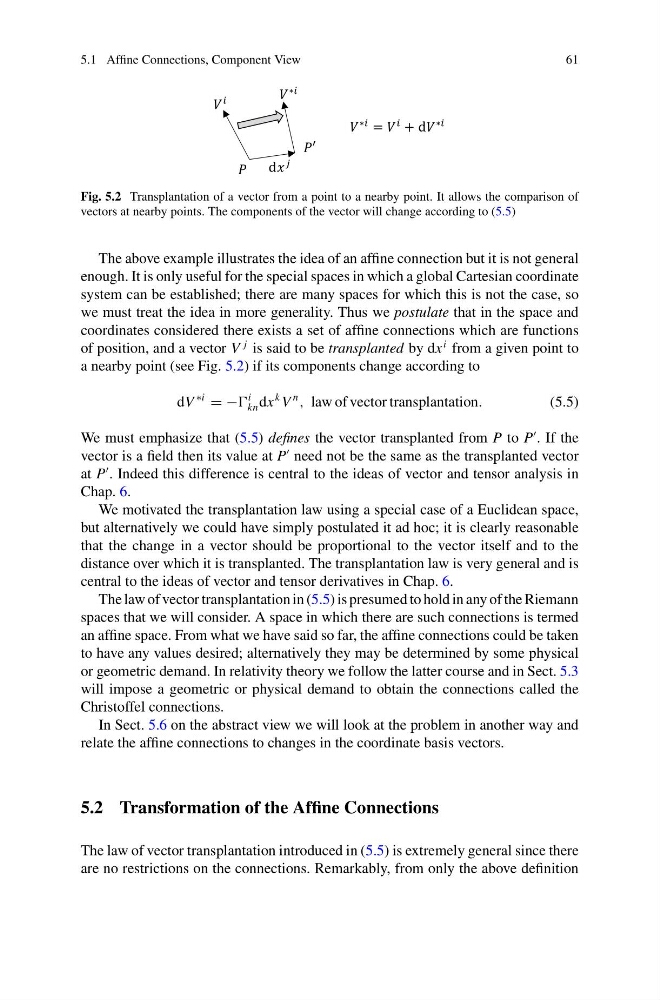
Fig. 5.2 Transplantation of a vector from a point to a nearby point. It allows the comparison of
vectors at nearby points. The components of the vector will change according to (5.5)
The above example illustrates the idea of an affine connection but it is not general
enough. It is only useful for the special spaces in which a global Cartesian coordinate
system can be established; there are many spaces for which this is not the case, so
we must treat the idea in more generality. Thus we postulate that in the space and
coordinates considered there exists a set of affine connections which are functions
of position, and a vector V
j is said to be transplanted by dx
i from a given point to
a nearby point (see Fig. 5.2) if its components change according to
dV
∗i
= −
i
kn dx
k V
n
, law of vector transplantation.
(5.5)
We must emphasize that (5.5) defines the vector transplanted from P to P
. If the
vector is a field then its value at P
need not be the same as the transplanted vector
at P
. Indeed this difference is central to the ideas of vector and tensor analysis in
Chap. 6.
We motivated the transplantation law using a special case of a Euclidean space,
but alternatively we could have simply postulated it ad hoc; it is clearly reasonable
that the change in a vector should be proportional to the vector itself and to the
distance over which it is transplanted. The transplantation law is very general and is
central to the ideas of vector and tensor derivatives in Chap. 6.
The law of vector transplantation in (5.5) is presumed to hold in any of the Riemann
spaces that we will consider. A space in which there are such connections is termed
an affine space. From what we have said so far, the affine connections could be taken
to have any values desired; alternatively they may be determined by some physical
or geometric demand. In relativity theory we follow the latter course and in Sect. 5.3
will impose a geometric or physical demand to obtain the connections called the
Christoffel connections.
In Sect. 5.6 on the abstract view we will look at the problem in another way and
relate the affine connections to changes in the coordinate basis vectors.
5.2 Transformation of the Affine Connections
The law of vector transplantation introduced in (5.5) is extremely general since there
are no restrictions on the connections. Remarkably, from only the above definition
61
Fig. 5.2 Transplantation of a vector from a point to a nearby point. It allows the comparison of
vectors at nearby points. The components of the vector will change according to (5.5)
The above example illustrates the idea of an affine connection but it is not general
enough. It is only useful for the special spaces in which a global Cartesian coordinate
system can be established; there are many spaces for which this is not the case, so
we must treat the idea in more generality. Thus we postulate that in the space and
coordinates considered there exists a set of affine connections which are functions
of position, and a vector V
j is said to be transplanted by dx
i from a given point to
a nearby point (see Fig. 5.2) if its components change according to
dV
∗i
= −
i
kn dx
k V
n
, law of vector transplantation.
(5.5)
We must emphasize that (5.5) defines the vector transplanted from P to P
. If the
vector is a field then its value at P
need not be the same as the transplanted vector
at P
. Indeed this difference is central to the ideas of vector and tensor analysis in
Chap. 6.
We motivated the transplantation law using a special case of a Euclidean space,
but alternatively we could have simply postulated it ad hoc; it is clearly reasonable
that the change in a vector should be proportional to the vector itself and to the
distance over which it is transplanted. The transplantation law is very general and is
central to the ideas of vector and tensor derivatives in Chap. 6.
The law of vector transplantation in (5.5) is presumed to hold in any of the Riemann
spaces that we will consider. A space in which there are such connections is termed
an affine space. From what we have said so far, the affine connections could be taken
to have any values desired; alternatively they may be determined by some physical
or geometric demand. In relativity theory we follow the latter course and in Sect. 5.3
will impose a geometric or physical demand to obtain the connections called the
Christoffel connections.
In Sect. 5.6 on the abstract view we will look at the problem in another way and
relate the affine connections to changes in the coordinate basis vectors.
5.2 Transformation of the Affine Connections
The law of vector transplantation introduced in (5.5) is extremely general since there
are no restrictions on the connections. Remarkably, from only the above definition