

60
5 Affine Connections and Geodesics
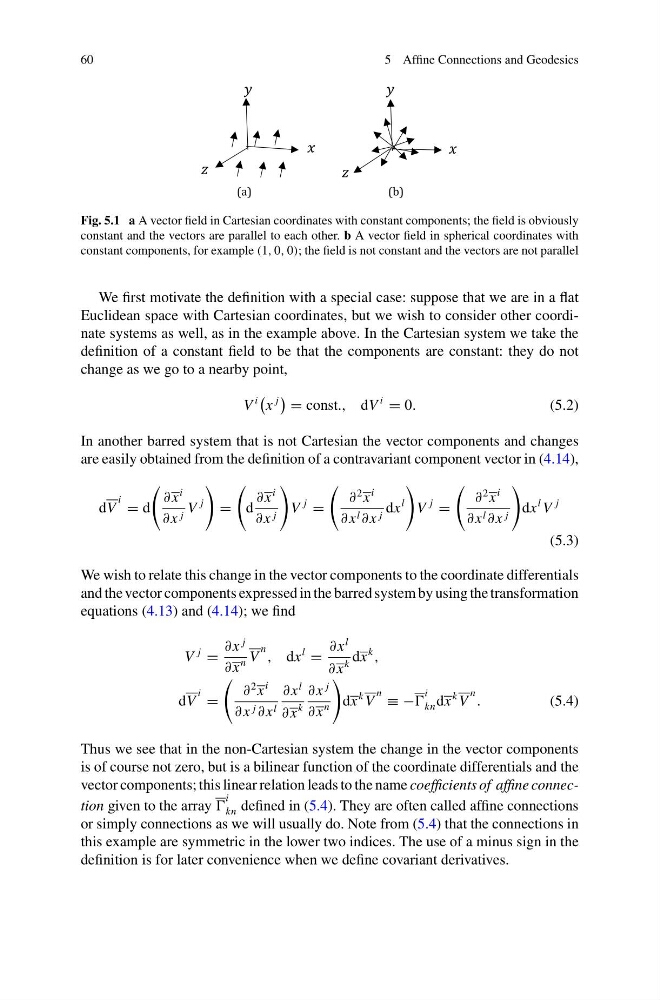
Fig. 5.1 a A vector field in Cartesian coordinates with constant components; the field is obviously
constant and the vectors are parallel to each other. b A vector field in spherical coordinates with
constant components, for example (1, 0, 0); the field is not constant and the vectors are not parallel
We first motivate the definition with a special case: suppose that we are in a flat
Euclidean space with Cartesian coordinates, but we wish to consider other coordinate systems as well, as in the example above. In the Cartesian system we take the
definition of a constant field to be that the components are constant: they do not
change as we go to a nearby point,
V
i
x
j
= const., dV
i
= 0.
(5.2)
In another barred system that is not Cartesian the vector components and changes
are easily obtained from the definition of a contravariant component vector in (4.14),
dV
i = d
∂ x
i
∂ x j V
j
=
d
∂ x
i
∂ x j
V
j
=
∂
2 x
i
∂ x l ∂ x j dx
l
V
j
=
∂
2 x
i
∂ x l ∂ x j
dx
l V
j
(5.3)
We wish to relate this change in the vector components to the coordinate differentials
and the vector components expressed in the barred system by using the transformation
equations (4.13) and (4.14); we find
V
j
=
∂ x
j
∂ x
n V
n , dx
l
=
∂ x
l
∂ x
k
dx
k
,
dV
i =
∂
2 x
i
∂ x j ∂ x l
∂ x
l
∂ x
k
∂ x
j
∂ x
n
dx
k V
n ≡ −
i
kn dx
k V
n .
(5.4)
Thus we see that in the non-Cartesian system the change in the vector components
is of course not zero, but is a bilinear function of the coordinate differentials and the
vector components; this linear relation leads to the name coefficients of affine connection given to the array
i
kn defined in (5.4). They are often called affine connections
or simply connections as we will usually do. Note from (5.4) that the connections in
this example are symmetric in the lower two indices. The use of a minus sign in the
definition is for later convenience when we define covariant derivatives.
5 Affine Connections and Geodesics
Fig. 5.1 a A vector field in Cartesian coordinates with constant components; the field is obviously
constant and the vectors are parallel to each other. b A vector field in spherical coordinates with
constant components, for example (1, 0, 0); the field is not constant and the vectors are not parallel
We first motivate the definition with a special case: suppose that we are in a flat
Euclidean space with Cartesian coordinates, but we wish to consider other coordinate systems as well, as in the example above. In the Cartesian system we take the
definition of a constant field to be that the components are constant: they do not
change as we go to a nearby point,
V
i
x
j
= const., dV
i
= 0.
(5.2)
In another barred system that is not Cartesian the vector components and changes
are easily obtained from the definition of a contravariant component vector in (4.14),
dV
i = d
∂ x
i
∂ x j V
j
=
d
∂ x
i
∂ x j
V
j
=
∂
2 x
i
∂ x l ∂ x j dx
l
V
j
=
∂
2 x
i
∂ x l ∂ x j
dx
l V
j
(5.3)
We wish to relate this change in the vector components to the coordinate differentials
and the vector components expressed in the barred system by using the transformation
equations (4.13) and (4.14); we find
V
j
=
∂ x
j
∂ x
n V
n , dx
l
=
∂ x
l
∂ x
k
dx
k
,
dV
i =
∂
2 x
i
∂ x j ∂ x l
∂ x
l
∂ x
k
∂ x
j
∂ x
n
dx
k V
n ≡ −
i
kn dx
k V
n .
(5.4)
Thus we see that in the non-Cartesian system the change in the vector components
is of course not zero, but is a bilinear function of the coordinate differentials and the
vector components; this linear relation leads to the name coefficients of affine connection given to the array
i
kn defined in (5.4). They are often called affine connections
or simply connections as we will usually do. Note from (5.4) that the connections in
this example are symmetric in the lower two indices. The use of a minus sign in the
definition is for later convenience when we define covariant derivatives.