

Appendix 2: The Signature Theorem in Two Dimensions
57
G =
g 11 − (g 12 )
2
/g 22 0
0
g 22
=
¯
g 11 0
0 ¯
g 22
.
(4.93)
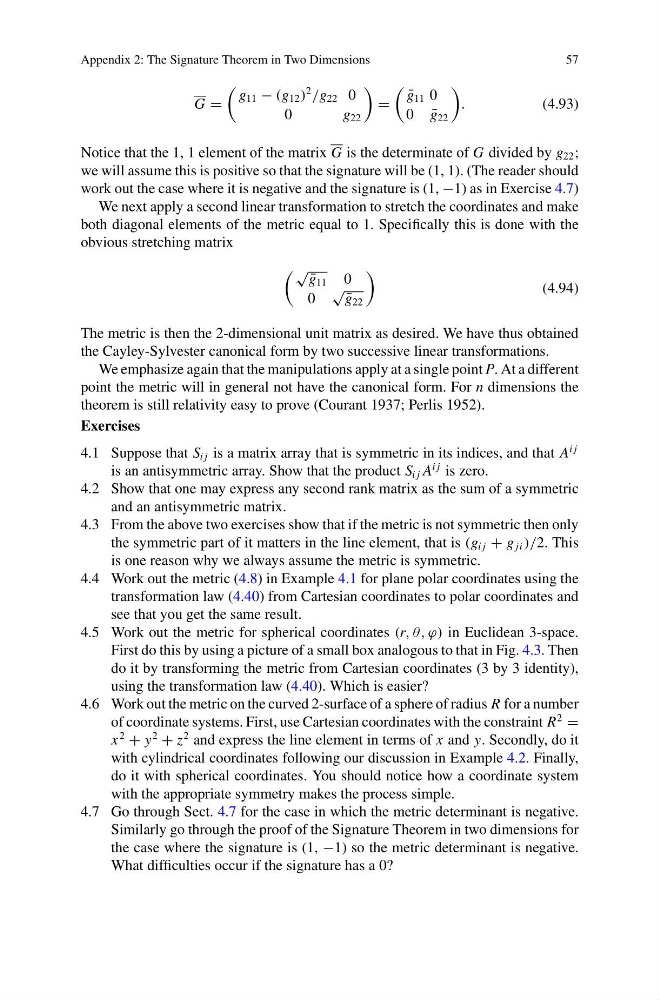
Notice that the 1, 1 element of the matrix G is the determinate of G divided by g 22 ;
we will assume this is positive so that the signature will be (1, 1). (The reader should
work out the case where it is negative and the signature is (1, −1) as in Exercise 4.7)
We next apply a second linear transformation to stretch the coordinates and make
both diagonal elements of the metric equal to 1. Specifically this is done with the
obvious stretching matrix
√ ¯
g 11 0
0
√ ¯
g 22
(4.94)
The metric is then the 2-dimensional unit matrix as desired. We have thus obtained
the Cayley-Sylvester canonical form by two successive linear transformations.
We emphasize again that the manipulations apply at a single point P. At a different
point the metric will in general not have the canonical form. For n dimensions the
theorem is still relativity easy to prove (Courant 1937; Perlis 1952).
Exercises
4.1 Suppose that S i j is a matrix array that is symmetric in its indices, and that A
i j
is an antisymmetric array. Show that the product S i j A
i j is zero.
4.2 Show that one may express any second rank matrix as the sum of a symmetric
and an antisymmetric matrix.
4.3 From the above two exercises show that if the metric is not symmetric then only
the symmetric part of it matters in the line element, that is (g i j + g ji )/2. This
is one reason why we always assume the metric is symmetric.
4.4 Work out the metric (4.8) in Example 4.1 for plane polar coordinates using the
transformation law (4.40) from Cartesian coordinates to polar coordinates and
see that you get the same result.
4.5 Work out the metric for spherical coordinates (r, θ, ϕ) in Euclidean 3-space.
First do this by using a picture of a small box analogous to that in Fig. 4.3. Then
do it by transforming the metric from Cartesian coordinates (3 by 3 identity),
using the transformation law (4.40). Which is easier?
4.6 Work out the metric on the curved 2-surface of a sphere of radius R for a number
of coordinate systems. First, use Cartesian coordinates with the constraint R
2
=
x
2
+ y
2
+ z
2 and express the line element in terms of x and y. Secondly, do it
with cylindrical coordinates following our discussion in Example 4.2. Finally,
do it with spherical coordinates. You should notice how a coordinate system
with the appropriate symmetry makes the process simple.
4.7 Go through Sect. 4.7 for the case in which the metric determinant is negative.
Similarly go through the proof of the Signature Theorem in two dimensions for
the case where the signature is (1, −1) so the metric determinant is negative.
What difficulties occur if the signature has a 0?
57
G =
g 11 − (g 12 )
2
/g 22 0
0
g 22
=
¯
g 11 0
0 ¯
g 22
.
(4.93)
Notice that the 1, 1 element of the matrix G is the determinate of G divided by g 22 ;
we will assume this is positive so that the signature will be (1, 1). (The reader should
work out the case where it is negative and the signature is (1, −1) as in Exercise 4.7)
We next apply a second linear transformation to stretch the coordinates and make
both diagonal elements of the metric equal to 1. Specifically this is done with the
obvious stretching matrix
√ ¯
g 11 0
0
√ ¯
g 22
(4.94)
The metric is then the 2-dimensional unit matrix as desired. We have thus obtained
the Cayley-Sylvester canonical form by two successive linear transformations.
We emphasize again that the manipulations apply at a single point P. At a different
point the metric will in general not have the canonical form. For n dimensions the
theorem is still relativity easy to prove (Courant 1937; Perlis 1952).
Exercises
4.1 Suppose that S i j is a matrix array that is symmetric in its indices, and that A
i j
is an antisymmetric array. Show that the product S i j A
i j is zero.
4.2 Show that one may express any second rank matrix as the sum of a symmetric
and an antisymmetric matrix.
4.3 From the above two exercises show that if the metric is not symmetric then only
the symmetric part of it matters in the line element, that is (g i j + g ji )/2. This
is one reason why we always assume the metric is symmetric.
4.4 Work out the metric (4.8) in Example 4.1 for plane polar coordinates using the
transformation law (4.40) from Cartesian coordinates to polar coordinates and
see that you get the same result.
4.5 Work out the metric for spherical coordinates (r, θ, ϕ) in Euclidean 3-space.
First do this by using a picture of a small box analogous to that in Fig. 4.3. Then
do it by transforming the metric from Cartesian coordinates (3 by 3 identity),
using the transformation law (4.40). Which is easier?
4.6 Work out the metric on the curved 2-surface of a sphere of radius R for a number
of coordinate systems. First, use Cartesian coordinates with the constraint R
2
=
x
2
+ y
2
+ z
2 and express the line element in terms of x and y. Secondly, do it
with cylindrical coordinates following our discussion in Example 4.2. Finally,
do it with spherical coordinates. You should notice how a coordinate system
with the appropriate symmetry makes the process simple.
4.7 Go through Sect. 4.7 for the case in which the metric determinant is negative.
Similarly go through the proof of the Signature Theorem in two dimensions for
the case where the signature is (1, −1) so the metric determinant is negative.
What difficulties occur if the signature has a 0?