

56
4 Riemann Spaces and Tensors
A function of the manifold points P can be defined in terms of a function of the
coordinates as f (P) = f
x
k
. Continuous and differentiable functions are naturally
of particular usefulness.
In general the labeling of the points in a manifold is not unique and several
coordinate systems may be used to label a region of the manifold; they are often
denoted as unprimed and primed, or unbarred and barred as we have done. If there
is a differentiable and invertible transformation ¯
x
k
= ¯
x
k
x
i
between any two such
coordinate systems we say that the manifold is differentiable. This means that a
differentiable function of the points in the manifold corresponds to a continuous
function in both coordinate systems.
Thus, in short, a manifold is simply the kind of space physics has used for centuries,
defined a bit more carefully with an emphasis on coordinate systems and open sets.
Appendix 2: The Signature Theorem in Two Dimensions
The Signature Theorem states that one can find a linear transformation to a coordinate
system in which the metric tensor is diagonal and has 1, −1, or 0 as diagonal elements.
We will illustrate the proof in two dimensions with signature (1, 1) for simplicity.
This is clearly a matrix problem so we will use matrix notation rather than index
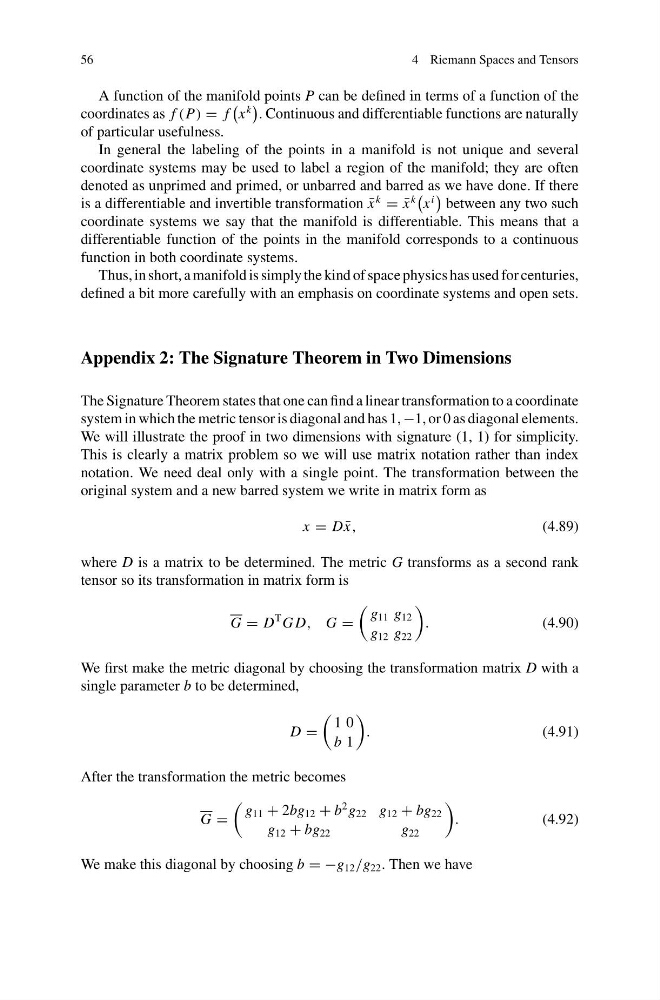
notation. We need deal only with a single point. The transformation between the
original system and a new barred system we write in matrix form as
x = D ¯
x,
(4.89)
where D is a matrix to be determined. The metric G transforms as a second rank
tensor so its transformation in matrix form is
G = D
T G D, G =
g 11 g 12
g 12 g 22
.
(4.90)
We first make the metric diagonal by choosing the transformation matrix D with a
single parameter b to be determined,
D =
1 0
b 1
.
(4.91)
After the transformation the metric becomes
G =
g 11 + 2bg 12 + b
2 g 22 g 12 + bg 22
g 12 + bg 22
g 22
.
(4.92)
We make this diagonal by choosing b = −g 12 /g 22 . Then we have
4 Riemann Spaces and Tensors
A function of the manifold points P can be defined in terms of a function of the
coordinates as f (P) = f
x
k
. Continuous and differentiable functions are naturally
of particular usefulness.
In general the labeling of the points in a manifold is not unique and several
coordinate systems may be used to label a region of the manifold; they are often
denoted as unprimed and primed, or unbarred and barred as we have done. If there
is a differentiable and invertible transformation ¯
x
k
= ¯
x
k
x
i
between any two such
coordinate systems we say that the manifold is differentiable. This means that a
differentiable function of the points in the manifold corresponds to a continuous
function in both coordinate systems.
Thus, in short, a manifold is simply the kind of space physics has used for centuries,
defined a bit more carefully with an emphasis on coordinate systems and open sets.
Appendix 2: The Signature Theorem in Two Dimensions
The Signature Theorem states that one can find a linear transformation to a coordinate
system in which the metric tensor is diagonal and has 1, −1, or 0 as diagonal elements.
We will illustrate the proof in two dimensions with signature (1, 1) for simplicity.
This is clearly a matrix problem so we will use matrix notation rather than index
notation. We need deal only with a single point. The transformation between the
original system and a new barred system we write in matrix form as
x = D ¯
x,
(4.89)
where D is a matrix to be determined. The metric G transforms as a second rank
tensor so its transformation in matrix form is
G = D
T G D, G =
g 11 g 12
g 12 g 22
.
(4.90)
We first make the metric diagonal by choosing the transformation matrix D with a
single parameter b to be determined,
D =
1 0
b 1
.
(4.91)
After the transformation the metric becomes
G =
g 11 + 2bg 12 + b
2 g 22 g 12 + bg 22
g 12 + bg 22
g 22
.
(4.92)
We make this diagonal by choosing b = −g 12 /g 22 . Then we have