

4.2 Vectors, Component View
39
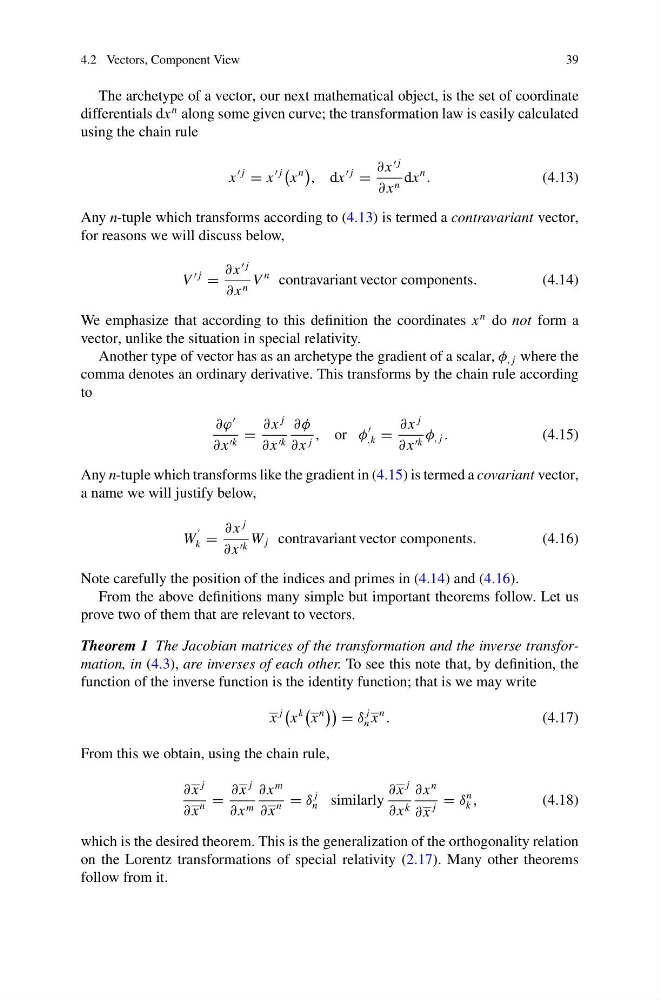
The archetype of a vector, our next mathematical object, is the set of coordinate
differentials dx
n along some given curve; the transformation law is easily calculated
using the chain rule
x
j
= x
j
x
n
, dx
j
=
∂ x
j
∂ x n dx
n
.
(4.13)
Any n-tuple which transforms according to (4.13) is termed a contravariant vector,
for reasons we will discuss below,
V
j
=
∂ x
j
∂ x n V
n contravariant vector components.
(4.14)
We emphasize that according to this definition the coordinates x
n do not form a
vector, unlike the situation in special relativity.
Another type of vector has as an archetype the gradient of a scalar, φ , j where the
comma denotes an ordinary derivative. This transforms by the chain rule according
to
∂ϕ
∂ x k =
∂ x
j
∂ x k
∂φ
∂ x j , or φ
,k =
∂ x
j
∂ x k φ , j .
(4.15)
Any n-tuple which transforms like the gradient in (4.15) is termed a covariant vector,
a name we will justify below,
W
k =
∂ x
j
∂ x k W j contravariant vector components.
(4.16)
Note carefully the position of the indices and primes in (4.14) and (4.16).
From the above definitions many simple but important theorems follow. Let us
prove two of them that are relevant to vectors.
Theorem 1 The Jacobian matrices of the transformation and the inverse transformation, in (4.3), are inverses of each other. To see this note that, by definition, the
function of the inverse function is the identity function; that is we may write
x
j
x
k
x
n
= δ
j
n x
n
.
(4.17)
From this we obtain, using the chain rule,
∂ x
j
∂ x
n =
∂ x
j
∂ x m
∂ x
m
∂ x
n = δ
j
n similarly
∂ x
j
∂ x k
∂ x
n
∂ x
j
= δ
n
k ,
(4.18)
which is the desired theorem. This is the generalization of the orthogonality relation
on the Lorentz transformations of special relativity (2.17). Many other theorems
follow from it.
39
The archetype of a vector, our next mathematical object, is the set of coordinate
differentials dx
n along some given curve; the transformation law is easily calculated
using the chain rule
x
j
= x
j
x
n
, dx
j
=
∂ x
j
∂ x n dx
n
.
(4.13)
Any n-tuple which transforms according to (4.13) is termed a contravariant vector,
for reasons we will discuss below,
V
j
=
∂ x
j
∂ x n V
n contravariant vector components.
(4.14)
We emphasize that according to this definition the coordinates x
n do not form a
vector, unlike the situation in special relativity.
Another type of vector has as an archetype the gradient of a scalar, φ , j where the
comma denotes an ordinary derivative. This transforms by the chain rule according
to
∂ϕ
∂ x k =
∂ x
j
∂ x k
∂φ
∂ x j , or φ
,k =
∂ x
j
∂ x k φ , j .
(4.15)
Any n-tuple which transforms like the gradient in (4.15) is termed a covariant vector,
a name we will justify below,
W
k =
∂ x
j
∂ x k W j contravariant vector components.
(4.16)
Note carefully the position of the indices and primes in (4.14) and (4.16).
From the above definitions many simple but important theorems follow. Let us
prove two of them that are relevant to vectors.
Theorem 1 The Jacobian matrices of the transformation and the inverse transformation, in (4.3), are inverses of each other. To see this note that, by definition, the
function of the inverse function is the identity function; that is we may write
x
j
x
k
x
n
= δ
j
n x
n
.
(4.17)
From this we obtain, using the chain rule,
∂ x
j
∂ x
n =
∂ x
j
∂ x m
∂ x
m
∂ x
n = δ
j
n similarly
∂ x
j
∂ x k
∂ x
n
∂ x
j
= δ
n
k ,
(4.18)
which is the desired theorem. This is the generalization of the orthogonality relation
on the Lorentz transformations of special relativity (2.17). Many other theorems
follow from it.