

24
3 The Motion of Particles
a
μ
=
du
μ
dτ
=
d
dτ
(γ c, γ
v) = γ
d
dt
(γ c, γ
v) =
γ c
dγ
dt
, γ
2 d v
dt
+ γ
v
dγ
dt
. (3.16)
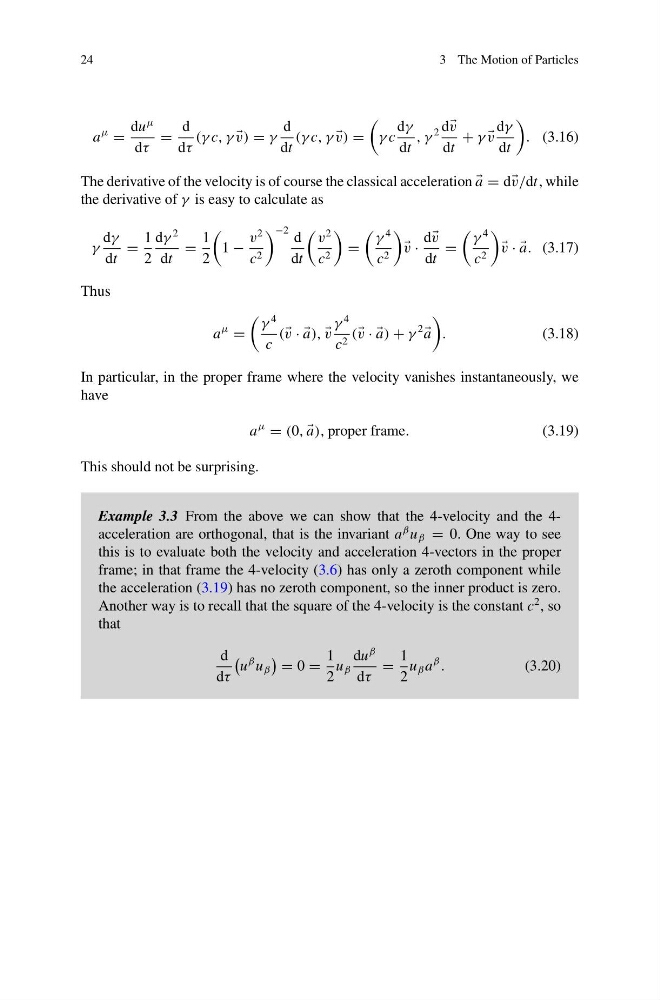
The derivative of the velocity is of course the classical acceleration
a = d v/dt, while
the derivative of γ is easy to calculate as
γ
dγ
dt
=
1
2
dγ
2
dt
=
1
2
1 −
v
2
c 2
−2 d
dt
v
2
c 2
=
γ
4
c 2
v ·
d v
dt
=
γ
4
c 2
v · ·
a. (3.17)
Thus
a
μ
=
γ
4
c
( v · ·
a),
v
γ
4
c 2 ( v · ·
a) + γ
2
a
.
(3.18)
In particular, in the proper frame where the velocity vanishes instantaneously, we
have
a
μ
= (0,
a), proper frame.
(3.19)
This should not be surprising.
Example 3.3 From the above we can show that the 4-velocity and the 4acceleration are orthogonal, that is the invariant a
β u β = 0. One way to see
this is to evaluate both the velocity and acceleration 4-vectors in the proper
frame; in that frame the 4-velocity (3.6) has only a zeroth component while
the acceleration (3.19) has no zeroth component, so the inner product is zero.
Another way is to recall that the square of the 4-velocity is the constant c
2 , so
that
d
dτ
u
β u β
= 0 =
1
2
u β
du
β
dτ
=
1
2
u β a
β
.
(3.20)
3 The Motion of Particles
a
μ
=
du
μ
dτ
=
d
dτ
(γ c, γ
v) = γ
d
dt
(γ c, γ
v) =
γ c
dγ
dt
, γ
2 d v
dt
+ γ
v
dγ
dt
. (3.16)
The derivative of the velocity is of course the classical acceleration
a = d v/dt, while
the derivative of γ is easy to calculate as
γ
dγ
dt
=
1
2
dγ
2
dt
=
1
2
1 −
v
2
c 2
−2 d
dt
v
2
c 2
=
γ
4
c 2
v ·
d v
dt
=
γ
4
c 2
v · ·
a. (3.17)
Thus
a
μ
=
γ
4
c
( v · ·
a),
v
γ
4
c 2 ( v · ·
a) + γ
2
a
.
(3.18)
In particular, in the proper frame where the velocity vanishes instantaneously, we
have
a
μ
= (0,
a), proper frame.
(3.19)
This should not be surprising.
Example 3.3 From the above we can show that the 4-velocity and the 4acceleration are orthogonal, that is the invariant a
β u β = 0. One way to see
this is to evaluate both the velocity and acceleration 4-vectors in the proper
frame; in that frame the 4-velocity (3.6) has only a zeroth component while
the acceleration (3.19) has no zeroth component, so the inner product is zero.
Another way is to recall that the square of the 4-velocity is the constant c
2 , so
that
d
dτ
u
β u β
= 0 =
1
2
u β
du
β
dτ
=
1
2
u β a
β
.
(3.20)