

3.1 Energy and Momentum
23
E
c
= γ
E
c
− βγ P, P
= −βγ
E
c
+ γ P,
(3.13)
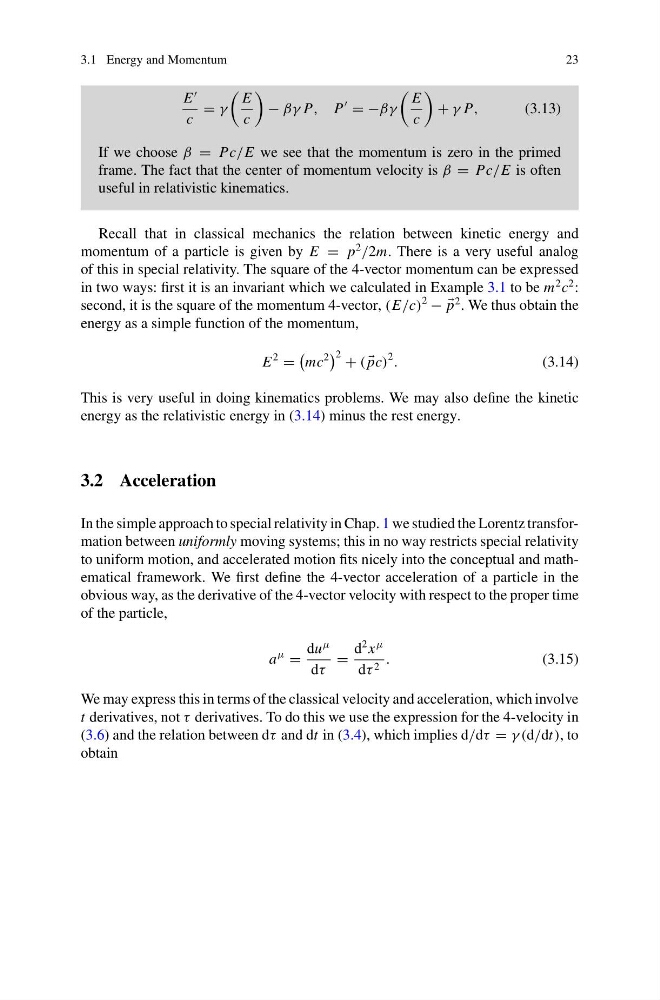
If we choose β = Pc/E we see that the momentum is zero in the primed
frame. The fact that the center of momentum velocity is β = Pc/E is often
useful in relativistic kinematics.
Recall that in classical mechanics the relation between kinetic energy and
momentum of a particle is given by E = p
2
/2m. There is a very useful analog
of this in special relativity. The square of the 4-vector momentum can be expressed
in two ways: first it is an invariant which we calculated in Example 3.1 to be m
2 c
2 :
second, it is the square of the momentum 4-vector, (E/c)
2
− −
p
2 . We thus obtain the
energy as a simple function of the momentum,
E
2
=
mc
2
2 + (
pc)
2 .
(3.14)
This is very useful in doing kinematics problems. We may also define the kinetic
energy as the relativistic energy in (3.14) minus the rest energy.
3.2 Acceleration
In the simple approach to special relativity in Chap. 1 we studied the Lorentz transformation between uniformly moving systems; this in no way restricts special relativity
to uniform motion, and accelerated motion fits nicely into the conceptual and mathematical framework. We first define the 4-vector acceleration of a particle in the
obvious way, as the derivative of the 4-vector velocity with respect to the proper time
of the particle,
a
μ
=
du
μ
dτ
=
d
2 x
μ
dτ 2 .
(3.15)
We may express this in terms of the classical velocity and acceleration, which involve
t derivatives, not τ derivatives. To do this we use the expression for the 4-velocity in
(3.6) and the relation between dτ and dt in (3.4), which implies d/dτ = γ (d/dt), to
obtain
23
E
c
= γ
E
c
− βγ P, P
= −βγ
E
c
+ γ P,
(3.13)
If we choose β = Pc/E we see that the momentum is zero in the primed
frame. The fact that the center of momentum velocity is β = Pc/E is often
useful in relativistic kinematics.
Recall that in classical mechanics the relation between kinetic energy and
momentum of a particle is given by E = p
2
/2m. There is a very useful analog
of this in special relativity. The square of the 4-vector momentum can be expressed
in two ways: first it is an invariant which we calculated in Example 3.1 to be m
2 c
2 :
second, it is the square of the momentum 4-vector, (E/c)
2
− −
p
2 . We thus obtain the
energy as a simple function of the momentum,
E
2
=
mc
2
2 + (
pc)
2 .
(3.14)
This is very useful in doing kinematics problems. We may also define the kinetic
energy as the relativistic energy in (3.14) minus the rest energy.
3.2 Acceleration
In the simple approach to special relativity in Chap. 1 we studied the Lorentz transformation between uniformly moving systems; this in no way restricts special relativity
to uniform motion, and accelerated motion fits nicely into the conceptual and mathematical framework. We first define the 4-vector acceleration of a particle in the
obvious way, as the derivative of the 4-vector velocity with respect to the proper time
of the particle,
a
μ
=
du
μ
dτ
=
d
2 x
μ
dτ 2 .
(3.15)
We may express this in terms of the classical velocity and acceleration, which involve
t derivatives, not τ derivatives. To do this we use the expression for the 4-velocity in
(3.6) and the relation between dτ and dt in (3.4), which implies d/dτ = γ (d/dt), to
obtain