

3.1 Energy and Momentum
21
u
β
=
dx
β
dτ
=
c
dt
dτ
,
d x
dτ
=
dt
dτ
c,
d x
dt
.
(3.5)
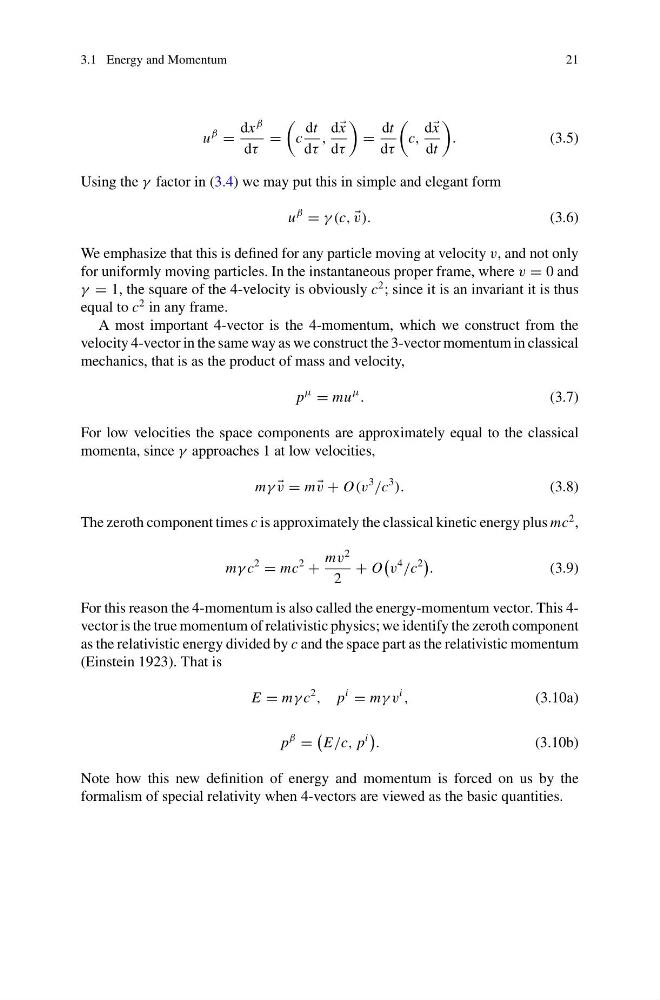
Using the γ factor in (3.4) we may put this in simple and elegant form
u
β
= γ (c,
v).
(3.6)
We emphasize that this is defined for any particle moving at velocity v, and not only
for uniformly moving particles. In the instantaneous proper frame, where v = 0 and
γ = 1, the square of the 4-velocity is obviously c
2 ; since it is an invariant it is thus
equal to c
2 in any frame.
A most important 4-vector is the 4-momentum, which we construct from the
velocity 4-vector in the same way as we construct the 3-vector momentum in classical
mechanics, that is as the product of mass and velocity,
p
μ
= mu
μ
.
(3.7)
For low velocities the space components are approximately equal to the classical
momenta, since γ approaches 1 at low velocities,
mγ
v = m
v + O(v
3
/c
3
).
(3.8)
The zeroth component times c is approximately the classical kinetic energy plus mc
2 ,
mγ c
2
= mc
2
+
mv
2
2
+ O
v
4
/c
2
.
(3.9)
For this reason the 4-momentum is also called the energy-momentum vector. This 4vector is the true momentum of relativistic physics; we identify the zeroth component
as the relativistic energy divided by c and the space part as the relativistic momentum
(Einstein 1923). That is
E = mγ c
2
, p
i
= mγ v
i
,
(3.10a)
p
β
=
E/c, p
i
.
(3.10b)
Note how this new definition of energy and momentum is forced on us by the
formalism of special relativity when 4-vectors are viewed as the basic quantities.
21
u
β
=
dx
β
dτ
=
c
dt
dτ
,
d x
dτ
=
dt
dτ
c,
d x
dt
.
(3.5)
Using the γ factor in (3.4) we may put this in simple and elegant form
u
β
= γ (c,
v).
(3.6)
We emphasize that this is defined for any particle moving at velocity v, and not only
for uniformly moving particles. In the instantaneous proper frame, where v = 0 and
γ = 1, the square of the 4-velocity is obviously c
2 ; since it is an invariant it is thus
equal to c
2 in any frame.
A most important 4-vector is the 4-momentum, which we construct from the
velocity 4-vector in the same way as we construct the 3-vector momentum in classical
mechanics, that is as the product of mass and velocity,
p
μ
= mu
μ
.
(3.7)
For low velocities the space components are approximately equal to the classical
momenta, since γ approaches 1 at low velocities,
mγ
v = m
v + O(v
3
/c
3
).
(3.8)
The zeroth component times c is approximately the classical kinetic energy plus mc
2 ,
mγ c
2
= mc
2
+
mv
2
2
+ O
v
4
/c
2
.
(3.9)
For this reason the 4-momentum is also called the energy-momentum vector. This 4vector is the true momentum of relativistic physics; we identify the zeroth component
as the relativistic energy divided by c and the space part as the relativistic momentum
(Einstein 1923). That is
E = mγ c
2
, p
i
= mγ v
i
,
(3.10a)
p
β
=
E/c, p
i
.
(3.10b)
Note how this new definition of energy and momentum is forced on us by the
formalism of special relativity when 4-vectors are viewed as the basic quantities.