

19.6 The Planck Era and Quantum Physics
295
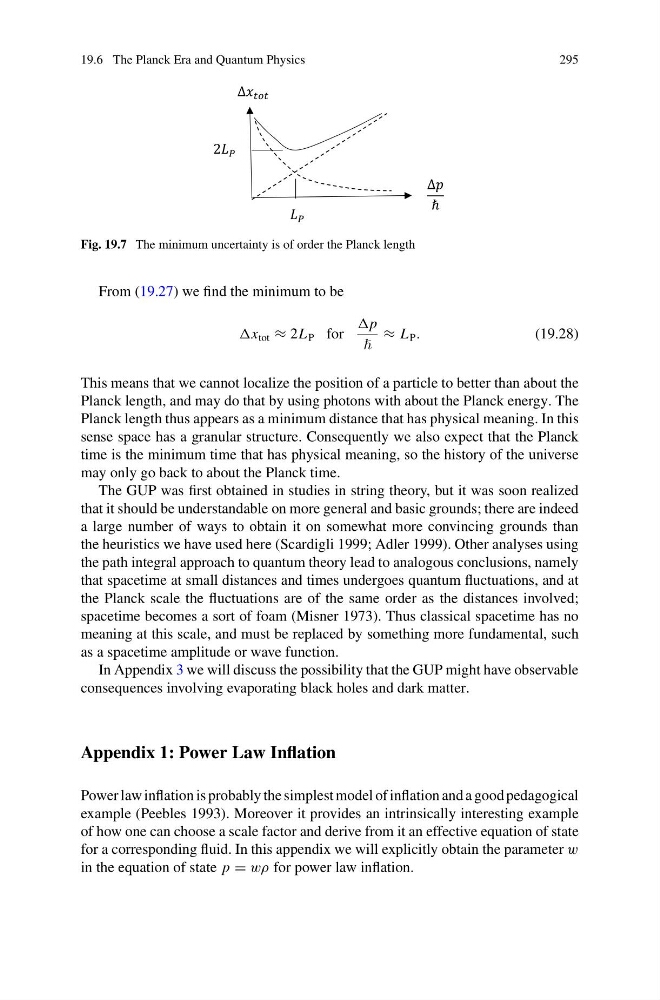
Fig. 19.7 The minimum uncertainty is of order the Planck length
From (19.27) we find the minimum to be
tot ≈ 2L P for
≈ L P .
(19.28)
This means that we cannot localize the position of a particle to better than about the
Planck length, and may do that by using photons with about the Planck energy. The
Planck length thus appears as a minimum distance that has physical meaning. In this
sense space has a granular structure. Consequently we also expect that the Planck
time is the minimum time that has physical meaning, so the history of the universe
may only go back to about the Planck time.
The GUP was first obtained in studies in string theory, but it was soon realized
that it should be understandable on more general and basic grounds; there are indeed
a large number of ways to obtain it on somewhat more convincing grounds than
the heuristics we have used here (Scardigli 1999; Adler 1999). Other analyses using
the path integral approach to quantum theory lead to analogous conclusions, namely
that spacetime at small distances and times undergoes quantum fluctuations, and at
the Planck scale the fluctuations are of the same order as the distances involved;
spacetime becomes a sort of foam (Misner 1973). Thus classical spacetime has no
meaning at this scale, and must be replaced by something more fundamental, such
as a spacetime amplitude or wave function.
In Appendix 3 we will discuss the possibility that the GUP might have observable
consequences involving evaporating black holes and dark matter.
Appendix 1: Power Law Inflation
Power law inflation is probably the simplest model of inflation and a good pedagogical
example (Peebles 1993). Moreover it provides an intrinsically interesting example
of how one can choose a scale factor and derive from it an effective equation of state
for a corresponding fluid. In this appendix we will explicitly obtain the parameter w
in the equation of state p = wρ for power law inflation.
295
Fig. 19.7 The minimum uncertainty is of order the Planck length
From (19.27) we find the minimum to be
tot ≈ 2L P for
≈ L P .
(19.28)
This means that we cannot localize the position of a particle to better than about the
Planck length, and may do that by using photons with about the Planck energy. The
Planck length thus appears as a minimum distance that has physical meaning. In this
sense space has a granular structure. Consequently we also expect that the Planck
time is the minimum time that has physical meaning, so the history of the universe
may only go back to about the Planck time.
The GUP was first obtained in studies in string theory, but it was soon realized
that it should be understandable on more general and basic grounds; there are indeed
a large number of ways to obtain it on somewhat more convincing grounds than
the heuristics we have used here (Scardigli 1999; Adler 1999). Other analyses using
the path integral approach to quantum theory lead to analogous conclusions, namely
that spacetime at small distances and times undergoes quantum fluctuations, and at
the Planck scale the fluctuations are of the same order as the distances involved;
spacetime becomes a sort of foam (Misner 1973). Thus classical spacetime has no
meaning at this scale, and must be replaced by something more fundamental, such
as a spacetime amplitude or wave function.
In Appendix 3 we will discuss the possibility that the GUP might have observable
consequences involving evaporating black holes and dark matter.
Appendix 1: Power Law Inflation
Power law inflation is probably the simplest model of inflation and a good pedagogical
example (Peebles 1993). Moreover it provides an intrinsically interesting example
of how one can choose a scale factor and derive from it an effective equation of state
for a corresponding fluid. In this appendix we will explicitly obtain the parameter w
in the equation of state p = wρ for power law inflation.