

294
19 Inflation and Some Questions
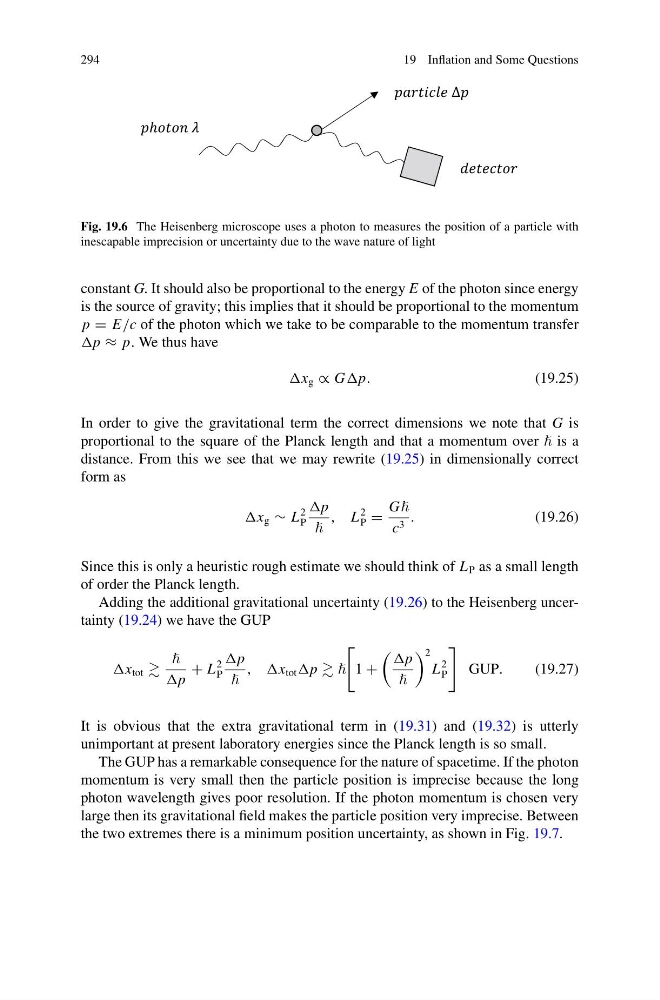
Fig. 19.6 The Heisenberg microscope uses a photon to measures the position of a particle with
inescapable imprecision or uncertainty due to the wave nature of light
constant G. It should also be proportional to the energy E of the photon since energy
is the source of gravity; this implies that it should be proportional to the momentum
p = E/c of the photon which we take to be comparable to the momentum transfer
≈ p. We thus have
g ∝ G
(19.25)
In order to give the gravitational term the correct dimensions we note that G is
proportional to the square of the Planck length and that a momentum over is a
distance. From this we see that we may rewrite (19.25) in dimensionally correct
form as
g ∼ L
2
P
, L
2
P =
G
c 3 .
(19.26)
Since this is only a heuristic rough estimate we should think of L P as a small length
of order the Planck length.
Adding the additional gravitational uncertainty (19.26) to the Heisenberg uncertainty (19.24) we have the GUP
tot
p
+ L
2
P
, ,x tot
1 +
2
L
2
P
GUP.
(19.27)
It is obvious that the extra gravitational term in (19.31) and (19.32) is utterly
unimportant at present laboratory energies since the Planck length is so small.
The GUP has a remarkable consequence for the nature of spacetime. If the photon
momentum is very small then the particle position is imprecise because the long
photon wavelength gives poor resolution. If the photon momentum is chosen very
large then its gravitational field makes the particle position very imprecise. Between
the two extremes there is a minimum position uncertainty, as shown in Fig. 19.7.
19 Inflation and Some Questions
Fig. 19.6 The Heisenberg microscope uses a photon to measures the position of a particle with
inescapable imprecision or uncertainty due to the wave nature of light
constant G. It should also be proportional to the energy E of the photon since energy
is the source of gravity; this implies that it should be proportional to the momentum
p = E/c of the photon which we take to be comparable to the momentum transfer
≈ p. We thus have
g ∝ G
(19.25)
In order to give the gravitational term the correct dimensions we note that G is
proportional to the square of the Planck length and that a momentum over is a
distance. From this we see that we may rewrite (19.25) in dimensionally correct
form as
g ∼ L
2
P
, L
2
P =
G
c 3 .
(19.26)
Since this is only a heuristic rough estimate we should think of L P as a small length
of order the Planck length.
Adding the additional gravitational uncertainty (19.26) to the Heisenberg uncertainty (19.24) we have the GUP
tot
p
+ L
2
P
, ,x tot
1 +
2
L
2
P
GUP.
(19.27)
It is obvious that the extra gravitational term in (19.31) and (19.32) is utterly
unimportant at present laboratory energies since the Planck length is so small.
The GUP has a remarkable consequence for the nature of spacetime. If the photon
momentum is very small then the particle position is imprecise because the long
photon wavelength gives poor resolution. If the photon momentum is chosen very
large then its gravitational field makes the particle position very imprecise. Between
the two extremes there is a minimum position uncertainty, as shown in Fig. 19.7.