

14.4 Evolution of Cosmic Fluid Constituents
229
This states that the change in the total energy in the co-moving volume is balanced
by the work done on the volume by the pressure. It is the statement of cosmic energy
conservation which we promised.
It is of prime importance to use (14.11) to analyze the separate evolution of
the constituents of the cosmic fluid, in particular the matter and radiation energy
densities. To do this we assume each constituent can be described by an effective
linear equation of state, p = wρ where w is a constant parameter. Recall from
Sect. 12.2 that according to the kinetic theory of gases the parameter is given by
w = (1/3)
v
2
/c
2
where v
2 is the root-mean-square velocity of a gas molecule; as
we saw, for the cold matter of the present universe w = 0 while for very hot gas or
radiation w = 1/3. Equation (14.11) involves the total energy density and pressure
in the cosmic fluid; we make the fundamental assumption that each constituent of
the fluid separately obeys (14.11), which means that the constituents do not interact
or at least do not interact strongly. This assumption is clearly reasonable for the cold
matter and radiation in the present universe, but should be reconsidered for the earlier
universe.
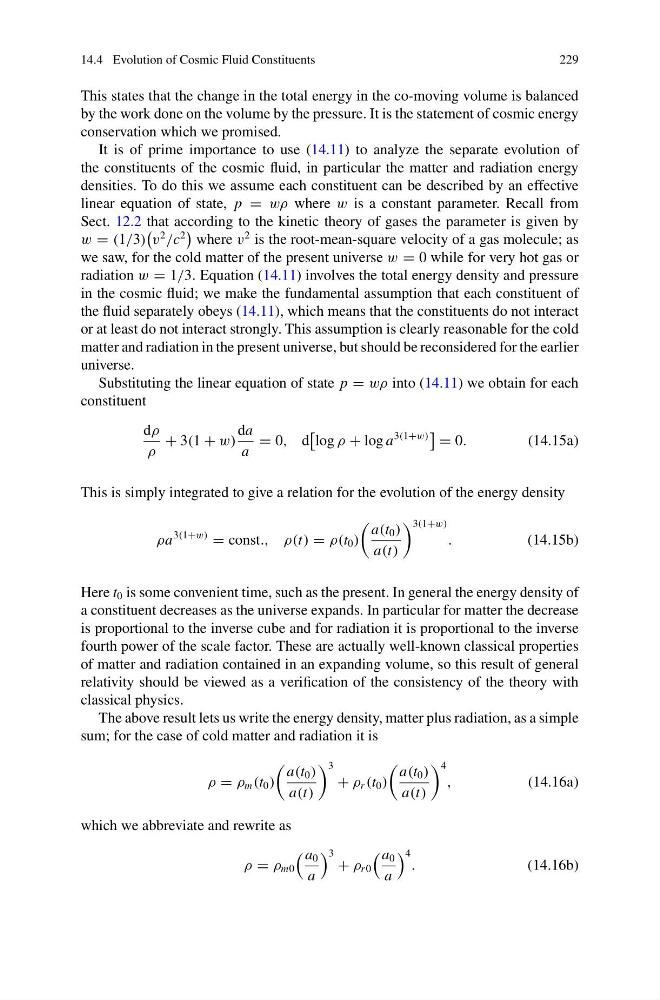
Substituting the linear equation of state p = wρ into (14.11) we obtain for each
constituent
dρ
ρ
+ 3(1 + w)
da
a
= 0, d
log ρ + log a
3(1+w)
= 0.
(14.15a)
This is simply integrated to give a relation for the evolution of the energy density
ρa
3(1+w)
= const., ρ(t) = ρ(t 0 )
a(t 0 )
a(t)
3(1+w)
.
(14.15b)
Here t 0 is some convenient time, such as the present. In general the energy density of
a constituent decreases as the universe expands. In particular for matter the decrease
is proportional to the inverse cube and for radiation it is proportional to the inverse
fourth power of the scale factor. These are actually well-known classical properties
of matter and radiation contained in an expanding volume, so this result of general
relativity should be viewed as a verification of the consistency of the theory with
classical physics.
The above result lets us write the energy density, matter plus radiation, as a simple
sum; for the case of cold matter and radiation it is
ρ = ρ m (t 0 )
a(t 0 )
a(t)
3
+ ρ r (t 0 )
a(t 0 )
a(t)
4
,
(14.16a)
which we abbreviate and rewrite as
ρ = ρ m0
a 0
a
3 + ρ r 0
a 0
a
4 .
(14.16b)
229
This states that the change in the total energy in the co-moving volume is balanced
by the work done on the volume by the pressure. It is the statement of cosmic energy
conservation which we promised.
It is of prime importance to use (14.11) to analyze the separate evolution of
the constituents of the cosmic fluid, in particular the matter and radiation energy
densities. To do this we assume each constituent can be described by an effective
linear equation of state, p = wρ where w is a constant parameter. Recall from
Sect. 12.2 that according to the kinetic theory of gases the parameter is given by
w = (1/3)
v
2
/c
2
where v
2 is the root-mean-square velocity of a gas molecule; as
we saw, for the cold matter of the present universe w = 0 while for very hot gas or
radiation w = 1/3. Equation (14.11) involves the total energy density and pressure
in the cosmic fluid; we make the fundamental assumption that each constituent of
the fluid separately obeys (14.11), which means that the constituents do not interact
or at least do not interact strongly. This assumption is clearly reasonable for the cold
matter and radiation in the present universe, but should be reconsidered for the earlier
universe.
Substituting the linear equation of state p = wρ into (14.11) we obtain for each
constituent
dρ
ρ
+ 3(1 + w)
da
a
= 0, d
log ρ + log a
3(1+w)
= 0.
(14.15a)
This is simply integrated to give a relation for the evolution of the energy density
ρa
3(1+w)
= const., ρ(t) = ρ(t 0 )
a(t 0 )
a(t)
3(1+w)
.
(14.15b)
Here t 0 is some convenient time, such as the present. In general the energy density of
a constituent decreases as the universe expands. In particular for matter the decrease
is proportional to the inverse cube and for radiation it is proportional to the inverse
fourth power of the scale factor. These are actually well-known classical properties
of matter and radiation contained in an expanding volume, so this result of general
relativity should be viewed as a verification of the consistency of the theory with
classical physics.
The above result lets us write the energy density, matter plus radiation, as a simple
sum; for the case of cold matter and radiation it is
ρ = ρ m (t 0 )
a(t 0 )
a(t)
3
+ ρ r (t 0 )
a(t 0 )
a(t)
4
,
(14.16a)
which we abbreviate and rewrite as
ρ = ρ m0
a 0
a
3 + ρ r 0
a 0
a
4 .
(14.16b)