

228
14 The Dynamical Equations of Cosmology
dependence of the various constituent densities on the scale factor of the universe,
which is a most important result.
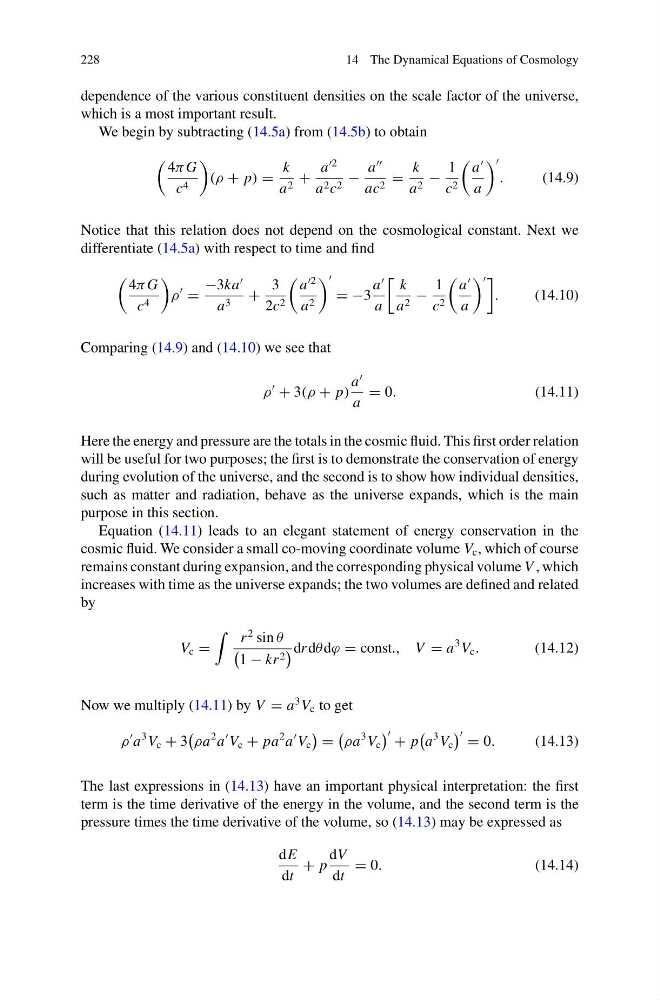
We begin by subtracting (14.5a) from (14.5b) to obtain
4π G
c 4
(ρ + p) =
k
a 2 +
a
2
a 2 c 2 −
a
ac 2 =
k
a 2 −
1
c 2
a
a
.
(14.9)
Notice that this relation does not depend on the cosmological constant. Next we
differentiate (14.5a) with respect to time and find
4π G
c 4
ρ
=
−3ka
a 3 +
3
2c 2
a
2
a 2
= −3
a
a
k
a 2 −
1
c 2
a
a
.
(14.10)
Comparing (14.9) and (14.10) we see that
ρ
+ 3(ρ + p)
a
a
= 0.
(14.11)
Here the energy and pressure are the totals in the cosmic fluid. This first order relation
will be useful for two purposes; the first is to demonstrate the conservation of energy
during evolution of the universe, and the second is to show how individual densities,
such as matter and radiation, behave as the universe expands, which is the main
purpose in this section.
Equation (14.11) leads to an elegant statement of energy conservation in the
cosmic fluid. We consider a small co-moving coordinate volume V c , which of course
remains constant during expansion, and the corresponding physical volume V , which
increases with time as the universe expands; the two volumes are defined and related
by
V c =
r
2 sin θ
1 − kr 2
dr dθ dϕ = const., V = a
3 V c .
(14.12)
Now we multiply (14.11) by V = a
3 V c to get
ρ
a
3 V c + 3
ρa
2 a
V c + pa
2 a
V c
=
ρa
3 V c
+ p
a
3 V c
= 0.
(14.13)
The last expressions in (14.13) have an important physical interpretation: the first
term is the time derivative of the energy in the volume, and the second term is the
pressure times the time derivative of the volume, so (14.13) may be expressed as
dE
dt
+ p
dV
dt
= 0.
(14.14)
14 The Dynamical Equations of Cosmology
dependence of the various constituent densities on the scale factor of the universe,
which is a most important result.
We begin by subtracting (14.5a) from (14.5b) to obtain
4π G
c 4
(ρ + p) =
k
a 2 +
a
2
a 2 c 2 −
a
ac 2 =
k
a 2 −
1
c 2
a
a
.
(14.9)
Notice that this relation does not depend on the cosmological constant. Next we
differentiate (14.5a) with respect to time and find
4π G
c 4
ρ
=
−3ka
a 3 +
3
2c 2
a
2
a 2
= −3
a
a
k
a 2 −
1
c 2
a
a
.
(14.10)
Comparing (14.9) and (14.10) we see that
ρ
+ 3(ρ + p)
a
a
= 0.
(14.11)
Here the energy and pressure are the totals in the cosmic fluid. This first order relation
will be useful for two purposes; the first is to demonstrate the conservation of energy
during evolution of the universe, and the second is to show how individual densities,
such as matter and radiation, behave as the universe expands, which is the main
purpose in this section.
Equation (14.11) leads to an elegant statement of energy conservation in the
cosmic fluid. We consider a small co-moving coordinate volume V c , which of course
remains constant during expansion, and the corresponding physical volume V , which
increases with time as the universe expands; the two volumes are defined and related
by
V c =
r
2 sin θ
1 − kr 2
dr dθ dϕ = const., V = a
3 V c .
(14.12)
Now we multiply (14.11) by V = a
3 V c to get
ρ
a
3 V c + 3
ρa
2 a
V c + pa
2 a
V c
=
ρa
3 V c
+ p
a
3 V c
= 0.
(14.13)
The last expressions in (14.13) have an important physical interpretation: the first
term is the time derivative of the energy in the volume, and the second term is the
pressure times the time derivative of the volume, so (14.13) may be expressed as
dE
dt
+ p
dV
dt
= 0.
(14.14)