

226
14 The Dynamical Equations of Cosmology
In the next section we will briefly discuss the observational values of the density
ratios at the present time. In Sect. 16.3 we will return to the question of the shape of
the universe.
14.3 Observed Dark Matter and Dark Energy Densities
The present observational value of the Hubble constant, as discussed in Chap. 13,
is H 0 = 70 ± 5 (km/s)/Mpc, so the Hubble time is 14.0 × 10
9 year. This gives
a critical energy density of 8.28 × 10
−10 J/m
3 or a critical mass density of about
0.92 × 10
−26 kg/m
3 , which is roughly 1 hydrogen atom per cubic meter on a global
average. The measured mass density due to visible galaxies and other matter is of
order 10
−28 kg/m
3 , several orders of magnitude less than the critical value; however
this does not mean that the curvature parameter is negative, since there may well
be other significant matter present in the universe that is not visible. The visible or
ordinary matter only gives a lower bound. Indeed the study of stars in galaxies and of
galaxies in galaxy clusters indicates the presence of unseen dark matter producing
a gravitational field; the amount of this dark matter appears to be quite significant
(Rubin 1995, 1997).
Observations of stars and gas on the edges of spiral galaxies indicate that the
matter orbits the center of the galaxy with a velocity v that is approximately constant,
independent of the distance r from the center. This is quite surprising: most of the
visible matter in a galaxy is in a small central bulge, so one expects the velocity to
fall off like the square root of the distance from the center; this is easy to see by
considering circular Newtonian orbits as noted in Exercises 14.3 and 14.4.
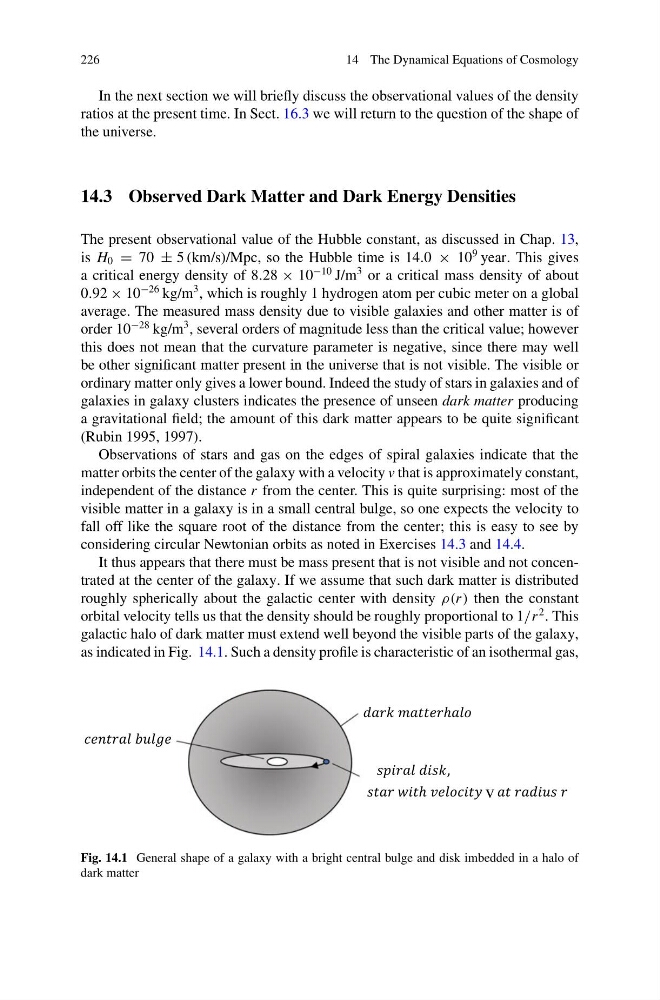
It thus appears that there must be mass present that is not visible and not concentrated at the center of the galaxy. If we assume that such dark matter is distributed
roughly spherically about the galactic center with density ρ(r ) then the constant
orbital velocity tells us that the density should be roughly proportional to 1/r
2 . This
galactic halo of dark matter must extend well beyond the visible parts of the galaxy,
as indicated in Fig. 14.1. Such a density profile is characteristic of an isothermal gas,
,
v
Fig. 14.1 General shape of a galaxy with a bright central bulge and disk imbedded in a halo of
dark matter
14 The Dynamical Equations of Cosmology
In the next section we will briefly discuss the observational values of the density
ratios at the present time. In Sect. 16.3 we will return to the question of the shape of
the universe.
14.3 Observed Dark Matter and Dark Energy Densities
The present observational value of the Hubble constant, as discussed in Chap. 13,
is H 0 = 70 ± 5 (km/s)/Mpc, so the Hubble time is 14.0 × 10
9 year. This gives
a critical energy density of 8.28 × 10
−10 J/m
3 or a critical mass density of about
0.92 × 10
−26 kg/m
3 , which is roughly 1 hydrogen atom per cubic meter on a global
average. The measured mass density due to visible galaxies and other matter is of
order 10
−28 kg/m
3 , several orders of magnitude less than the critical value; however
this does not mean that the curvature parameter is negative, since there may well
be other significant matter present in the universe that is not visible. The visible or
ordinary matter only gives a lower bound. Indeed the study of stars in galaxies and of
galaxies in galaxy clusters indicates the presence of unseen dark matter producing
a gravitational field; the amount of this dark matter appears to be quite significant
(Rubin 1995, 1997).
Observations of stars and gas on the edges of spiral galaxies indicate that the
matter orbits the center of the galaxy with a velocity v that is approximately constant,
independent of the distance r from the center. This is quite surprising: most of the
visible matter in a galaxy is in a small central bulge, so one expects the velocity to
fall off like the square root of the distance from the center; this is easy to see by
considering circular Newtonian orbits as noted in Exercises 14.3 and 14.4.
It thus appears that there must be mass present that is not visible and not concentrated at the center of the galaxy. If we assume that such dark matter is distributed
roughly spherically about the galactic center with density ρ(r ) then the constant
orbital velocity tells us that the density should be roughly proportional to 1/r
2 . This
galactic halo of dark matter must extend well beyond the visible parts of the galaxy,
as indicated in Fig. 14.1. Such a density profile is characteristic of an isothermal gas,
,
v
Fig. 14.1 General shape of a galaxy with a bright central bulge and disk imbedded in a halo of
dark matter