

14.2 Critical Density and the Shape of the Universe
225
14.2 Critical Density and the Shape of the Universe
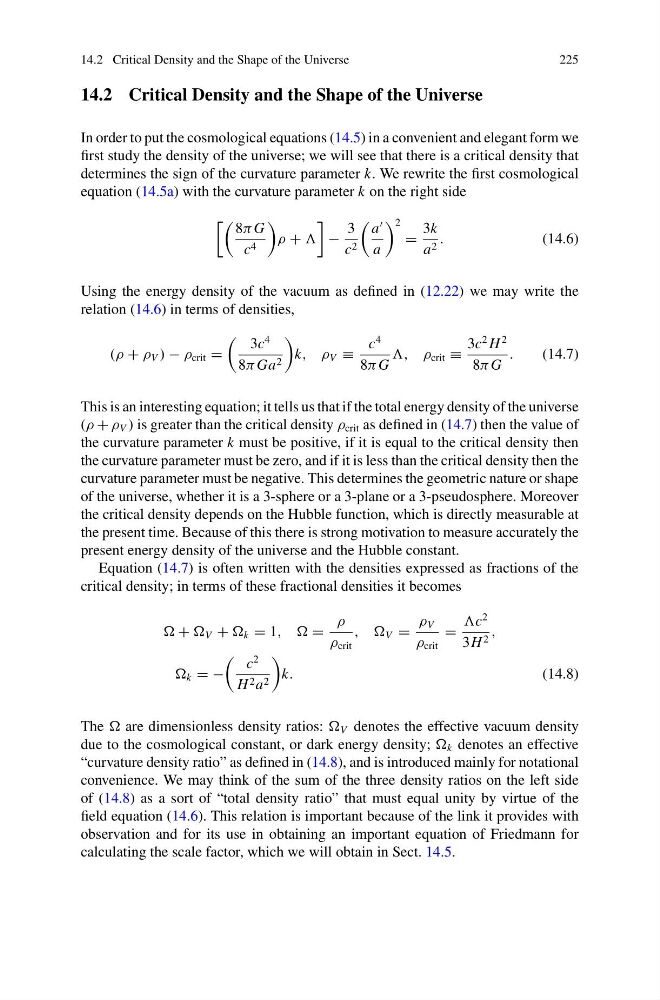
In order to put the cosmological equations (14.5) in a convenient and elegant form we
first study the density of the universe; we will see that there is a critical density that
determines the sign of the curvature parameter k. We rewrite the first cosmological
equation (14.5a) with the curvature parameter k on the right side
8π G
c 4
ρ +
−
3
c 2
a
a
2
=
3k
a 2 .
(14.6)
Using the energy density of the vacuum as defined in (12.22) we may write the
relation (14.6) in terms of densities,
(ρ + ρ V ) − ρ crit =
3c
4
8π Ga 2
k, ρ V ≡
c
4
8π G
, ρ crit ≡
3c
2 H
2
8π G
.
(14.7)
This is an interesting equation; it tells us that if the total energy density of the universe
(ρ + ρ V ) is greater than the critical density ρ crit as defined in (14.7) then the value of
the curvature parameter k must be positive, if it is equal to the critical density then
the curvature parameter must be zero, and if it is less than the critical density then the
curvature parameter must be negative. This determines the geometric nature or shape
of the universe, whether it is a 3-sphere or a 3-plane or a 3-pseudosphere. Moreover
the critical density depends on the Hubble function, which is directly measurable at
the present time. Because of this there is strong motivation to measure accurately the
present energy density of the universe and the Hubble constant.
Equation (14.7) is often written with the densities expressed as fractions of the
critical density; in terms of these fractional densities it becomes
+ V + k = 1, , =
ρ
ρ crit
, , V =
ρ V
ρ crit
=
c
2
3H 2 ,
k = −
c
2
H 2 a 2
k.
(14.8)
The are dimensionless density ratios: V denotes the effective vacuum density
due to the cosmological constant, or dark energy density; k denotes an effective
“curvature density ratio” as defined in (14.8), and is introduced mainly for notational
convenience. We may think of the sum of the three density ratios on the left side
of (14.8) as a sort of “total density ratio” that must equal unity by virtue of the
field equation (14.6). This relation is important because of the link it provides with
observation and for its use in obtaining an important equation of Friedmann for
calculating the scale factor, which we will obtain in Sect. 14.5.
225
14.2 Critical Density and the Shape of the Universe
In order to put the cosmological equations (14.5) in a convenient and elegant form we
first study the density of the universe; we will see that there is a critical density that
determines the sign of the curvature parameter k. We rewrite the first cosmological
equation (14.5a) with the curvature parameter k on the right side
8π G
c 4
ρ +
−
3
c 2
a
a
2
=
3k
a 2 .
(14.6)
Using the energy density of the vacuum as defined in (12.22) we may write the
relation (14.6) in terms of densities,
(ρ + ρ V ) − ρ crit =
3c
4
8π Ga 2
k, ρ V ≡
c
4
8π G
, ρ crit ≡
3c
2 H
2
8π G
.
(14.7)
This is an interesting equation; it tells us that if the total energy density of the universe
(ρ + ρ V ) is greater than the critical density ρ crit as defined in (14.7) then the value of
the curvature parameter k must be positive, if it is equal to the critical density then
the curvature parameter must be zero, and if it is less than the critical density then the
curvature parameter must be negative. This determines the geometric nature or shape
of the universe, whether it is a 3-sphere or a 3-plane or a 3-pseudosphere. Moreover
the critical density depends on the Hubble function, which is directly measurable at
the present time. Because of this there is strong motivation to measure accurately the
present energy density of the universe and the Hubble constant.
Equation (14.7) is often written with the densities expressed as fractions of the
critical density; in terms of these fractional densities it becomes
+ V + k = 1, , =
ρ
ρ crit
, , V =
ρ V
ρ crit
=
c
2
3H 2 ,
k = −
c
2
H 2 a 2
k.
(14.8)
The are dimensionless density ratios: V denotes the effective vacuum density
due to the cosmological constant, or dark energy density; k denotes an effective
“curvature density ratio” as defined in (14.8), and is introduced mainly for notational
convenience. We may think of the sum of the three density ratios on the left side
of (14.8) as a sort of “total density ratio” that must equal unity by virtue of the
field equation (14.6). This relation is important because of the link it provides with
observation and for its use in obtaining an important equation of Friedmann for
calculating the scale factor, which we will obtain in Sect. 14.5.